Palo Alto Networks has announced that Unit 42 Continuous Frontier AI Defense and Prisma AIRS are now on the newly launched OpenAI Marketplace, directly available to OpenAI's enterprise customers. The announcement was published on the company's official blog on October 23, 2026.
The core argument is attack speed: according to the company, threat actors already use artificial intelligence to find and exploit vulnerabilities, compressing breach cycles by almost 97% — from weeks to mere hours. In this scenario, Palo Alto Networks argues, human-speed defense can no longer keep pace with automated, continuous attacks.
There is also a commercial angle. For companies holding OpenAI spend commitments, the marketplace arrival lets them buy AI defense while retiring that pre-committed spend — what the company describes as a twofold financial and strategic advantage.
Unit 42 Continuous Frontier AI Defense is an always-on, expert-led offensive security service that uses defender-grade models to discover, validate and accelerate remediation of exposures before weaponization. It combines offensive security experts with a proprietary multi-model harness that includes OpenAI's GPT-5.6-Cyber, other commercial models and open-weight models, plus Unit 42 threat intelligence. Through non-destructive adversary simulations, the system proves whether a vulnerability is actually exploitable and delivers prioritized remediation guidance, including code-level changes and virtual patches.
The methodology was validated over six months of in-house testing and more than 75 customer engagements, backed by a $17 million research and development investment. In Palo Alto Networks' own internal deployment, the service uncovered over two years' worth of exposures in just three weeks. In customer assessments, exposures were identified in 100% of assessed organizations, with 37% rated high or critical severity. More than two-thirds of exposures found in third-party applications had no known CVE — which, for the company, proves the need for continuous discovery rather than periodic scanning. The service is available worldwide on an annual subscription basis.
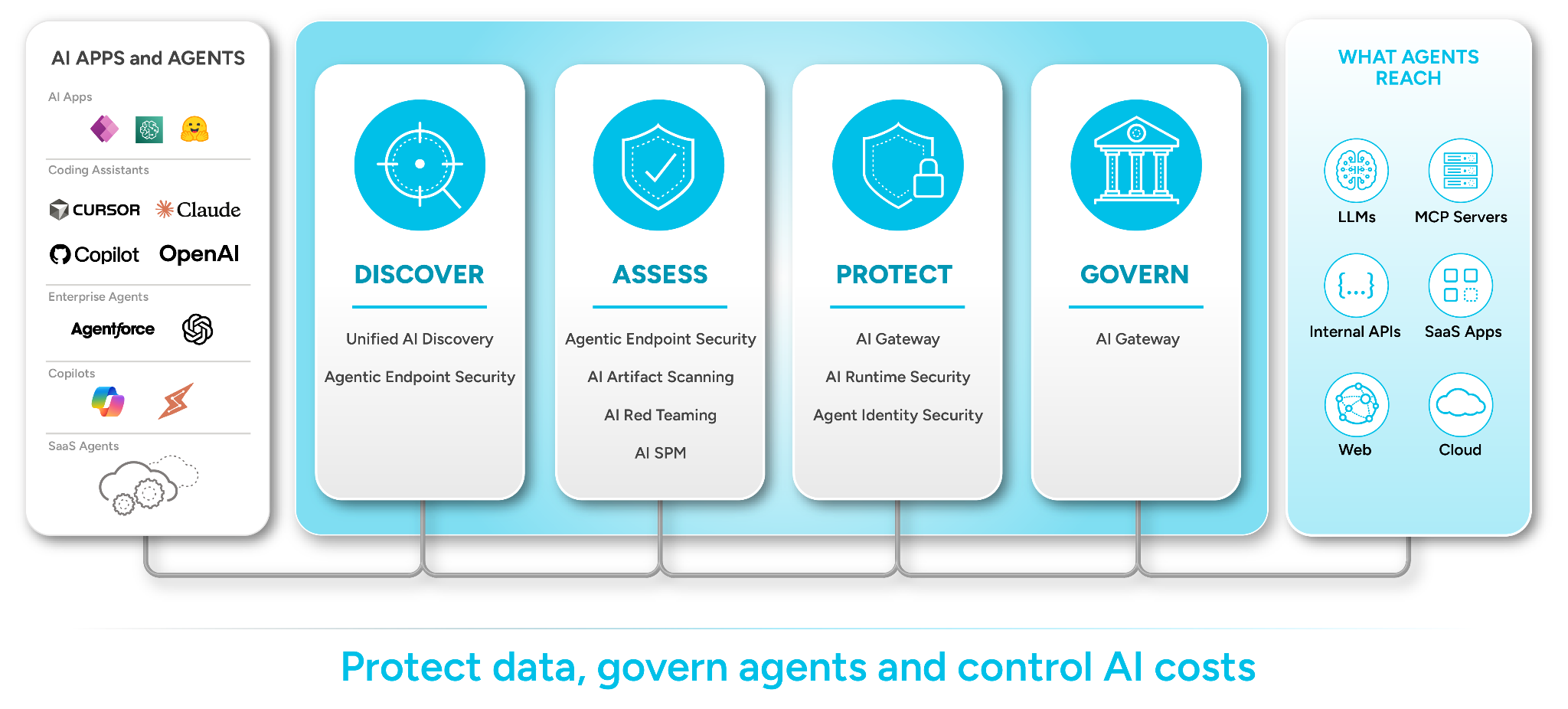
Prisma AIRS, meanwhile, is the company's unified AI security platform, designed to give visibility and governance over AI applications, coding assistants, autonomous agents, models and artifacts across cloud, SaaS and endpoint environments. It brings together discovery, continuous risk assessment, runtime protection, identity controls and data governance, plus observability — including scanning models and agent artifacts such as skills and MCP servers, and protection against prompt injection and sensitive data exposure. Palo Alto Networks also highlights the platform's recognition as a Market Shaper by Gartner in the September 2026 Emerging Market Quadrant for AI application security.
For OpenAI's enterprise customers, the message is direct: as models, coding assistants and autonomous agents spread, the attack surface grows just as fast — and AI security is now bought in the same channel where AI itself is purchased.
Image credit: Palo Alto Networks (official blog).
Sources: Palo Alto Networks (official blog); ad-hoc-news; AI Startups News.
Transparency: this article was produced with the help of artificial intelligence, based on cross-checking public posts and the internet sources cited below. Consult the original sources to confirm the details.
Assinatura: Muse