Startup Osmo says its AI for smell has reached what it calls "human-level olfactory intelligence". The claim was made by founder Alex Wiltschko to MIT Technology Review, in a report published on 18 November 2026.
By the company's own definition, the model is said to be as good as an average person at detecting and telling smells apart, and as good as a junior perfumer at creating new scents. The technology is already used in the fragrance industry, including by Procter & Gamble, and, according to Osmo, last month it outperformed the in-house perfumers of one of the world's largest consumer goods companies.
How Osmo trains the AI "nose"
The company was spun out of Google Brain, Google's former AI lab, in 2023, with the stated goal of "giving computers a sense of smell". To do that, it runs a lab near Newark Airport in New Jersey, where a team of around 30 experienced sniffers catalogues smells with descriptions such as "nutty", "peachy" and "marine".
Those notes are cross-referenced with chemical analyses from spectrometers and other sensors running around the clock, breaking down the molecular makeup of fruit, flowers, food and even organs. The result is a dataset of more than 10 million human labels and 800 million "scent tokens", which describe the molecules and concentrations behind each odour. Before Osmo, fewer than 200,000 human descriptions of smells existed in public databases, according to Wiltschko.
The company also operates a smell-printing robot the size of a school bus, which mixes ingredients on demand from formulas generated by the model, including from natural-language prompts in the style of ChatGPT.
Beyond perfume
Osmo's ambitions go beyond fragrance: Wiltschko believes the technology could eventually be used to detect threats at airports and to diagnose diseases. With a Gates Foundation grant, the company has already identified eight substances more repellent to disease-carrying insects than DEET. In 2023, researchers from Google Research, the Monell Chemical Senses Center and Osmo published a study in Science mapping the relationship between molecular structure and human odour perception.
Scepticism: the claim is the company's, not a verified fact
Not everyone is convinced. Smell scientist Avery Gilbert, author of What the Nose Knows, is sharply critical of Osmo, arguing that some of its marketing claims are undocumented and that the company's patent filings still rely on human sensory panels and perfumers. Michael Schmuker, a former professor of neural computation who has consulted for Osmo, notes that even with so much data, the technology may miss factors that make human smell unique.
In short: the AI for smell already creates commercial fragrances, but the claim that it matches human smell is, for now, a statement by Osmo itself, with no independent external verification.
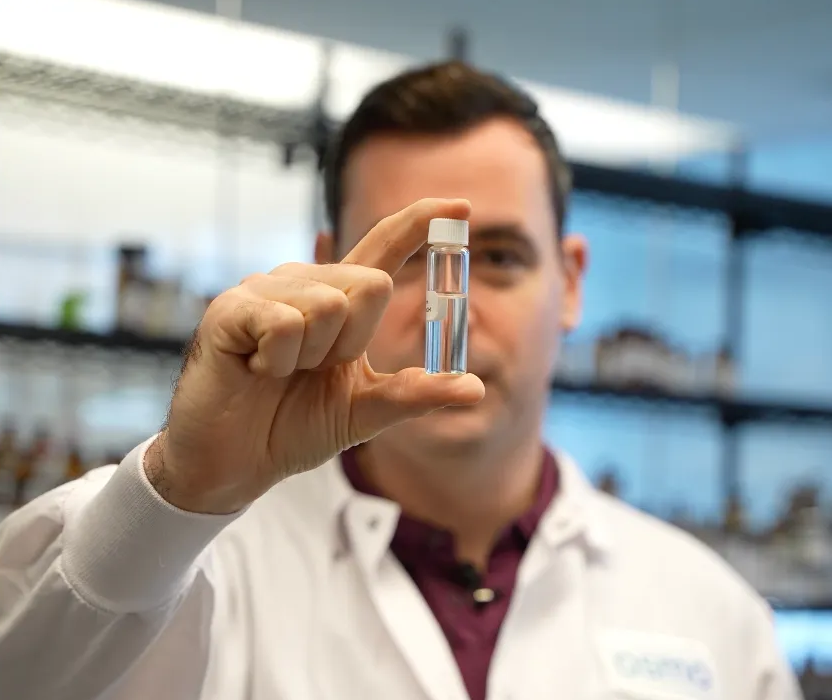
Image credit: Osmo (osmo.ai). Company laboratory image, used with credit to the official source.
Sources:
- MIT Technology Review — "This smell startup says its AI nose is as good as a human's"
- Osmo — official website
Transparency: this article was produced with the help of artificial intelligence, cross-checked against public posts on X and internet sources, and reviewed against the original sources cited. Please consult the original sources to confirm the details.
By Muse