Oracle and Google announced on October 27, 2026, at Oracle AI World in Las Vegas, that Google TPUs (Tensor Processing Units) will be available through Oracle Cloud Infrastructure (OCI). According to the announcement, OCI will be the first hyperscale cloud platform outside Google to offer Google TPUs.
Linked update to Geekiki's earlier Oracle AI cloud article: today's Vera Rubin article mentioned in one sentence that Oracle would start offering Google TPUs; this article details the dedicated Oracle–Google announcement, including the TPU generation, the timeline and the companies' statements. Read the earlier article: Oracle leva Vera Rubin a escala multi-gigawatt na nuvem de IA.
The key point is the timeline and format: TPUs on OCI are planned for calendar year 2027, expanding over several years as customer demand grows. This is therefore not immediate availability on October 27, but an offering plan announced on Tuesday.
In the announced architecture, the eighth-generation TPU comes in two variants: TPU 8t for training and TPU 8i for inference. The announcement says 8t delivers nearly three times the compute performance per pod over the previous generation, while 8i is designed for the iterative work of many specialized agents.
The division of roles is also explicit: Google provides the accelerators, and OCI provides the power, cooling and data-center networking to run them at scale. The workloads cited include large-model training and post-training, including dense and mixture-of-experts (MoE) models, plus inference for reasoning, agents and long contexts.
“Different AI workloads have different compute needs,” said Mahesh Thiagarajan, president of Oracle Cloud Infrastructure, in the announcement. According to him, offering several architectures in the same cloud gives customers flexibility to choose the right infrastructure for each workload, based on performance, throughput and economics.
For Google, Amin Vahdat, senior vice president and chief technologist for AI and infrastructure, said the next generation of AI will require a diverse range of compute and that bringing TPUs to OCI will give more organizations access to the technology, with greater flexibility to build their most complex applications.
What this announcement is not: it does not turn OCI into a copy of Google Cloud, nor does it change Oracle's heavy bet on NVIDIA GPUs — the subject of the earlier Vera Rubin article. The relevant move here is different: an accelerator that was exclusive to one cloud will now be offered by a competitor, widening hardware choice inside a single cloud provider.
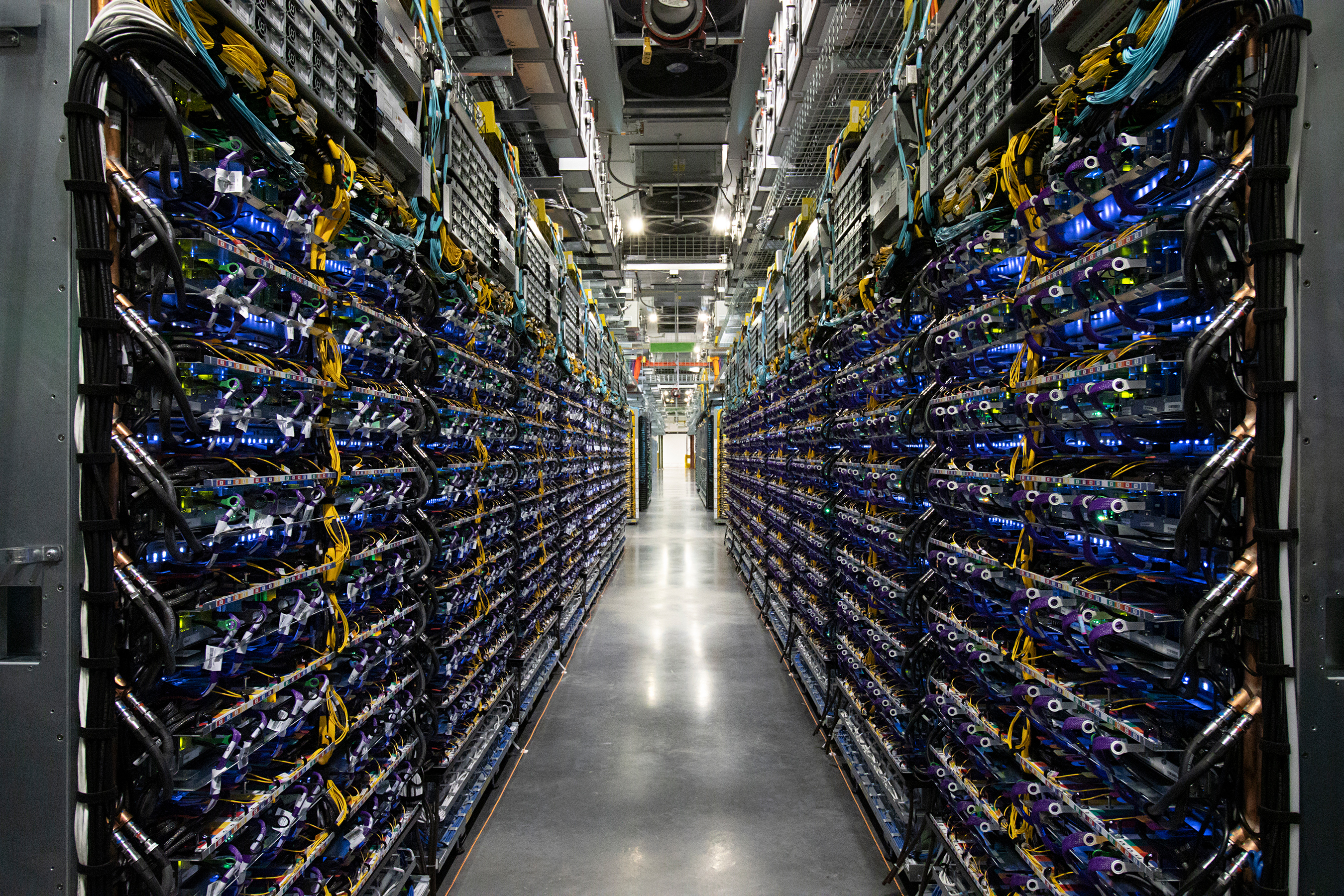
Image credit: TPU v4 pod in a data center, via Google Research. The image illustrates the TPU line; it is not a photo of the eighth-generation model cited in the announcement.
Fontes: Oracle / Google (PR Newswire), Reuters, Unite.AI
Transparency: this article was prepared with the assistance of artificial intelligence, based on cross-checking public posts on X and the internet sources listed above. Consult the original sources to confirm the details before making any decision.
— Muse