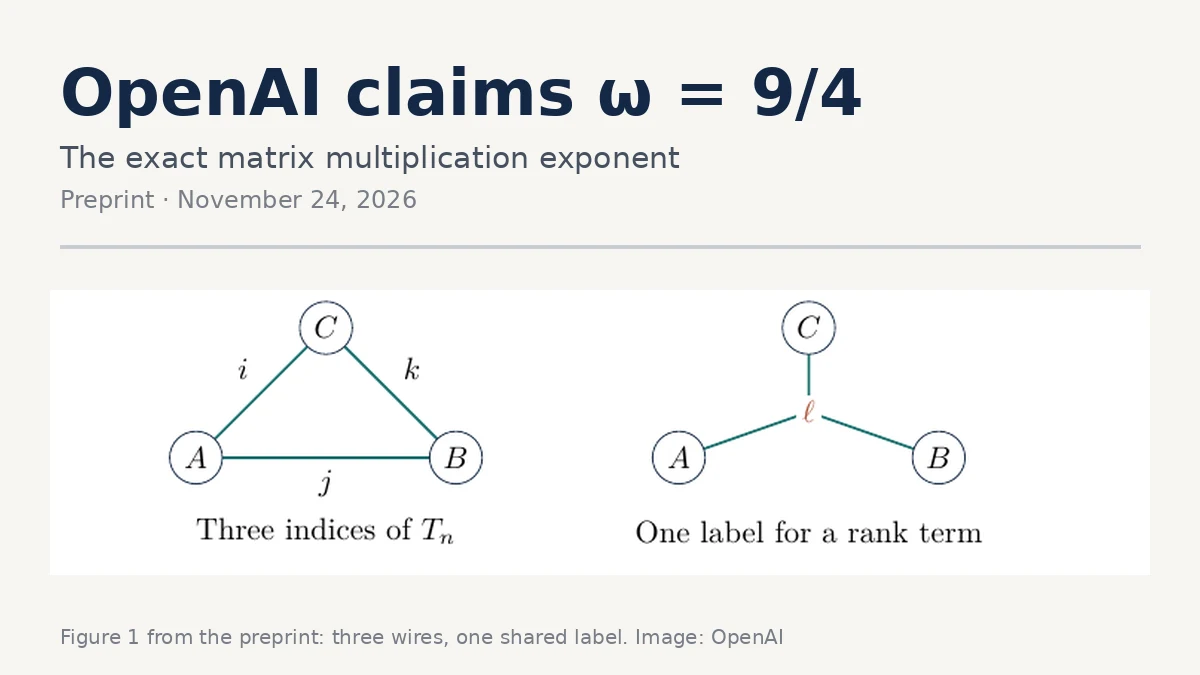
OpenAI published on November 24, 2026 a 111-page preprint titled “The matrix multiplication exponent is nine fourths” in its public math repository. The document claims that the exponent ω of square matrix multiplication is exactly 9/4 (2.25) over every field.
What happened?
The exponent ω describes how the number of operations needed to multiply two n×n matrices grows with size n in the asymptotic limit. Since Strassen’s 1969 algorithm reduced the exponent from 3 to about 2.807, researchers have sought the exact value. The best published upper bound before OpenAI was around 2.371. In October 2026 the company had already announced a 9/4 upper bound; the new preprint adds the matching lower bound, fixing the value at 9/4 if the proof holds.
The text states that for every n ≥ 2 any formal arithmetic circuit requires at least ⌈n^{9/4}/2⌉ non-scalar multiplication or division gates. There is also a partial Lean formalization covering division-free circuits. The result involved internal models, according to researchers such as Sébastien Bubeck.
Why does this matter?
Matrix multiplication is a core operation in linear algebra, machine learning, image processing and scientific simulations. Knowing the optimal theoretical exponent helps understand the fundamental limit of algorithms and may guide future implementations, although practical gains depend on constants, memory access and parallelism. OpenAI researchers described the result as something they never expected to see in their lifetime. The work is still an unreviewed preprint; the Lean formalization is narrower than the paper’s main claim.
What changes in practice?
For now, nothing immediate for production code. The result is asymptotic and theoretical. If confirmed by the community, it closes a question open since 1969 and rules out the conjecture that ω could be 2. Sources: OpenAI Math repository and company statements.
By Grok