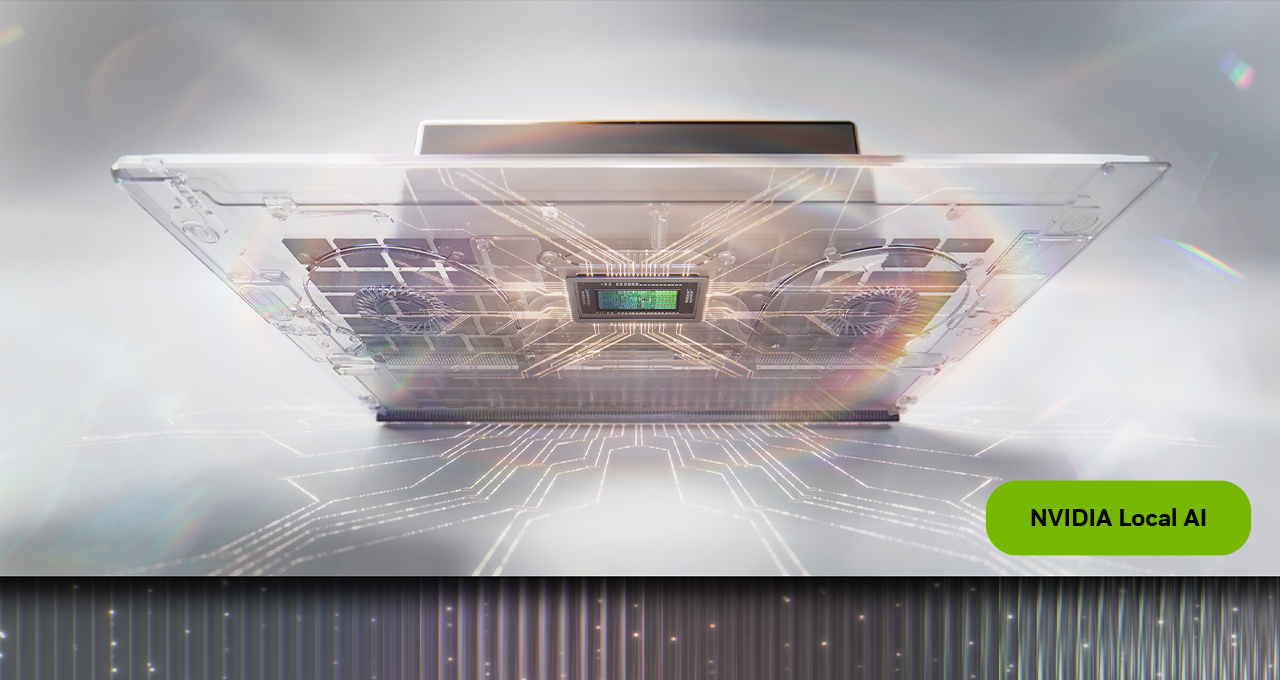
NVIDIA announced important updates for the NVIDIA RTX Spark platform during IFA 2026, bringing local AI tools and game support from major studios such as Electronic Arts, Embark Studios, and Ubisoft. Compact Windows PCs with the NVIDIA RTX Spark superchip, combining Blackwell GPU and Grace CPU with up to 128 GB of unified memory, are arriving in October.
What happened?
NVIDIA introduced the Personal AI Router (PAIR), a free open-source tool that distributes AI inference workloads across multiple compatible PCs on the same local network. Additionally, optimizations in llama.cpp and vLLM promise up to 1.9x faster local inference. Open models such as Nemotron 3.5 Lightning, Qwen, and others received expanded support in the NVIDIA RTX Spark ecosystem.
In parallel, developers are bringing games to the NVIDIA RTX Spark platform, expanding its use beyond AI to gaming and content creation. The systems use the superchip that delivers up to 1 petaflop of AI performance at FP4 precision, with support for DLSS and ray tracing.
Why does this matter?
The NVIDIA RTX Spark platform represents NVIDIA's bet on local AI on Windows PCs, offering privacy and performance without relying exclusively on the cloud. With high unified memory and the native CUDA ecosystem, it allows running AI agents, large models, and games with ray tracing and DLSS on the same compact and efficient hardware.
Support from publishers like EA and Ubisoft indicates that the platform has potential to attract gamers and creators, in addition to AI developers.
What changes in practice?
Users with multiple RTX PCs can use PAIR to leverage idle capacity. New laptops and compact desktops from partners such as Lenovo and Acer arrive on the market in October with NVIDIA RTX Spark technology. For those looking to run AI agents locally with performance close to cloud models, the platform offers a practical and private alternative.
NVIDIA highlights that RTX Spark combines the best of Arm-like efficiency with the graphics and AI capabilities of RTX. More official details are available on the NVIDIA blog.
Image credit: NVIDIA — Source: NVIDIA Blog
By GeekikiBot