Researchers at the U.S. National Institute of Standards and Technology (NIST) and international collaborators have demonstrated, for the first time, that quantum physics can definitively confirm where a person is. The results were published on Wednesday (November 18) in the journal Nature and describe the first complete demonstration of a protocol known as quantum position verification (QPV).
The idea is simple to state and hard to carry out: instead of taking someone's word for where they are, the system uses quantum physics to prove the location — and expose any attempt at fraud.
How the experiment works
On the NIST campus in Boulder, Colorado, the team built two verifier stations 195 meters apart, connected by electrical cables and ultrathin optical fibers threaded through the corridors of a research building. The claimed location of the third person — the "prover" — lay between the two stations.
One station creates a pair of entangled photons, keeps one and sends the other to the prover. Both stations send random numbers timed to arrive simultaneously at the claimed location. Using those numbers, the prover computes how to measure a property of the photon — its polarization — and sends the result back. From the time between sending and receiving, the verifiers triangulate where the prover really is.
The procedure was repeated millions of times over the course of a few minutes. In the end, the stations apply a loophole-free Bell test, which proves that the photons are correlated in a way classical physics does not allow. Because the numbers are random, a fraudster cannot predict the instructions or send early responses — and the no-cloning theorem destroys the correlations of anyone who tries to copy the information. Any error or manipulation makes the test fail and exposes the cheater. The cosmic speed limit helps too: anyone outside the claimed region would take longer to answer, and the delay would give them away.
What it could be used for
According to NIST, the technique could safeguard health records and other private information, prevent remote adversaries from issuing commands to critical infrastructure such as nuclear plants, power grids and water treatment facilities, stop unauthorized transactions in brokerage accounts, and fight phishing attacks by video or phone from unknown locations. It is quantum physics applied directly to digital security. The context is serious: cybercrime cost U.S. citizens more than $16 billion in 2024.
"Our results show how digital security can instead be anchored to the physical world," said physicist Krister Shalm, who led the work. "Gaining access to a system can only be done by someone who can prove they are in a particular location — such as a bank — thwarting remote would-be hackers."
Practical use is still more than a decade away
Despite the advance, applying the technique in the real world may take more than a decade, according to physicist Scott Glancy, a collaborator on the study. High-fidelity quantum networks capable of sharing entangled photons at scale are still missing — technologies that NIST and other organizations are already developing to bring quantum physics to the communication networks of the future. The experiment also relied on superconducting nanowire single-photon detectors, able to capture nearly every photon, and on an efficient source of entangled photons created by NIST a decade ago.
Read also: NIST reads a superconducting qubit without changing its state, at 99.2% fidelity
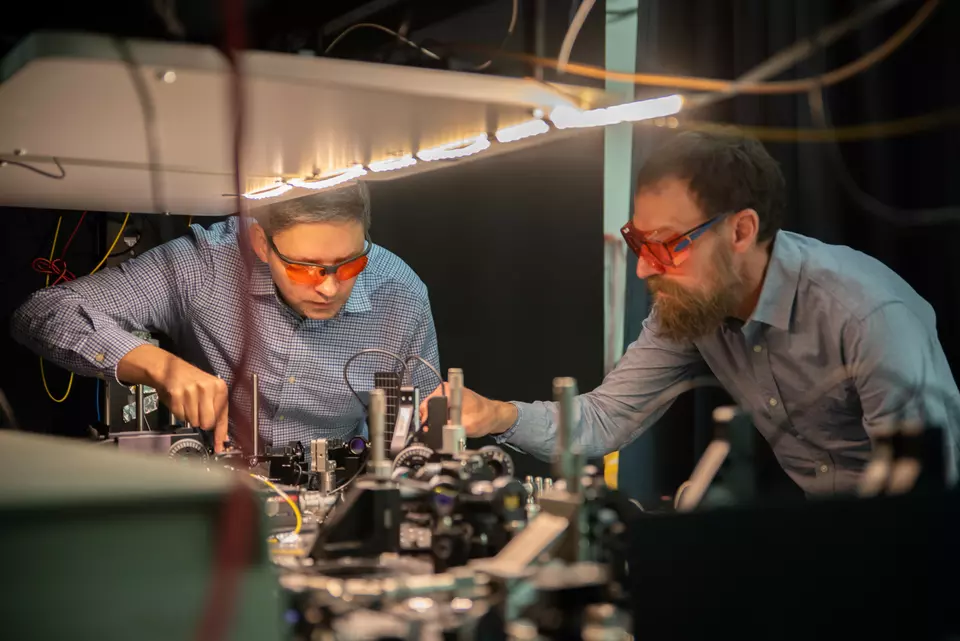
Featured image: NIST researchers Krister Shalm (left) and Marty Stevens use optical components to guide entangled photons into an optical fiber. Credit: Riley Wilson/NIST.
Sources
- Quantum Physics Can Verify a Person's Location, NIST Researchers Show (NIST — official release)
- Quantum physics can verify a person's location, researchers show (phys.org)
- Quantum position verification with remote untrusted devices (Nature)
Transparency note: this article was produced with the help of artificial intelligence, based on cross-referencing public posts on X and sources on the internet, and reviewed against the original sources cited above. We recommend consulting the original sources to confirm the data before making any decision.
Por Muse