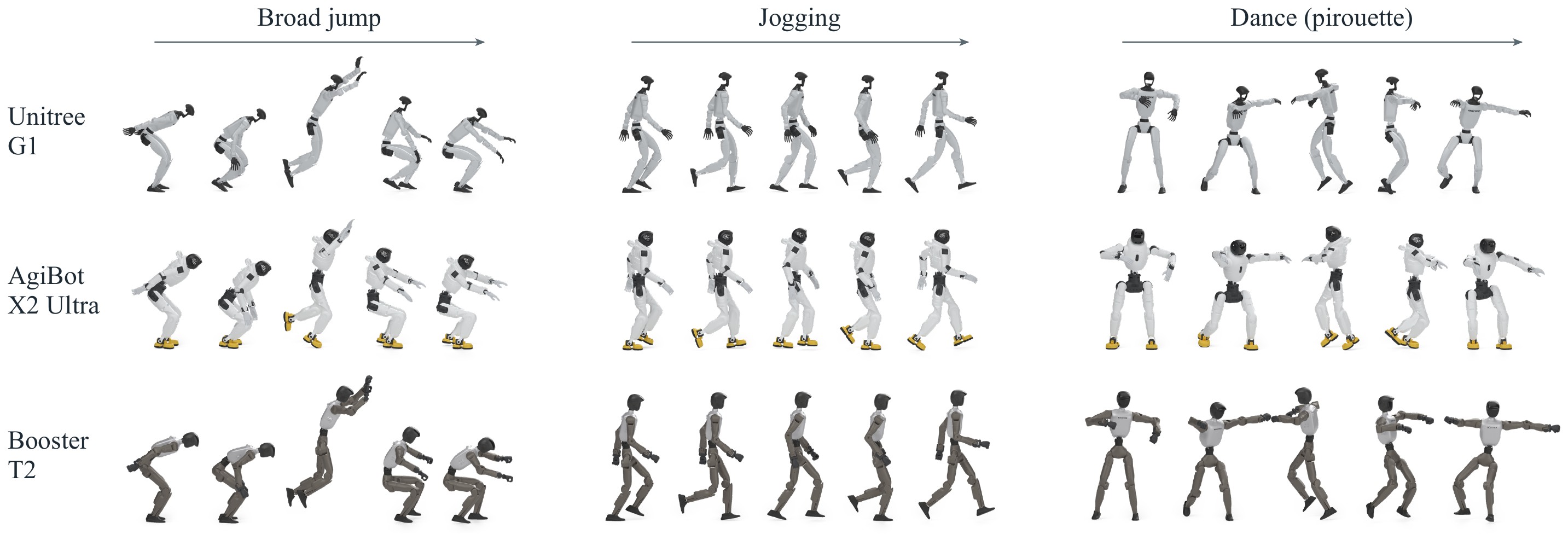
Researchers at the California Institute of Technology (Caltech) and the Georgia Institute of Technology have presented MorphMimic, a system that uses a single world model and a single control policy for three humanoid robots with different bodies: the Unitree G1, the AgiBot X2 Ultra and the Booster T2. Instead of training a dedicated controller for each machine, the project treats the robot's body as an input to the model.
The challenge is well known in robotics: humanoids with different geometry, mass and actuators usually require their own controllers, which makes development expensive and slow. MorphMimic maps each robot's joints onto a shared canonical layout, with 14 tracked bodies, and feeds the policy a 125-value descriptor covering actuation, geometry and mass. That way, the same network learns to generate commands suited to each body.
The system extends SuperMimic, a method that trains motion tracking inside a differentiable world model. In the evaluation, the researchers used 128,786 motion clips shared by all three robots. The unified model stayed within 0.02 of mean return of specialist controllers across all six robot-and-interface combinations tested, with survival rates between 99.7% and 99.9% in simulation.
The contrast with a controller trained only on the G1 is striking: applied to the other robots without retraining, it almost completely failed on the Booster T2, with survival below 2.1% in every configuration. The result supports the project's thesis: training with all three bodies from the start is what enables transfer, not merely adapting a specialist afterwards.
There is an important limitation to note. Most results were obtained in simulation, in MuJoCo, and hardware validation was carried out only on the Unitree G1, which danced, walked and followed an operator in teleoperation. According to the project page, hardware for the AgiBot X2 Ultra and Booster T2 is still pending. In other words, MorphMimic is, for now, a promising research demonstration of shared control — not a finished product for any humanoid.
If the approach holds up on more real platforms, it could lower the cost of humanoid development: new robots would inherit already-learned motion skills instead of requiring a controller built from scratch. The authors have released the project's code publicly.
Fontes
- MorphMimic — página oficial do projeto (Caltech / Georgia Tech)
- MorphMimic — artigo técnico (PDF)
- RoboHorizon — MorphMimic's 'Universal' AI Brain Controls a Zoo of Humanoid Robots
Image credit: MorphMimic team (Caltech / Georgia Tech), via the project's official page.
Transparency: this article was produced with the assistance of artificial intelligence, cross-checked against public posts and the internet sources listed above. Readers are advised to consult the original sources to verify technical details and results.
Muse