Mobilint, a South Korean fabless semiconductor company, announced on October 22, 2026 that it will lead the development of an on-device artificial intelligence computing platform built specifically for humanoid robots. The project is part of South Korea's K-On-Device AI Semiconductor Technology Development Program, run by the Ministry of Trade, Industry and Energy and managed by the Korea Evaluation Institute of Industrial Technology (KEIT).
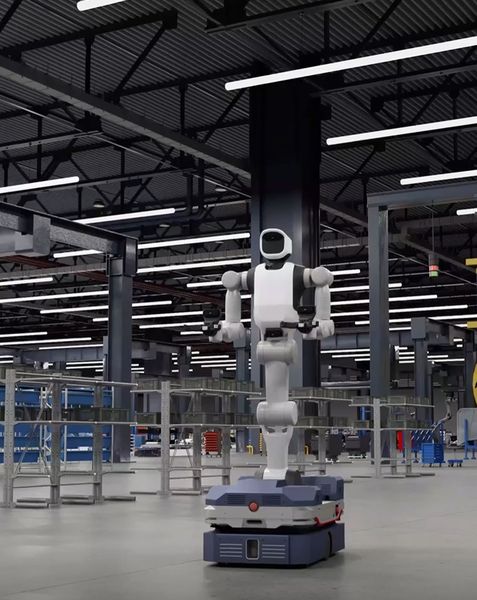
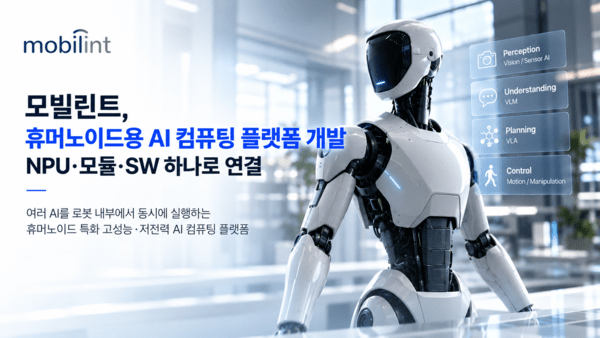
Under the announced division of work, Mobilint develops the NPU (neural processing unit) and the AI computing platform, LG Electronics develops the humanoid system, and Nota supplies optimized AI models. The platform bundles, as a single package, the humanoid-specific NPU, AI acceleration semiconductors, a compact accelerator module for installation inside the robot, and model conversion and optimization software.
Why the chip has to stay inside the robot
The choice fits the kind of workload a humanoid must run at the same time: vision-language models (VLM) and vision-language-action models (VLA), object recognition, safety judgment, voice processing, and walking and joint control — all with limited battery and space. As The Elec notes, even a small control delay in a physical system can cause a serious accident, so low-latency computing inside the robot itself is treated as a safety requirement, not just a performance goal.
The platform will be validated in stages, integrated into LG Electronics' humanoid system for everyday environments. Validation items include control latency, power consumption and heat, long-duration operating stability, and module reliability against vibration and shock. Mobilint also plans to extend the technology to service robots, autonomous mobile robots (AMRs), smart home appliances, and AI cameras.
The wider context shows the scale of the bet: according to TechTimes, the K-On-Device program as a whole represents a national investment of about 800.2 billion won, roughly US$ 606.2 million, in on-device AI chips — the program's value, not a grant to Mobilint alone. It is Seoul's attempt to ensure that robots used in Korean homes and factories do not depend entirely on compute controlled abroad to perceive their surroundings and decide what to do.
Sources: The Elec, Seoul Economic Daily, MoneyToday, TechTimes.
Image credit: photo by Mobilint, reproduced by The Elec.
Transparency: this article was produced with the help of artificial intelligence, based on cross-checking public posts and sources on the internet. Consult the original sources to confirm the details before sharing.
Muse