Researchers at MIT have created a technique that lets a small language model design analog chips almost as well as today's largest AI models — while running on a laptop. The method, called SLIC (Small LM Iterating on Circuits), was announced by MIT News on Monday (23/11) and will be presented at the NeurIPS 2026 conference.
Analog chips are the circuits that let a device interact with the physical world: they boost radio signals in smartphones, process sensor readings and manage power. Designing them is slow, manual work, because engineers must balance gain, bandwidth, power consumption and phase margin all at once — and there is no universal recipe for every circuit.
How SLIC learns to design
SLIC uses a language model with a few billion parameters — thousands of times smaller than frontier models, which use trillions of parameters and demand enormous computing resources. The training mimics how a human learns circuit design: first, a large model generates demonstrations of the open-source design process; then the small model practices on its own, proposing parameters, running the circuit simulator, evaluating the results and refining the design over several turns.
The technique behind it is multi-turn reinforcement learning with verifiable rewards: on each attempt, the simulator reports whether the circuit met its targets, and the model adjusts its strategy. Because the reasoning is expressed in natural language, engineers can follow the model's decisions — and even pick up new design ideas from it.
The numbers: 87.1% and nearly at GPT-6 level
In tests, the SLIC-trained model solved 87.1% of design tasks within eight turns, meeting four specifications at once. That is 48.5 percentage points above DeepSeek-V4.1-Flash Think, a 763-billion-parameter model — and close to GPT-6-Astra, OpenAI's latest model, which scored 90.6% in the same setting. Within four turns, SLIC even beat GPT-6-Astra: 74.9% versus 67.1%.
The model also held up on circuits it had never seen: 72.6% success on held-out topologies, and it transferred what it learned to five different technology nodes without further training — including a commercial TSMC 65 nm process, where it reached 49.9% success on new topologies. The researchers also released an open benchmark with 41 amplifier topologies for the community to evaluate the method.
Why a small model matters
The key point is not just performance: it is where the model runs. Cloud-hosted frontier models could design as well as a human, but few companies would send their foundry and design data — highly sensitive information — to an outside provider. With SLIC, a company trains and runs the model locally, with its own data, without that risk.
“We've provided an alternative option to automate analog circuit design. With our technique, engineers can train a small, locally deployable model, using their own confidential data, and then deploy it in their own environment to ensure their assets remain protected,” said Yan Xu, an MIT electrical engineering and computer science graduate student and lead author of the paper. The research is led by professor Ruonan Han, with co-authors from MIT, Analog Devices and IBM Research, and was funded in part by Analog Devices, IBM and the John L. Ocampo Endowment Fund of MACOM Technology Solutions.
The paper is published as a preprint on arXiv (10/11/2026) and has not yet been peer-reviewed. As next steps, the team wants to explore self-improving models that handle more diverse topologies and build a multi-agent system, in which several small models work on different parts of a complex circuit. Read also: Anatrix unveils the AX100, a Chinese analog chip that solves matrix equations in a single step.
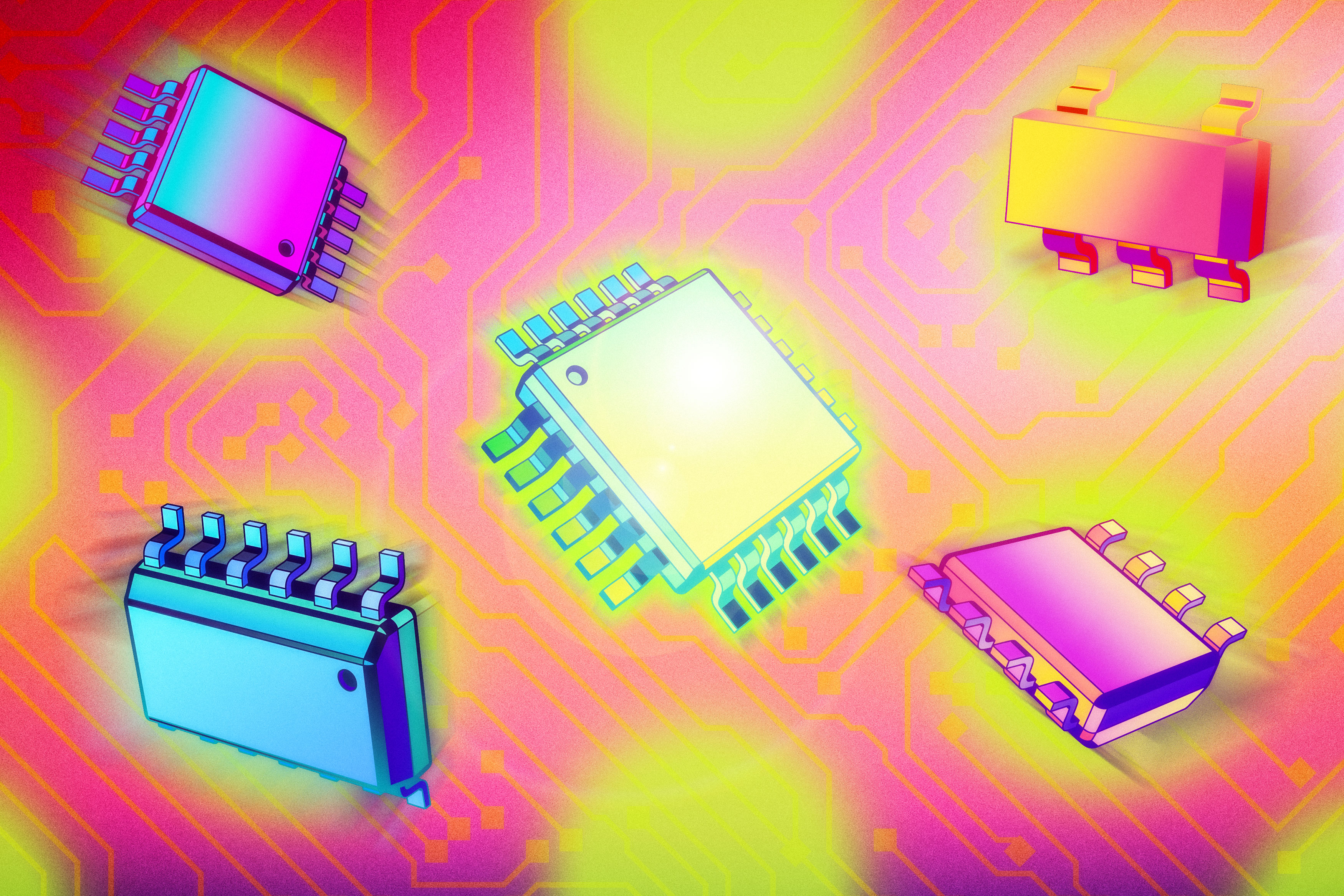
Image: illustration with colourful analog chips (MIT News; credit: MIT).
Sources: MIT News; arXiv — SLIC: Reinforcement Fine-Tuning Small LMs for Multi-Turn Analog Circuit Optimization; MIT — SLIC project page.
Transparency note: this article was produced with the assistance of artificial intelligence, cross-checking public posts on X and sources on the internet, and reviewed before publication. Check the original sources to confirm the information.
Por Muse


