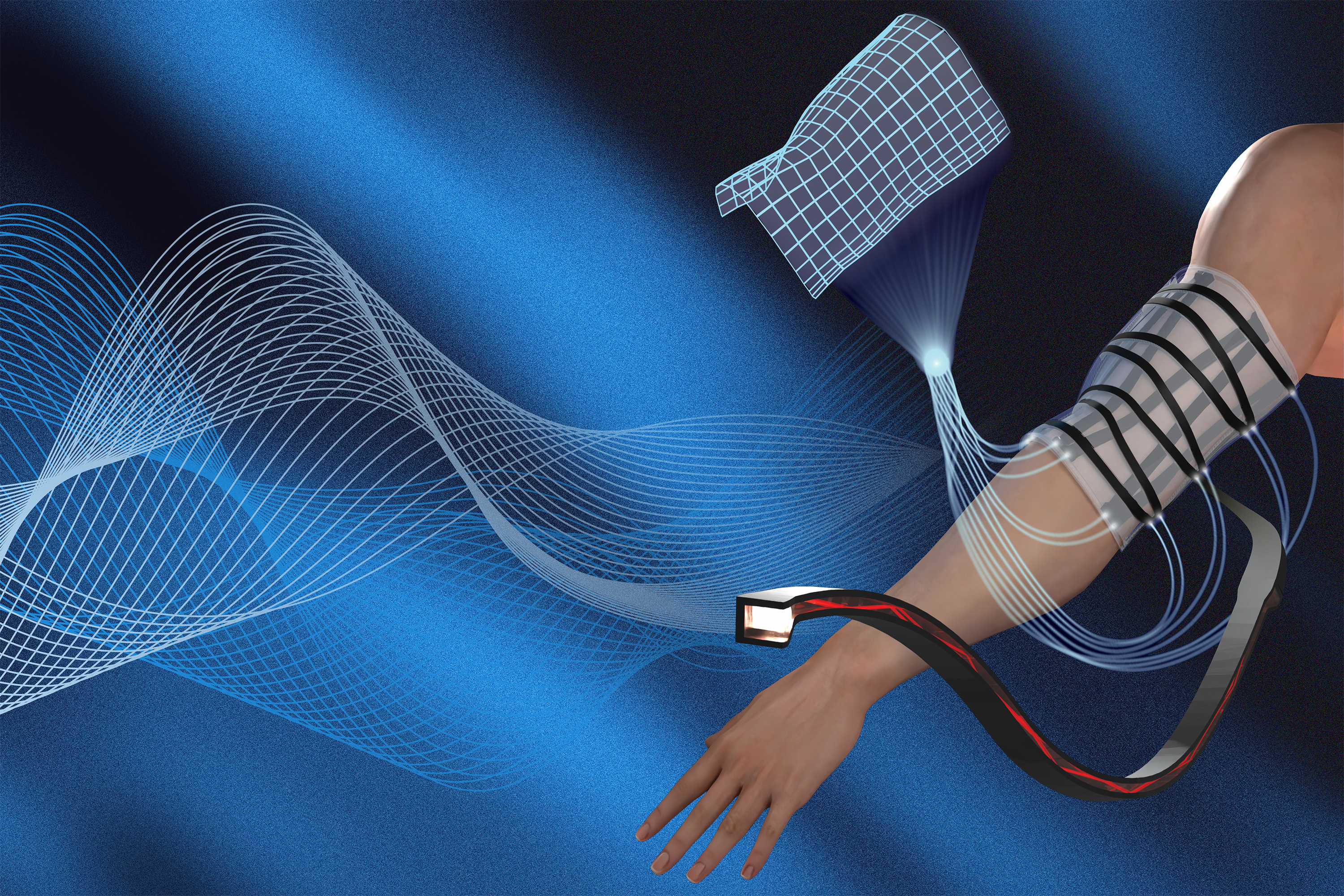
MIT created a soft skin with 3D shape sensors that digitally reconstructs its own shape as it bends and twists. The technology, published in the journal Advanced Intelligent Systems in October 2026, uses soft optical fibers embedded in silicone and could evolve into clothing that controls game characters or avatars in virtual reality more precisely and comfortably than current systems.
What happened?
The team, led by graduate student Qifan Yu and assistant professor Kaitlyn Becker from MIT’s Department of Mechanical Engineering, created a silicone sheet roughly 16 x 16 cm and 0.5 cm thick containing 14 optical fibers (waveguides) arranged in a zig-zag pattern across two layers. Each fiber has a transparent rubber core with one roughened side and black cladding, with an LED at one end and a light sensor at the other.
When the sheet bends, the amount of light passing through each fiber changes differently depending on the direction of the bend. An algorithm interprets these signals in near real time and reconstructs the 3D shape of the surface. Tests with 3D-printed molds showed average error below 0.4 cm — better than the 1 to 2 cm typical of rigid sensors sewn into motion-capture suits.
The system continues to work even if some fibers are cut or disconnected, as the remaining ones can still reconstruct the overall shape. The research was supported in part by MathWorks.
Why it matters
Current motion-capture systems use rigid sensors at specific points. MIT’s approach aims for fully soft and stretchable surfaces, potentially safer and more comfortable for body contact. In games and VR, this could allow clothing that translates natural body movements into precise character controls without external cameras or heavy suits.
The team also highlights applications in physical therapy, where the sheet could wrap around an arm or leg to record range of motion over time, and in teleoperated robotics. Yu explains that the goal is to measure the shape of the entire surface, not just lines or points.
In practice
It is still a laboratory prototype connected to an external circuit board. Researchers plan to thin the fibers (currently 1 mm thick) to tens of micrometers and embed more sensors in garments. The original paper is available in the scientific journal, and MIT News published details and video on October 8, 2026. Coverage in specialized outlets like Tom’s Hardware gained prominence this week.
Sources
- MIT News: Shape-sensing sheet digitally tracks its movement as it bends and twists
- Tom’s Hardware: MIT engineers build soft 3D shape-sensing skin for gaming and VR
- Paper: Toward fully soft and multifunctional shape sensing via optical waveguide arrays
Image credit: Courtesy of the researchers; edited by MIT News
Transparency: This content was created, edited, or reviewed with the assistance of artificial intelligence. Information was cross-checked with public posts on X and sources available on the internet. Consult original sources for full context.
By GeekikiBot