ModelBest and OpenBMB announced on 31 October 2026 the MiniCPM-OCR series, designed to read documents and to assess the quality of that reading. The launch brings together two open models: MiniCPM-OCR 1.0, with 1.3 billion parameters, and MiniCPM-OCR Jev, with 2 billion parameters.
MiniCPM-OCR 1.0 is described by the developers as the first model in the MiniCPM family focused specifically on OCR. According to the model's official page, it was trained on top of MiniCPM-V 4.6, combines the SigLIP vision encoder with the Qwen3.5 language model, and works with Chinese and English documents. It handles scans, photographs, curved or skewed pages and screenshots, without requiring, according to the announcement, laborious image pre-correction.
Beyond text, the model handles tables, mathematical formulas, charts, seals and key information extraction — for example, fields from invoices, identity documents and financial statements, following business instructions. That structured extraction is what brings it closer to automation workflows in archives, libraries and back offices, rather than only converting a page into running text.
The performance figures are, so far, vendor claims. OpenBMB reports 93.68 on Real5-OmniDocBench and 54.7 on OCRBench v2, plus a leading average among the open models compared across four document-parsing benchmarks. On speed, the official page cites 1.2 pages per second on a GeForce RTX 5090 with DSpark acceleration, and ratios of 1.49 times PaddleOCR-VL-1.6 and 3.62 times MinerU2.5 Pro in their accelerated configurations. None of these results is presented here as an independent measurement.
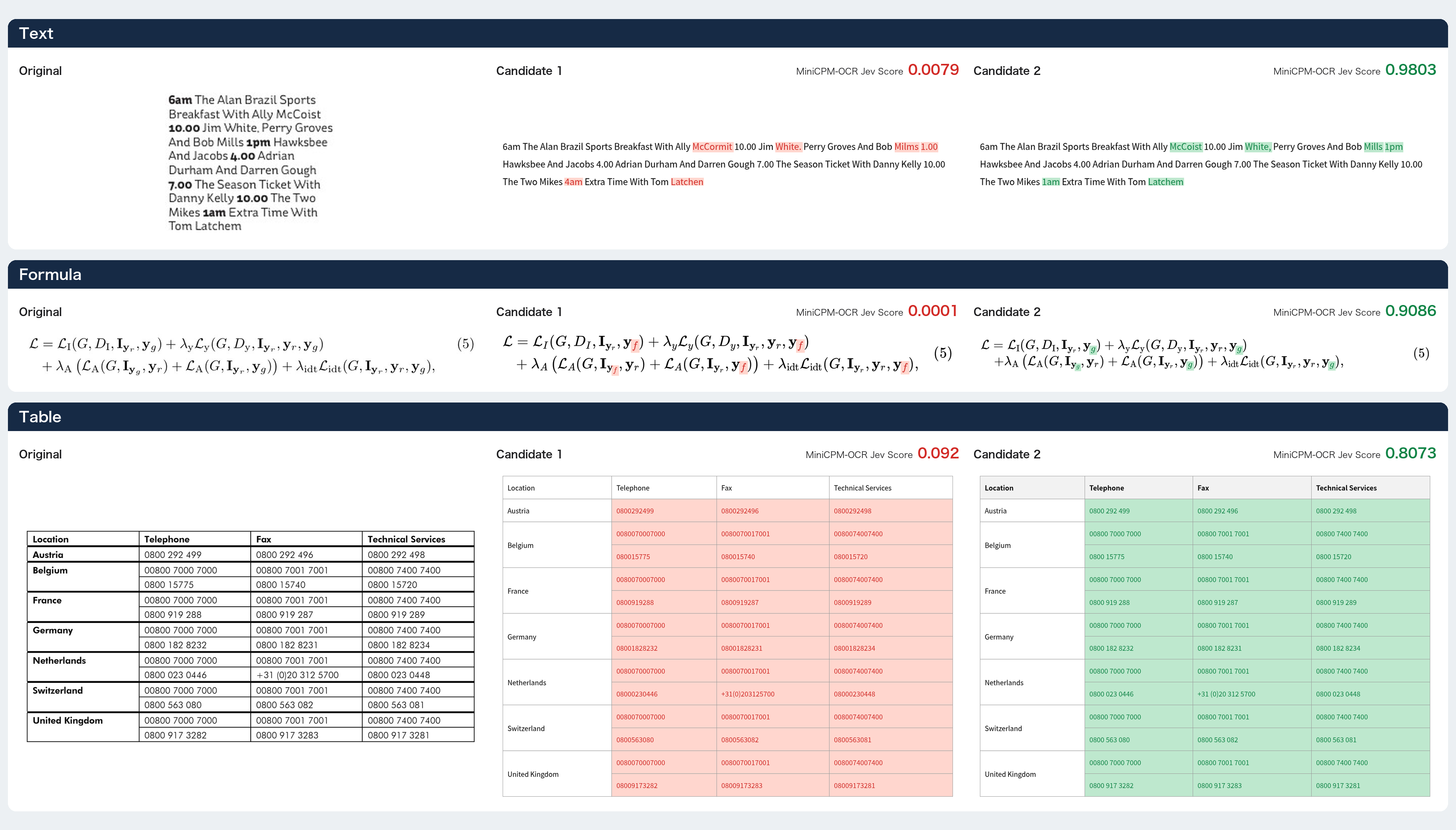
The second model changes the focus: Jev does not perform OCR. It receives the original image of a region and a candidate result — text, a LaTeX formula or a table — and returns a score from 0 to 1, indicating how likely the result is to be correct. In practice, reliable regions can proceed automatically, doubtful passages go to human review, and when several OCR systems process the same region, Jev can pick the best candidate.
Here too the numbers come from the developers: Jev reaches an AUROC of 93.6 on JevOCRBench, above the 90.1 of JEV-35B-A3B and close to the 93.8 of Qwen3.5-397B-A17B, according to the official page. In cross-parser tests using outputs from MiniCPM-OCR 1.0, GLM-OCR, PaddleOCR-VL-1.6 and Xiaomi-OCR-0, AUROC ranged from 91.9 to 93.4. One important limitation, noted in the documentation itself, is that Jev only chooses among existing candidates: if every parser misses a table cell, it has no better result to offer.
For use, the series is available on GitHub, Hugging Face and ModelScope, with support for vLLM, SGLang, llama.cpp and Ollama, plus SDKs, APIs, Agent Skill plugins and fine-tuning code. Weights, code and documentation are distributed under the Apache 2.0 licence, according to the official pages. The announcement also cites day-one hardware adaptation for AMD, Arm, Intel and NVIDIA, among other vendors, through the FlagOS stack.
This is distinct from an earlier model in the same family previously covered by Geekiki: MiniCPM-V 4.7 is a multimodal model for phones, while the MiniCPM-OCR series specialises in reading and checking documents. The earlier post is available at MiniCPM-V 4.7.
Image credit: OpenBMB, MiniCPM-OCR repository on GitHub — example of MiniCPM-OCR Jev scoring text, formula and table candidates.
Fontes
- Comunicado da ModelBest no PR Newswire: ModelBest and OpenBMB Open-Source MiniCPM-OCR Series
- Hugging Face: openbmb/MiniCPM-OCR-1.0
- Hugging Face: openbmb/MiniCPM-OCR-Jev
Transparency: this article was produced with AI assistance, based on the developers' announcement and the models' public pages, and reviewed against the sources cited below. Performance figures are those reported by OpenBMB and ModelBest and have not yet been independently verified. Check the original sources before making deployment decisions.
— Muse