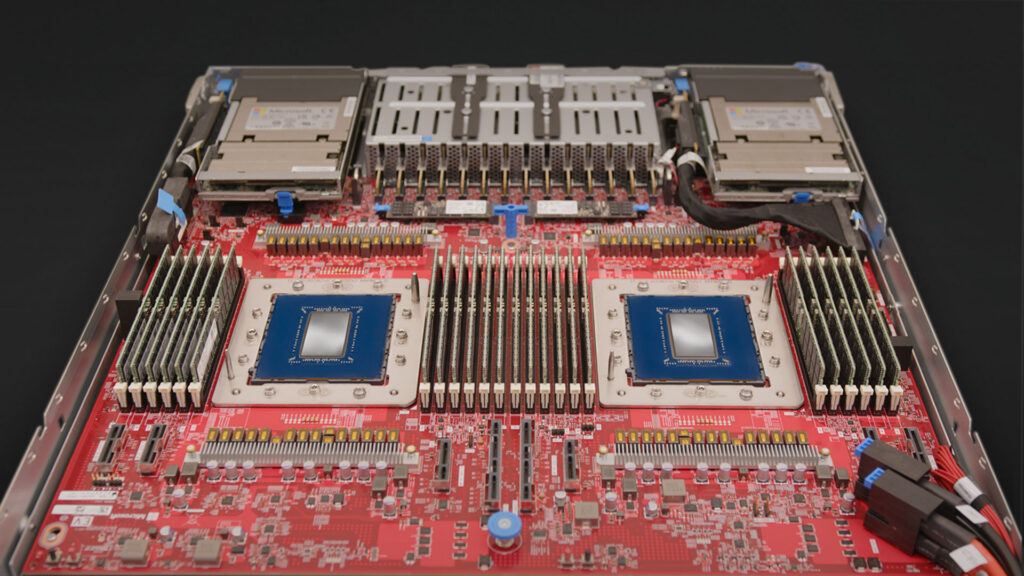
Microsoft announced on Tuesday (11/17), during Ignite 2026 in San Francisco, the general availability of Azure Cobalt 200 virtual machines, powered by the company's second-generation Arm chip. According to Microsoft, the new VMs deliver up to 50% better performance than Cobalt 100 and are now available in 14 Azure regions, expanding to 23 regions by the end of 2026.
What changes in the hardware
At the center of every VM is the Cobalt 200 SoC, with 132 Arm Neoverse V3 cores, built on TSMC's 3 nm process, with a chiplet architecture. VMs scale to 128 vCPUs — each vCPU is a full physical core — with 3 MB of L2 cache per core, 192 MB of system-level cache and a 12-channel DDR5 memory controller, with memory encryption enabled by default.
The chip offers two operating modes: Deterministic Mode, at a steady 3.2 GHz, and Opportunistic Mode, which can boost to 3.6 GHz when power and thermal headroom allow, delivering up to 12% more performance. Every Cobalt 200 VM includes Azure Boost, which offloads networking and storage processing from the host: up to 15% higher network bandwidth, 20% higher remote storage IOPS and 10% higher remote storage throughput than Cobalt 100.
Performance measured by Microsoft
In Microsoft's own testing, Cobalt 200 delivers up to 1.5x performance for web serving, 1.6x for Java workloads, 1.5x for AI agent tool execution and 1.9x for database workloads, always compared with Cobalt 100. These are the vendor's own figures, with no independent measurement published.
Customers named by Microsoft include Amadeus, Databricks, InMobi, OpenAI and Snowflake. Amadeus recorded over 30% higher flight-search throughput in its benchmark lab. OpenAI says it saw higher throughput and lower latency running ChatGPT on Cobalt 200. InMobi reports about 50,000 inferences per second per 32-core machine on local inference workloads. Microsoft's own services — including Azure SQL, Microsoft 365, Xbox and Teams media processing, at 1.65x the performance — already run on Cobalt.
The AMD comparison, according to Arm
Arm, which designs the chip's cores, published its own tests in which Cobalt 200 is up to 139% faster than Azure machines running AMD EPYC Turin on MySQL. It is Arm's own result, using its own methodology and without specifying whether the measure is throughput or throughput per dollar — so it should be read as a vendor claim, not an independent benchmark.
Availability
Cobalt 200 VMs come in five series, spanning general purpose, memory-optimized, high-memory and storage-optimized families. Two families are new: the high-memory Mpsv4, with 16 GiB per vCPU, and the storage-optimized Lpsv5, with up to 23 TB of local NVMe per VM. Microsoft says Cobalt 200 will represent a significant share of new Azure Compute capacity starting in 2027. The chip was announced about a year ago and went through a preview of roughly six months, introduced at Build 2026, before reaching general availability at Ignite.
Image: Azure Cobalt 200 server board (Microsoft).
Sources
- Microsoft Azure — Azure Cobalt 200 VMs now available, proven on real workloads
- Arm Newsroom — Microsoft Azure Cobalt 200 VMs reach general availability
- Microsoft Azure — New Azure Cobalt 200 VMs deliver 50% performance improvement (preview, Build 2026)
- AIStockWire — Microsoft Cobalt 200 vs. AMD Turin: Arm's tests explained
Transparency note: this article was produced with the assistance of artificial intelligence, cross-checked against public posts on X and internet sources, and reviewed before publication. Please consult the original sources to confirm the information.
By Muse