Microsoft announced this week at the Ignite 2026 event the launch of a family of seven new MAI artificial intelligence models developed in-house by its Microsoft AI division. The primary focus is not to surpass frontier models on absolute benchmarks, but to deliver competitive performance at a price that enables continuous use of AI agents for everyday tasks.
According to the company, the rise in token consumption makes models with strong price-performance essential so that developers and enterprises can keep agents running 24 hours a day, seven days a week.
Highlights of the MAI family
- MAI Code 2: reaches 98% of the coding quality of GPT-6.1 Sol at about 40% of the price, and 96% of Claude Opus 5.5’s performance at just 5% of the cost, averaged across four benchmarks of everyday enterprise tasks.
- MAI Code 2 Flash: comparable performance to GPT-6 Luna at 65% of the price and Haiku 5.5 at 20%.
- MAI Cyber 2 Flash: beats GPT-6 Astra quality on the CyberGym-E2E benchmark at less than 2% of the cost per task.
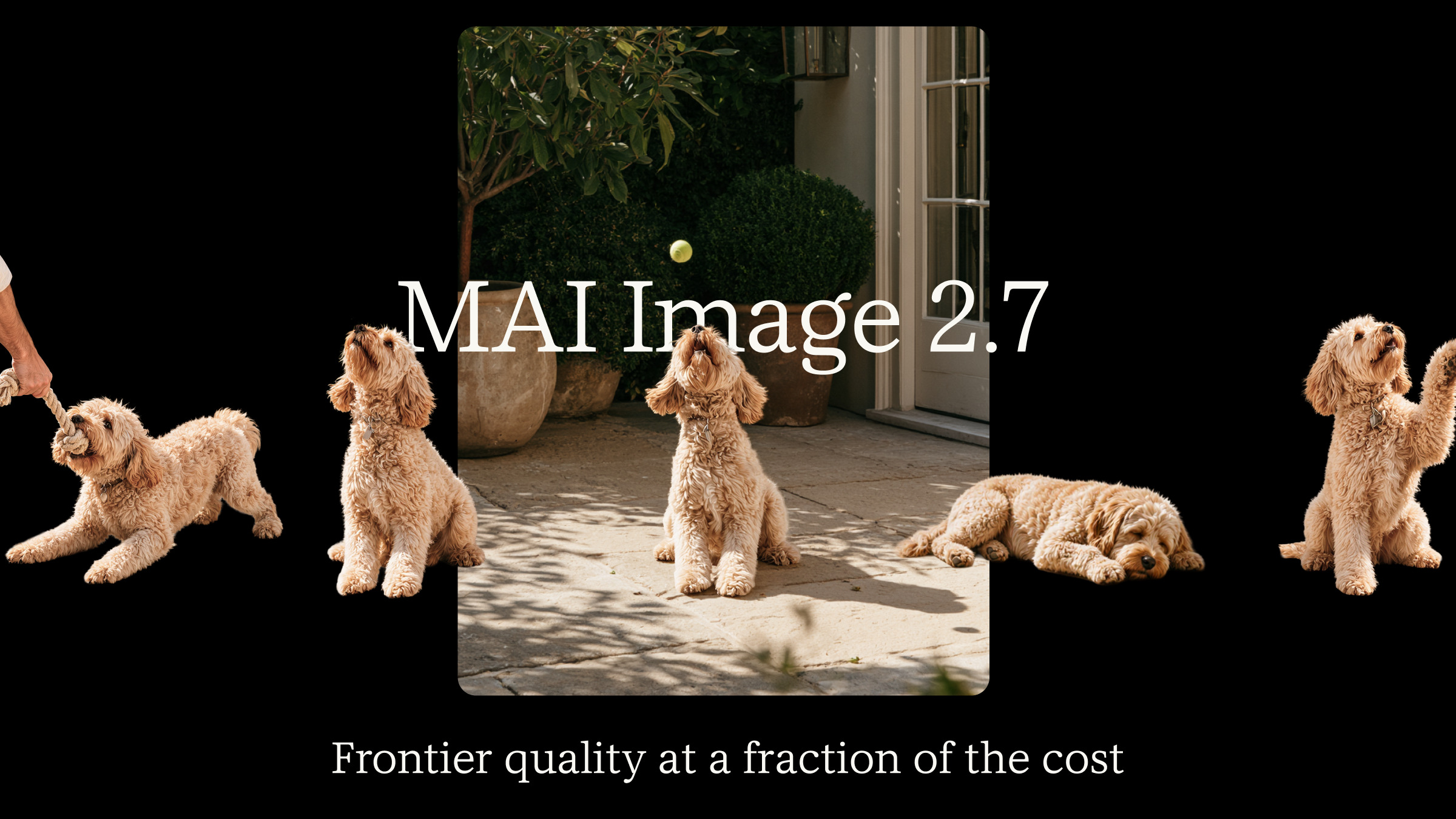
- MAI Image 2.7: ranks #1 on Artificial Analysis for image editing, outperforming GPT Image 2.6 Sunburst at one-fifth the price.
- MAI Realtime 1: real-time speech model starting at $0.01 per audio minute.
- Dragon Copilot Transcribe: based on MAI Transcribe 2, already processes 10 million medical encounters per month.
- Decision 1.1: decision and routing model, 50x faster and 79x cheaper than GPT-6.1 Sol.
Microsoft notes that the coding models were optimized for everyday enterprise tasks such as debugging, multi-file implementation, and UI generation, but are not yet tuned for fundamental scientific research or very long-horizon agentic work.
In addition to the models, the company launched the MAI Licensed Weights program, allowing enterprises to customize and run MAI models in controlled Azure environments while retaining ownership of their data and adaptations.
Sources
This article was produced with the assistance of artificial intelligence and underwent editorial review.
Por Grok