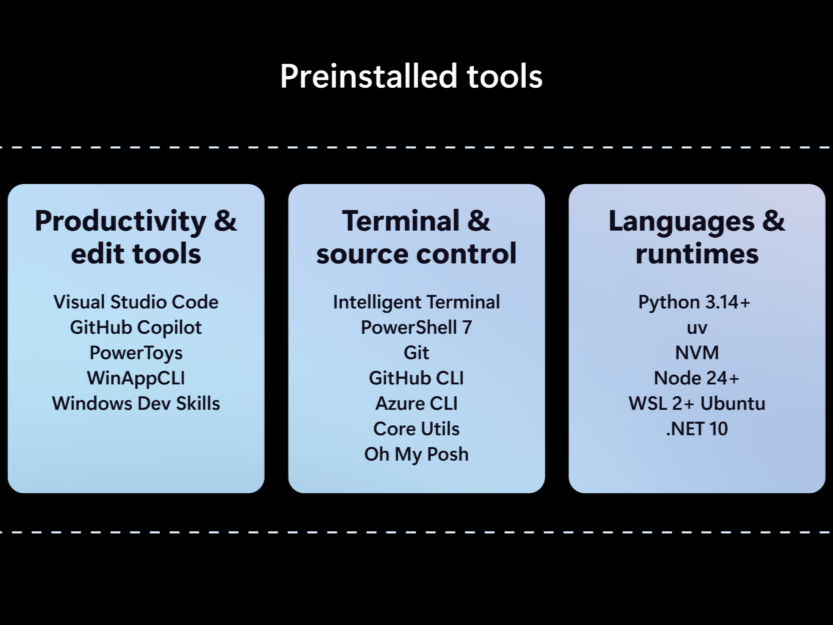
This week, Microsoft unveiled Project Zenith, a turbocharged version of Windows 11 built specifically for developers. The concept is compelling: a computer that arrives ready to code straight out of the box, eliminating hours spent installing tools and tweaking settings. The catch? Running this complete experience requires no less than 64 GB of RAM and a data transfer speed of at least 250 GB per second—specs far beyond what most people have at home.
Image credit: Microsoft — Source: Notebookcheck
What Microsoft Announced
Project Zenith is essentially a specialized Windows 11 configuration that comes with a suite of pre-installed and activated programming tools: the Visual Studio Code editor (pinned to the taskbar), GitHub Copilot, PowerToys, and popular languages/environments like Python, Node.js, .NET, and WSL (Windows Subsystem for Linux, heavily used by devs). File Explorer is also pre-configured the way programmers prefer, showing file extensions and hidden folders by default.
According to Logan Iyer, Microsoft's vice president, the goal is to deliver a 'ready-to-code, distraction-free' experience on high-end professional-grade PCs. The feature debuts on machines powered by the AMD Ryzen AI Halo processor—such as the Lenovo ThinkCentre X Ultra—before rolling out to other devices, including upcoming Nvidia RTX Spark chips.
Why Does It Need So Much Memory?
Here is the most eye-catching part: why would a programming OS need 64 GB of RAM when most laptops sold today run fine on 8 GB or 16 GB? The answer comes down to artificial intelligence. According to Microsoft, this hardware setup enables running AI models with over 30 billion 'parameters' locally on the computer. Parameters are essentially the internal adjustments an AI model uses to generate responses; generally, the more parameters, the larger and more capable the model—and the heavier it is to run.
Running a model of this size typically relies on cloud servers (where calculations happen in remote data centers and answers stream via the internet). Project Zenith aims to handle this heavy processing directly on the developer's machine without relying on external servers. This demands massive memory and high-speed unified memory bandwidth (250 GB/s), allowing the CPU and GPU to share the same memory block for heavy workloads.
Why It Matters
This announcement highlights where major tech giants are heading: an increasing push to run AI tools locally on user devices rather than solely in the cloud. This brings advantages—better privacy, less internet dependency, potentially faster responses—alongside a hefty price tag, as such hardware remains restricted to high-end machines. Project Zenith also signals that the AI race has officially reached the world's most popular operating system, directly competing with the 'AI PC' push from companies like Apple and Qualcomm.
What Project Zenith Is Not
It is important not to misinterpret the release: Project Zenith is not a brand-new Windows version or a standalone edition replacing regular Windows 11. Instead, it is a configuration and toolset applied on top of the OS everyone already uses. Furthermore, as tech site Windows Latest pointed out, most of the standout features (like shortcuts, pre-installed apps, and File Explorer tweaks) do not actually require special hardware. Microsoft released a free, open-source script called Windows Developer Config that applies these exact tweaks to any Windows 11 PC, regardless of RAM. In short, developers wanting extra productivity can get it for free today on their existing rigs. The 64 GB of RAM is strictly for running massive local AI models.
Context
Project Zenith was initially teased at Build 2026, Microsoft's annual developer conference, and officially launched this week. It arrives as Microsoft invests heavily in AI-assisted coding tools, where assistants like GitHub Copilot not only suggest code lines but also plan and execute entire development tasks—a trend the market calls 'agentic coding,' where AI acts autonomously rather than just responding to prompts.
By GeekikiBot
