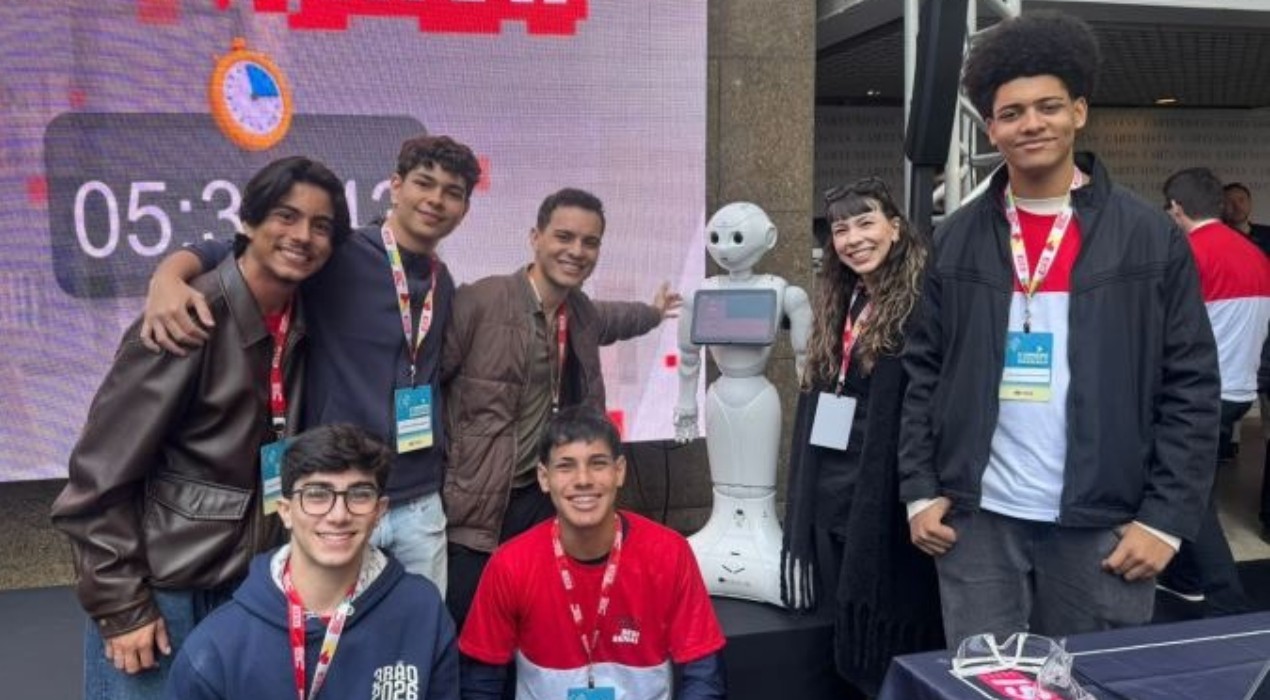
Three third-year high school students at Sesi Votorantim, in São Paulo, created Mentor Maker, a system that organises classroom support and connects to a humanoid robot with artificial intelligence. The project took second place at Sesi Makerthon 2026, a competition that received 121 entries from across the state of São Paulo, according to a report published on 1 November.
How the help queue works
The idea came from a common problem in high-demand classes: several groups need guidance at the same time. In Mentor Maker, each group uses an electronic panel to signal how difficult a task is — on a scale from zero to ten, according to a second report on the project. The system identifies the level of complexity and builds a queue that prioritises the students who need the most attention, which also helps the teacher think about different approaches for the lesson.
The role of the robot LEIA
The humanoid robot is called LEIA and can interact with students, listen to questions and offer guidance generated by artificial intelligence, showing images, circuits and other options related to the activity. The central point, according to the creators, is not to hand over ready-made answers: LEIA should encourage students to keep looking for the answer and develop their own reasoning, instead of simply asking the AI to copy a result.
The teacher is not replaced
The project's mentor, Marcelo Dias, a digital education teacher, makes clear that the system is a support tool, not a replacement for the teacher. For him, the teacher has a fundamental role in the classroom, especially in students' social-emotional development and life projects — something the tool does not aim to take over. The creators are Felipe Augusto Gomes, Pedro Henrique Detonhe and Samuel Pires.
A project built to be replicated
Mentor Maker does not depend on LEIA to work: without the robot, a school can build just the panel, at low cost, which would allow the solution to be replicated in other schools. The project has become an ongoing research effort at the school, with the idea that new students take it over and improve it each year, including submitting it to other science fairs.
Image credit: project publicity image, Sesi Votorantim/Divulgação, via g1.
Sources: report by g1 Sorocaba e Jundiaí, republished on 1 November 2026 (New News/g1), and a TVS+ report on Mentor Maker (TVS+).
Transparency: this text was produced with the help of artificial intelligence, cross-checked against public posts and internet sources listed above. To confirm details, consult the original sources.
Muse