A 66 GB AI model has no business fitting on a graphics card with 24 GB of memory — and yet Magnitude says it got that model generating at 41 tokens per second on an RTX 3090, with 64 GB of system RAM and a PCIe 4.0 SSD. The trick is not to put the whole model on the GPU: the open-source inference engine, introduced by Tom Greenwald, spreads a MoE model's experts across VRAM, RAM and the SSD, and tries to bring each piece into memory before the GPU asks for it.
Version 0.3.0-alpha.0, released on Monday (November 23), is the one that turns the idea into a feature: mixture-of-experts (MoE) models larger than the GPU memory and the system RAM can now load and run, with the most-used experts resident in the fastest tier and the rest streaming across GPU, RAM and disk as tokens are generated. The same release adds a CLI-only installation, faster kernels on Metal, CUDA, Vulkan and CPU, and support for DeepSeek V4.1 Flash.
Why the SSD can work here
In a MoE model, each token passes through only a small fraction of the weights: in Qwen 3.8 Flash Next, it is 10 of 512 routed experts per token. The engine still needs access to all of them — just not at the same time. Magnitude keeps the shared layers and the most frequent experts on the GPU, caches the next tier in RAM, and fetches the rest from the NVMe drive, trying to anticipate what comes next. When an expert arrives in time, the GPU keeps working; when it arrives late, generation waits.
The numbers reported by the team are these: 41 tokens/s with the 66 GB Qwen 3.8 Flash Next (2-bit build) on the RTX 3090; 17 tokens/s with the same model on a 12 GB RTX 3060, with 32 GB of RAM and a PCIe 3.0 SSD — a machine where the model file is larger than the VRAM and RAM combined; and 17 tokens/s with the 249 GB DeepSeek V4.1 Flash build on a 32 GB RTX 5090, with 128 GB of RAM and a PCIe 4.0 SSD. Earlier, in a post on X on Friday (November 20), Greenwald had claimed about 40 tokens/s with the 552-billion-parameter DeepSeek V4.1 Flash on a single gaming GPU, with most of the weights on the SSD.
The numbers come from the team itself — and that matters
These results need to be read with the right label: they are figures reported by the project itself, measured in decoding — how fast the engine produces tokens once generation is underway — with a 64K context setting and speculative decoding enabled. They say nothing about how long the model takes to load or to process the input before the first word, and an agent that re-reads files every cycle repeats that cost several times.
An independent analysis, published by Gürkan Özkan, checked the arithmetic of the claim: at 40 tokens per second, at most 2.2% of weight reads may wait for the SSD — in other words, at least 97.8% must already sit in faster memory — and the project's reported cache hit rate of 97% to 99% makes the math plausible. But the same piece records the limit: so far, nobody outside the team itself has measured these numbers, and the original X post published no method, hardware list, prompt mix or warm-up rule.
In practice, what changes for people running models locally is the menu: a model that used to be too large to try may become fast enough for a background job with sensitive files on the device itself — without sending anything to the cloud. For interactive work, the missing number is a different one: how long until the first token. Magnitude is free and open source, with an OpenAI-compatible API, and integrates with coding agents such as Claude Code, Codex and Cline.
Read also: PrismML lança Ternary Bonsai 2.5 27B: modelo de 5,9 GB para agentes de IA no dispositivo.
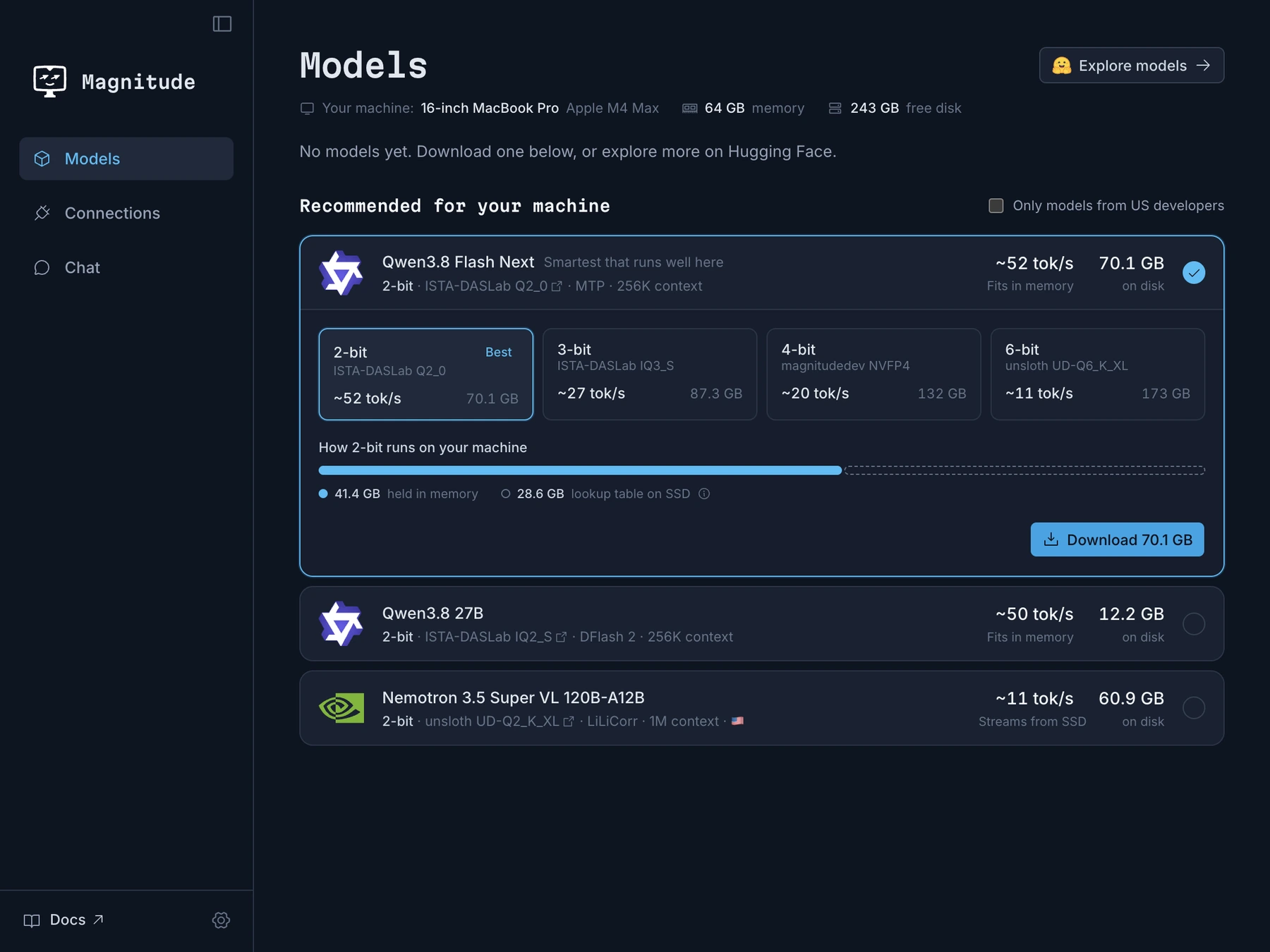
Image: the Magnitude app screen, showing the models recommended for the user's machine. Credit: Magnitude (magnitude.dev).
Sources
- The Neuron — Magnitude Runs Bigger Local AI Models From Your SSD (25/11/2026)
- GitHub (via newreleases.io) — magnitudedev/magnitude @magnitudedev/cli@0.3.0-alpha.0
- Gürkan Özkan — Magnitude says an SSD can keep a giant sparse AI model at 40 tokens a second: the arithmetic of that claim
- Magnitude — Run powerful open models on the hardware you already own (magnitude.dev)
Transparency note: this article was produced with the assistance of artificial intelligence, cross-checked against public posts on X and internet sources, and reviewed before publication. Please consult the original sources to confirm the information.
By Muse