CONFIRMED: Luxonis released the OAK 4 FFC on October 27, 2026, a board-level vision computer for robots, drones and other machines that a ready-made camera does not fit. The idea is straightforward: the builder chooses up to five camera modules and decides where each one goes, while a single board handles synchronization, calibration, stereo depth and on-device AI.
Five cameras, placed where the robot needs them
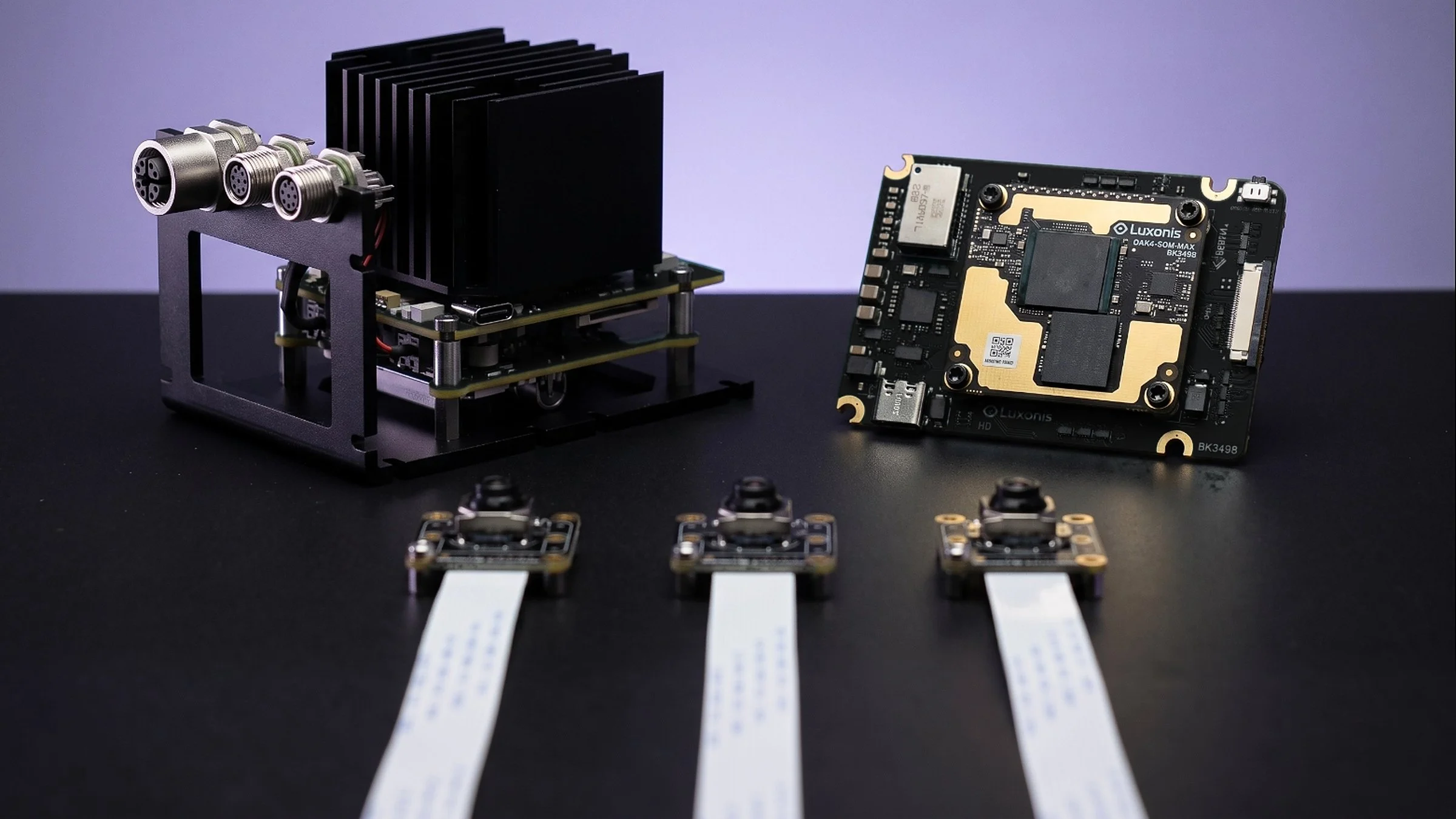
The OAK 4 FFC accepts up to five of Luxonis' own camera modules, chosen from nine options across three sensors: the 48-megapixel color IMX586, and the global-shutter OV9282, at 1 megapixel, and OG05, at 5 megapixels, in standard or wide fields of view. In practice, that makes it possible to mount, for example, a forward stereo pair at eye spacing on a humanoid, plus side and rear cameras, all on the same board. Thermal, time-of-flight (ToF) and additional global-shutter modules are planned to follow.
Calibration without a calibration board
Each module ships factory-calibrated, with its intrinsic parameters stored on the module itself. Users enter the camera positions in OAK Viewer, and Luxonis' Dynamic Calibration refines the alignment of cameras with overlapping views using the ordinary texture of the scene. The result can be a stereo pair with the baseline chosen by the project, for measuring depth, or views combined into a panorama and a bird's-eye view, like a car's parking display.
Two roles on the robot
On a stationary system or a simpler robot, the OAK 4 FFC can be the main computer: it runs the Linux-based Luxonis OS and concentrates the camera pipeline, the AI models and the application logic. On a more complex robot, it becomes the dedicated perception system, processing everything on device and sending only results, such as depth, detections and tracked objects, to the main computer, which stays free to plan, manipulate and run larger models. Processing is handled by the 6-core RVC4 processor, with 52 TOPS in total, according to the company.
For connectivity, the board offers 2.5 Gigabit Ethernet, PoE+ through the module included in the Developer Kit, 6 to 32 V DC input, USB-C, CAN FD and hardware frame sync. The board measures 70 x 53 mm, and the Barebone version weighs 36 grams, with 8 GB of RAM and 128 GB of storage. Luxonis has also released the OAK 4 FFC reference design as open source, so teams can build their own carrier board around the OAK 4 module.
Price and availability
Orders opened on the day of the announcement. The Developer Kit costs $849 and the Barebone $729, and both prices already include a temporary $200 surcharge for memory and storage. Camera modules are sold separately, starting at $34.99. Developer Kit orders begin shipping in November, and Barebone deliveries are scheduled for the first quarter of 2027.
For Luxonis, the central point is to reverse the design logic: instead of adapting the robot to the available camera, the team designs the vision system around the robot, and the company handles the hard parts underneath, such as synchronization and calibration. It is a launch aimed at people who build machines, not a consumer product, but it shows where robot vision for humanoids and drones is heading: more cameras, placed where they make sense, with perception solved at the edge.
Image credit: official image released by Luxonis on the OAK 4 FFC page.
Sources: BusinessWire, official Luxonis announcement, Luxonis, official OAK 4 FFC page and Robotics 24/7, launch coverage
Transparency: this article was prepared with the assistance of artificial intelligence, based on cross-checking internet sources and public posts about the launch. The data cited come from Luxonis' official announcement and the product's official page. Readers are advised to consult the original sources to verify the details.
Muse