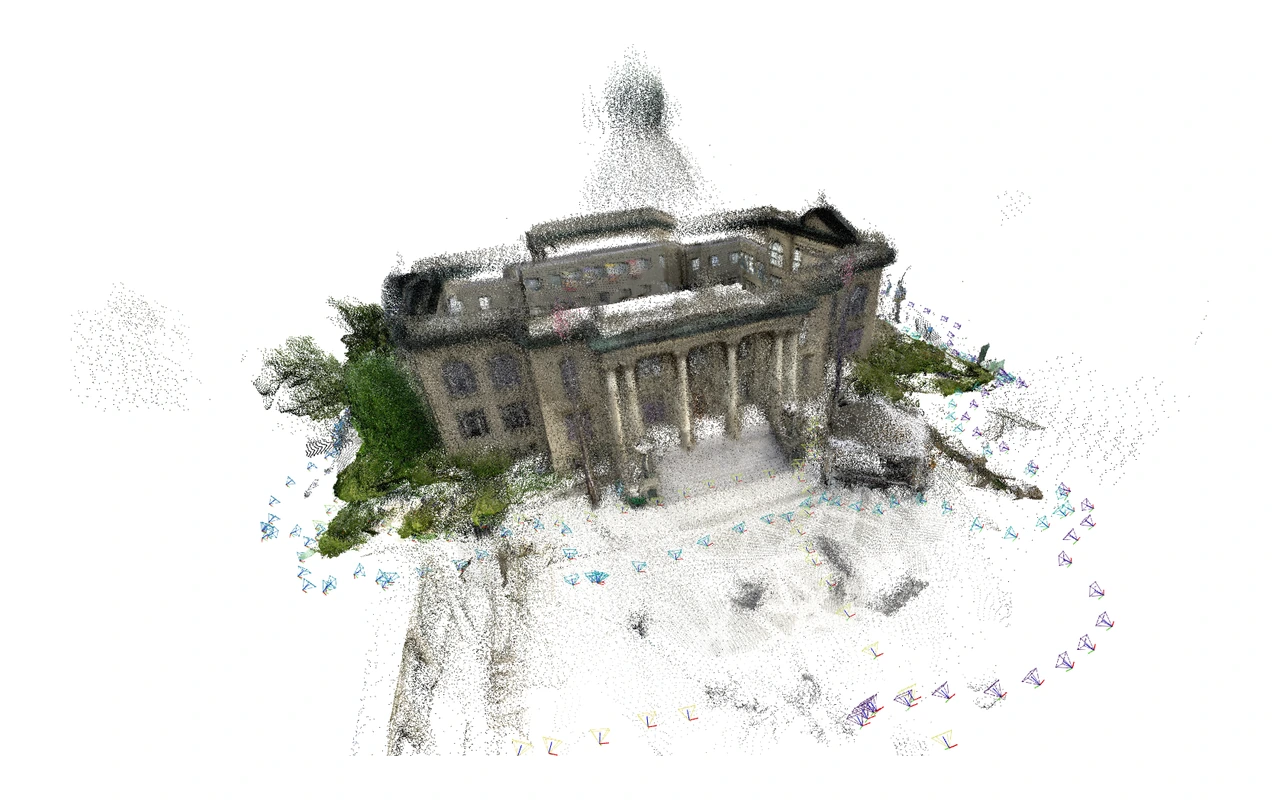
Robbyant, the embodied AI company within Ant Group, has open-sourced two models that give robots something close to spatial memory: LingBot-Map 2.0, for streaming 3D reconstruction, and LingBot-Navi, for navigation with memory. The announcement came on Thursday (November 26), with technical reports, code, model weights and a dataset of 511 real-world captured scenes.
The two models attack a double problem. On long routes, mapping accumulates errors — drift — that external correction tools never feed back into the model's internal memory. And navigation systems usually wipe the map at the end of each task, forcing the robot to re-explore from scratch places it already knows. Robbyant calls this “cross-task amnesia”.
LingBot-Map 2.0: correcting memory, not just the trajectory
LingBot-Map 2.0 is the successor to version 1.0, released in April 2026. The novelty is native error correction during inference, through a mechanism called Geometric Context Reshaping (GCR), inspired by memory reconsolidation in the human brain: the model reuses already-extracted local geometry and realigns high-level historical memory without re-encoding images — and without relying on external place-recognition modules or pose-graph optimization.
The model also uses LingBot-Vision, Robbyant's visual foundation model, to detect boundaries with sub-pixel precision and cut geometric errors off at the source.
In the company's published figures, the model runs at 27.51 frames per second on a single NVIDIA RTX 5090 GPU. On a long-distance urban test from the VBR benchmark — 5.2 km and nearly 19,000 frames — average trajectory error fell from 31.12 metres in version 1.0 to 4.72 metres, a reduction of almost 85% and more than twice as accurate as the best external loop-closure solution (9.98 metres). On the Oxford and KITTI benchmarks, error came in at 3.92 and 9.42 metres, and the model took first place in three dense 3D reconstruction benchmarks: CroCoDL, EuRoC and Oxford.
LingBot-Navi: the robot remembers where it has been
Built on LingBot-Map 2.0's 3D perception, LingBot-Navi keeps a persistent spatial memory across missions: instead of wiping the map, it retains objects and locations and, given a natural-language command, plans direct routes without re-exploring the environment. With every operation, the model refines its understanding of the surroundings — and it can run on-device, keeping commands and scene data local, for latency and privacy.
In simulations on the GOAT-Bench subset, LingBot-Navi reached 68.60% success, 10.36 percentage points above the best of six compared methods. In end-to-end tests — where the model plans the path and drives the movement itself — it reached 56.09% on GOAT-Bench and 32.36% on Robbyant's proprietary dataset, reconstructed from 36 real-world sites. And simply upgrading the mapping engine from version 1.0 to 2.0 raised navigation success by 4.15 and 2.35 percentage points on two evaluation sets, without retraining the navigation model.
Open source — with a caveat about the numbers
Technical reports, code, the Pure Streaming model weights for LingBot-Map 2.0 and LingBot-Navi, and the dataset of 511 real-world scenes were released to the community, with project pages, GitHub repositories and Hugging Face collections. Robbyant says the two models strengthen its “universal embodied AI brain” — from spatial perception to efficient navigation — with applications ranging from warehouse logistics and last-mile delivery to elderly care, medical assistance and household tasks.
The usual caveat applies: all performance figures are Robbyant's own, measured on its benchmarks, and have not yet been independently verified.
Image: 3D reconstruction of a building generated by LingBot-Map 2.0. Credit: Robbyant / Ant Group.
Sources
- Business Wire — Robbyant Open-Sources LingBot-Map 2.0 and LingBot-Navi
- GitHub — Robbyant/lingbot-map-v2
- Robbyant — LingBot-Map 2.0 project page
Transparency note: this article was produced with the assistance of artificial intelligence, cross-checked against public posts on X and internet sources, and reviewed before publication. Please consult the original sources to confirm the information.
By Muse