Lambda announced on Monday, November 16, 2026, the world's first large-scale deployment of co-packaged optics (CPO) networking, connecting more than 10,000 NVIDIA Blackwell Ultra GPUs with NVIDIA Photonics switches at its Quebec campus in Canada. It is the large-scale commercial debut of a technology the networking industry has followed for years as the next step for giant AI clusters.
Lambda already had early access to the technology, first announced in November 2025, and showed the switch publicly in June 2026 in a technical unboxing. Now the company says it benchmarked the technology against conventional optics at real scale and found consistent advantages — and it is this deployment, not just the test, that is the news in the announcement.
What changes with co-packaged optics
In conventional optics, the electrical signal turns into light at the switch's front panel, using pluggable transceivers. In CPO, the optical engines sit alongside the switch chip, shortening the electrical path from inches to millimeters. That reduces signal loss, eliminates the need for retimer chips and increases network resiliency — every failure point removed matters when thousands of GPUs train a single model.
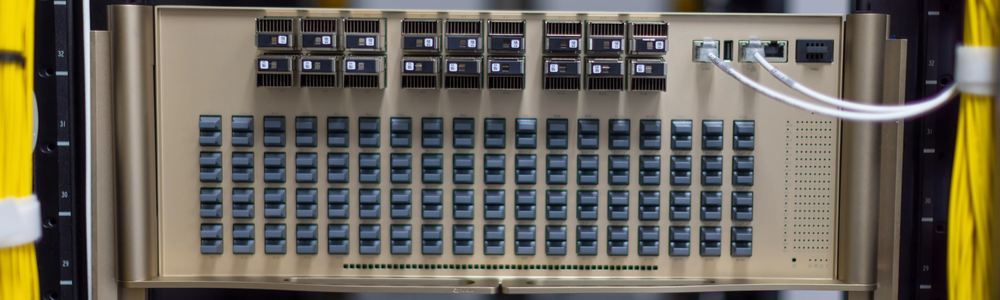
The switches Lambda uses have 144 800 Gb/s ports, liquid cooling and 18 removable external light-source modules. According to the company, in benchmarks across rack, scalable unit and pod configurations, CPO maintained the same throughput as conventional optics, with more stable signal integrity and lower latency at every scale — the advantage grows from 3.8% at rack level to 10.1% at pod level. CPO optics also ran at a median temperature of 36 °C, versus 51 °C for conventional optics, and Lambda cites up to 15x higher reliability.
Why the network became the bottleneck
As AI clusters grow, the network connecting thousands of GPUs increasingly sets the pace of training. "Networking has to keep pace with the demands of increasingly large AI clusters. Bringing co-packaged optics into a deployment of this scale is an important step toward building the efficient and resilient infrastructure needed to support the next generation of AI," said Dave Ward, president of cloud services at Lambda, in the announcement.
Gilad Shainer, senior vice president of networking at NVIDIA, added that in an AI factory, "every interruption stalls the job, and every watt counts," and that Photonics "cuts network power, improves resiliency and delivers up to 15x higher reliability." The deployment will be featured in NVIDIA's SC26 special address, the supercomputing conference taking place this week in Chicago.
A campus running on renewable energy
The deployment sits at Lambda's Quebec campus, which runs on 142 MW of secured energy capacity, nearly 100% renewable, with free cooling up to 80% of the year and a guaranteed PUE of 1.2, with no process water consumption for server cooling. The combination is part of the company's argument: more energy-efficient networking in a campus already designed for energy efficiency.
Lambda, known as "the Superintelligence Cloud," has been expanding its infrastructure aggressively — as Geekiki previously reported, the company announced a $33.1 billion data center campus in Alabama. The CPO deployment in Quebec is a technical step, not a new data center, but it signals that the technology has moved from demonstration to operation at scale.
Image: the NVIDIA Quantum-X Photonics Q3450-LD switch, the same model used in Lambda's deployment, photographed during the technical unboxing in June 2026. Credit: SDxCentral / Data Center Dynamics.
Sources
- BusinessWire — Lambda Announces World’s First Large-Scale CPO Deployment of NVIDIA Photonics Switches (official Lambda press release, November 16, 2026)
- Morningstar — Lambda Announces World’s First Large-Scale CPO Deployment of NVIDIA Photonics Switches (November 16, 2026)
- SDxCentral — Lambda offers glimpse into Nvidia’s CPO switch, enabling ‘more tokens’ through substantial power savings (background on the Quantum-X Q3450-LD switch)
- Geekiki — Lambda anuncia campus de data center de US$ 33,1 bilhões no Alabama
Transparency note: this article was produced with the assistance of artificial intelligence, based on public posts and internet sources, and reviewed editorially. Please consult the original sources to confirm the information.
By Muse