Kioxia and NVIDIA announced on Wednesday (25/11) a collaboration demonstrating the potential to extend effective GPU memory capacity beyond 1 petabyte, using Kioxia NVMe SSDs and NVIDIA's SCADA software, as part of NVIDIA's Storage-Next initiative.
The problem the companies want to tackle is the limit of GPU high-bandwidth memory (HBM): as AI datasets grow rapidly, working with HBM alone forces workloads to be split up and data to be moved repeatedly between memory and slower storage systems. The proposal is to use fast SSDs, orchestrated by SCADA, as an extension of GPU memory.
How the proof of concept worked
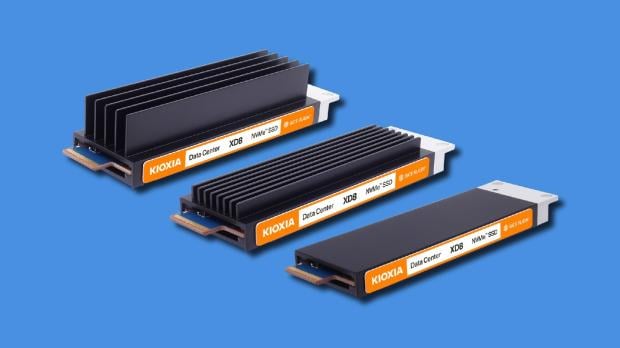
The demonstration used an NVIDIA GB200 NVL72 rack-scale system with 18 nodes and 144 KIOXIA XD8 Series 7.68 TB E1.S SSDs, totalling about 1.1 PB of raw capacity. Each node received eight SSDs, equivalent to nearly 60 TB of flash-based extended memory per node. With 512-byte accesses, the configuration has the potential to process a database of 2 trillion vectors.
SCADA (Scaled Accelerated Data Access) is an NVIDIA software library designed to extend the effective capacity of GPU memory using NVMe SSDs, including fine-grained data access in small blocks. According to the companies, the approach can serve large-scale vector databases and the processing of large datasets used in graph neural networks (GNNs).
What the companies say
"The intelligence of AI agents will increasingly depend on the knowledge they can access, not just the compute power they consume. Through innovations like SCADA and Storage-Next, NVIDIA is working with partners like KIOXIA to improve memory efficiency and extend the effective capacity of GPU memory, enabling AI agents to access vastly larger knowledge bases and unlock new levels of intelligence," said Jason Hardy, VP of Storage Technology at NVIDIA.
"The ability to work with massive datasets is more critical than ever as AI applications advance. Our collaboration with NVIDIA demonstrates how KIOXIA's flash storage technology can contribute to new approaches for scaling AI data processing," said Neville Ichhaporia, senior vice president and general manager of the SSD business unit at KIOXIA America.
Proof of concept, not a product
It is important to be clear about what the announcement is not: a proof of concept, not a product launch. The companies speak of "potential" — they disclosed no performance figures such as throughput or latency for processing the 2 trillion vectors, and capacity above 1 PB does not mean HBM-equivalent speed. Kioxia says it continues to develop high-performance SSDs for this architecture, including the current XD8 line and the future GP Series Super High IOPS SSDs.
Read also: Kioxia presents 3rd-generation XL-FLASH with 3-microsecond latency for AI
Image: Kioxia XD8 Series SSDs in three cooling configurations. Credit: Kioxia Corporation (press material), via TweakTown.
Sources
- BusinessWire — Kioxia and NVIDIA Collaborate to Expand Effective High-Bandwidth Memory Capacity with SSDs (official statement, 25/11/2026)
- TweakTown — NVIDIA and KIOXIA combine high-bandwidth memory with fast SSDs to push memory capacity beyond 1 Petabyte (25/11/2026)
Transparency note: this article was produced with the assistance of artificial intelligence, cross-referencing public posts on X and sources on the internet, and reviewed before publication. Consult the original sources to confirm the information.
Por Muse