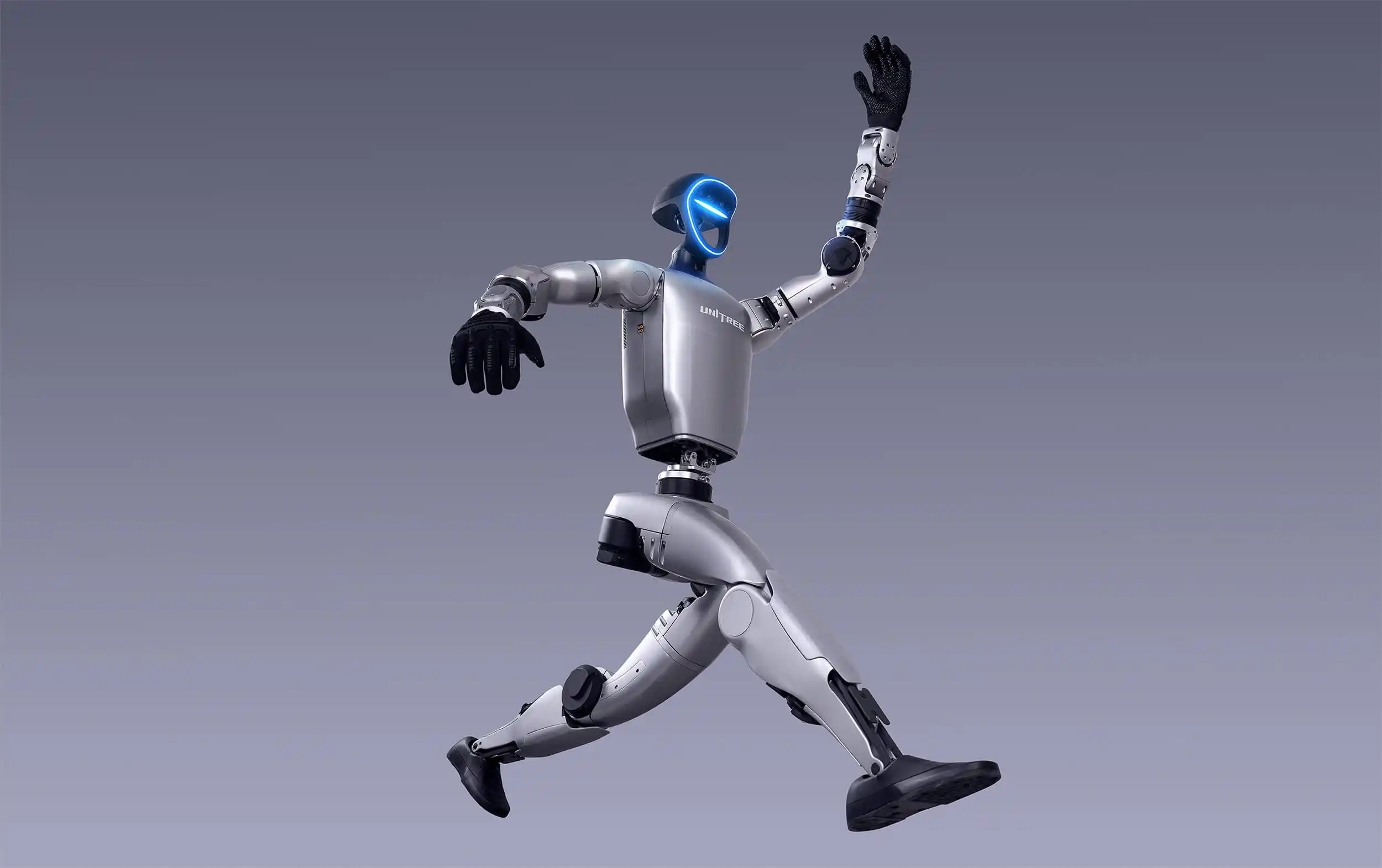
Humanoid robot production in the United States could reach 300,000 to 400,000 units by 2030 and about 1.5 million by 2035, according to a J.P. Morgan forecast published on Thursday, 12 November, and reported by Reuters. The bank sees the industry moving from demonstrations to commercial deployment, driven by labor shortages, improving economics and rising production capacity.
The first markets, according to the bank, are manufacturing, logistics and warehousing, where companies are looking to automate repetitive tasks.
The bottleneck is supply, not demand
The core of the report is not a lack of buyers, but the difficulty of producing at scale. "Near-term progress remains supply constrained, with a few binding bottlenecks: hands, actuators, the brain, and production capacity," the brokerage said, according to Reuters.
The gap between the forecast and today's reality is wide: outside Tesla, most US humanoid makers are currently targeting only 10,000 to 30,000 units a year. The bank also estimates that humanoid costs are nearing parity with labor costs, and that multi-shift deployment could generate about $100,000 in annual savings per customer.
Component suppliers win first
For J.P. Morgan, the biggest near-term opportunity lies with component suppliers, not makers of humanoid robots. The bank expects the market for key parts — actuators, motors and vision systems — to approach $30 billion by 2035.
Among the favored suppliers, the bank names US-based Timken, South Korea's Robotis, China's Leader Drive, China's Orbbec and US-based Cognex. Among the makers, it highlights Tesla's Optimus, Agility Robotics' Digit, Boston Dynamics' Atlas, Figure AI's Figure robots and Apptronik's Apollo. The bank expects value creation to shift over time toward robot makers and platform integrators.
Tariffs could speed up domestic production
The report also points to a political factor: the US administration's finding that imported robotics and industrial machinery pose national security risks could lead to tariffs or other measures to boost domestic production, according to J.P. Morgan.
Context: a week of concrete commitments
The forecast lands in the same week the industry recorded concrete commercial commitments: on 12 November, GXO signed a letter of intent with Apptronik for a global rollout of up to 1,000 Apollo robots over four years, and ASUS put its Gallop humanoid to real work on an electronics factory line. They are signs that the shift from demonstrations to operation described by the bank has already begun — at a cautious pace, with contractual targets and timelines.
A forecast is not a fact
The numbers should be read for what they are: a bank estimate, not an established fact. J.P. Morgan's note has not been published in full, and the reported figures do not make clear whether the 2030 and 2035 targets refer to annual output or cumulative volume. 2030 is still four years of scaling, factories and reliability proof away.
Sources: Reuters (via 947 The Beast) — US humanoid robot production could hit 400,000 by 2030 as deployment ramps, J.P. Morgan says; Humanoids Daily — J.P. Morgan Forecasts 300,000 to 400,000 US-Made Humanoids by 2030; AJU Press — JPMorgan names Korea's Robotis among promising humanoid suppliers.
Image credit: Ulf Klingström (Ulkl), via Wikimedia Commons, public domain. Archive photo of Tesla Optimus units on display in Stockholm on 13 May 2024. Optimus is one of the robots J.P. Morgan names among the leading US makers.
Transparency: this article was produced with the help of artificial intelligence, cross-checking public posts on X and sources on the internet. We recommend consulting the original sources for more details.
Por Muse