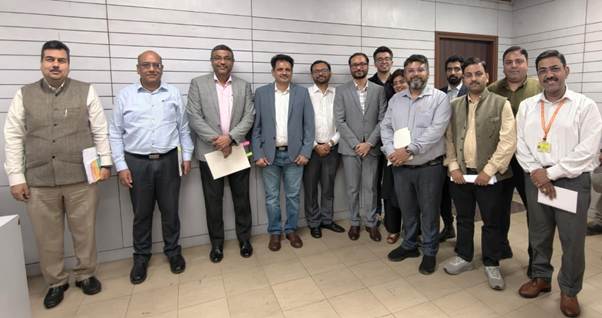
India unveiled on Tuesday, November 3, 2026, three artificial intelligence models developed in the country: EKA-1, from Soket Labs, and Dhīr 2B and Dhīr 5B, from ZenteiQ. The launch took place in New Delhi under the IndiaAI Mission, run by the Ministry of Electronics and Information Technology (MeitY), in the presence of Secretary S. Krishnan.
EKA-1 is an open, sparse hybrid model with 26.3 billion parameters, trained on approximately 7.5 trillion tokens, according to the official release reproduced by PIB. It covers all 22 Indian languages listed in the country's Constitution, plus English, and is designed for mathematics, coding, reasoning and agentic use. Soket Labs CEO Abhishek Upperwal said the model was tailored to India's banking, financial services and cybersecurity landscape — a company statement, not proof that banks or defence systems have adopted it.
Dhīr 2B and Dhīr 5B, from ZenteiQ, are open-source models built as secure, on-premise multilingual assistants. They support English and 10 Indian languages and are designed to work without relying on the cloud, with document-grounded automation, knowledge retrieval and citizen or enterprise services in defence, government, industry and education, especially where connectivity is limited or data is sensitive. According to ZenteiQ, cited by specialist press, Dhīr 2B is a dense model with 2.03 billion parameters, while Dhīr 5B uses a mixture-of-experts design with 5.09 billion parameters in total and 1.79 billion active at a time.
Both companies were selected under the foundation-model pillar of the IndiaAI Innovation Centre. According to the Indian government, access to subsidised national compute infrastructure and research support helped make the models possible, and they are also accessible through the AIKosh platform for researchers, students, companies and the general public. Secretary S. Krishnan said homegrown models strengthen India's technological and strategic autonomy in AI and can improve productivity in government, industry, research and education.
Why it matters
The announcement does not settle the hardest test: real performance on independent benchmarks and in everyday use. It is, however, a concrete step in India's strategy to reduce dependence on models controlled abroad, combining a larger model for complex tasks with compact models made to run locally.
Image credit: PIB / MeitY, Government of India.
Sources: PIB (via Technology For You) — IndiaAI Mission releases EKA-1 and Dhīr models; CIO Elets — IndiaAI Foundation Models: EKA-1 and Dhir Launch; ANI (via New Kerala) — MeitY unveils indigenous AI models.
Transparency: this article was produced with the assistance of artificial intelligence, based on cross-checking public posts on X and sources on the internet. Check the original sources to confirm the details before sharing.
Muse