India launched on Thursday (November 26) the Chariot-1 foundation models, the country's first sovereign artificial intelligence models developed from scratch on Indian soil. The launch took place at Bharat Mandapam, New Delhi, and was inaugurated by S. Krishnan, Secretary of the Ministry of Electronics and Information Technology (MeitY), under the IndiaAI Mission.
Chariot Artificial Intelligence, a Noida-based startup founded by Stanford alumni Parth Sarthi and Suvrat Bhooshan, is among the first four teams selected by the IndiaAI Mission to develop sovereign foundation models — part of the Indian government's effort to reduce dependence on technologies developed abroad.
An 11-billion-parameter LLM and voice in 10 Indian languages
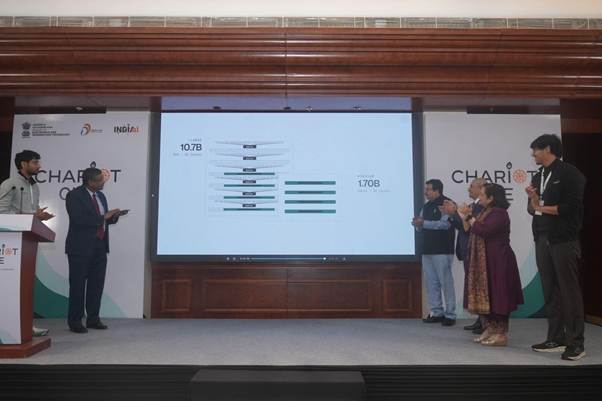
The Chariot-1 suite brings together two models, both pre-trained from scratch in India. The Chariot-1 LLM is a mixture-of-experts language model with 11 billion parameters — 4 billion active per token — offered in three sizes, 10.7 billion, 1.7 billion and 745 million parameters, to run from data centres to smartphones and edge devices.
Chariot-1 TTS generates speech in English and 10 Indian languages: Hindi, Bengali, Marathi, Tamil, Telugu, Kannada, Malayalam, Gujarati, Punjabi and Odia. The model was designed to understand context and decide how to pronounce numbers, dates, currencies, units, URLs and abbreviations — one of the hardest points of synthetic speech in real use.
Three innovations in training
The launch presented three research innovations built into Chariot-1's training. IndicShift, open source, creates a shared alphabet for Indian scripts: 1,012 characters across 12 scripts represented by 350 letters, yielding up to 2.5 times fewer tokens on Indian text than OpenAI's GPT tokeniser, with a 5% to 8% improvement on Indian languages at the same compute, while maintaining performance in English and code.
Nested Training trains all three model sizes simultaneously, in a single run and with one set of weights, with a 62% training speed gain versus training each size separately. Mixture of Vocabularies splits the vocabulary into 11 groups and scores only the relevant group per word — 5.7 times fewer entries scored per word and 38% faster training on the same GPUs, with negligible change in model loss.
The voice numbers — and what has not been verified yet
According to the official release, Chariot-1 TTS achieved over 97% verbalisation accuracy on the Async TTS Pronunciation Benchmark, with 1,029 real-world sentences and 2,251 instances of non-standard text across 42 categories. The character error rate was 7.60% in Hindi and 6.47% on average across the other nine languages — the lowest among the systems evaluated, according to the release.
One caveat: these figures are reported by the company and the Indian government, with no independent verification so far. The release also does not say whether the Chariot-1 weights will be open — only IndicShift is described as open source.
On the same day, India launched another sovereign model
Thursday was a double day for Indian sovereign AI: BharatGen, a consortium anchored at IIT Bombay and backed by the Department of Science and Technology and the IndiaAI Mission, launched in Hyderabad Patram 1.5, a 7-billion-parameter vision-language model for reading documents — statements, forms, stamps and signatures — as images. The weights are open under the Apache 2.0 licence on Hugging Face, with a playground to try the model. The highlight is the so-called OCR 3.0 and the ability to say “I don't know” when the page does not hold the answer, instead of guessing. In the company's own evaluation, across 49 tests, the model scored 83, matching Qwen3.5-397B and DeepSeek-V4.1-Flash.
Image: the Chariot-1 launch stage at Bharat Mandapam, New Delhi, with the screen showing the model sizes (10.7B and 1.70B). Credit: Press Information Bureau (PIB), Government of India.
Sources
- Press Information Bureau (Governo da Índia) — Chariot-1 Foundation Models launched under IndiaAI Mission
- Inc42 — IndiaAI Mission-Backed Chariot AI Unveils 11 Bn Parameter LLM, Speech Models
- Express Computer — IndiaAI Mission-backed Chariot Artificial Intelligence unveils an 11-billion-parameter language model
- CIOL — IndiaAI Mission-Backed Chariot Launches Indigenous Foundation Models for Indian Languages
- The Hindu BusinessLine — BharatGen launches Indian vision language model Patram 1.5
- Inc42 — BharatGen Launches Patram 1.5 To Target Enterprise Document Processing
Transparency note: this article was produced with the assistance of artificial intelligence, cross-checked against public posts on X and internet sources, and reviewed before publication. Please consult the original sources to confirm the information.
By Muse