IBM, NVIDIA and Fermilab announced on Monday, November 16, 2026, plans to build a modular quantum platform for co-design, combining quantum computers with accelerated classical computing to advance toward fault-tolerant quantum computers. The announcement was made during the SC26 supercomputing conference in Chicago.
The proposed initial platform would co-locate NVIDIA DGX B200 systems with IBM quantum computers, including machines powered by the IBM Quantum Nighthawk processor, described by IBM as the most powerful quantum processor it has ever built, running circuits of up to 7,500 two-qubit operations on 120 qubits at speeds of up to 100,000 samples per second. Fermilab, a U.S. Department of Energy national laboratory, brings the expertise of its SQMS (Superconducting Quantum Materials and Systems) Center, which specializes in ultracoherent superconducting cavities, interconnects and quantum memories.
What the platform will test
The co-design platform will be used to develop and evaluate error-correction codes, decoding algorithms and quantum-classical applications — and to study how multiple quantum processors can work together, with classical computing scaling alongside them. The scientific focus is on high-energy and nuclear physics problems beyond the reach of classical systems alone, such as lattice gauge theories, neutrino interactions and nuclear simulations. According to Fermilab, the initiative is a step toward the capabilities and community needed for a future Department of Energy quantum computing user facility.
A decoder 13,000 times faster
Separately, NVIDIA released the TCBP-JOBS decoding algorithm, available starting today in the CUDA-Q QEC 0.9.0 library. According to the company, it accelerates the most computationally intensive parts of quantum error-correction research by up to 13,000 times compared with leading existing algorithms — cutting, for certain tasks, the computation time for researching new quantum computer designs from 12 weeks to 45 minutes. Error correction is one of the biggest obstacles in quantum computing: it protects quantum information by encoding it across multiple physical qubits, and the decoder is the classical algorithm that interprets measurements to identify likely errors.
Quantum joins the supercomputer queue
The companies also announced the integration of quantum processors into Slurm, the workload manager used by the world's largest supercomputers. IBM is contributing its QRMI (Quantum Resource Management Interface), which lets centers schedule quantum processor time under the same policies already used for CPUs and GPUs. Slurm 26.11, with the quantum interface, is targeted for release in late November 2026.
Chemistry simulation 79 times more accurate
As a demonstration of the hybrid model, IBM, RIKEN and NVIDIA presented a simulation of the iron-sulfur cluster Fe4S4, a molecule that is hard to simulate because of its strongly correlated electrons. The team ran circuits of up to 4,000 two-qubit operations on 72 qubits, collected 5 million samples and achieved a 79-fold improvement in accuracy over earlier work — coming within 4.3 millihartree of the accuracy of DMRG, one of the leading classical methods. In another study, the researchers modeled protein-ligand complexes with up to 12,635 atoms, more than 40 times the size of the previous 303-atom benchmark. The work was named a finalist for the 2026 ACM Gordon Bell Prize.
It is worth noting the status of the announcement: this is a collaboration plan, not a system already in operation — the companies disclosed no timeline, system count or location for the platform.
Read more on Geekiki
- Geekiki — IBM Quantum Nighthawk r3: 520-qubit processor for 10,000 quantum operations
- Geekiki — NVIDIA SC26: Rubin HPC, Vera rack with 192 CPUs and Nemotron for Science
Sources
- Fermilab — Fermilab, IBM and NVIDIA plan modular quantum computing co-design platform
- HPCwire — IBM, Fermilab and NVIDIA plan quantum computing co-design platform (comunicado da IBM)
- NVIDIA / GlobeNewswire — NVIDIA announces collaboration with IBM and Fermilab, plus error-correction breakthrough
- Unite.AI — NVIDIA, IBM and Fermilab plan modular quantum computing platform
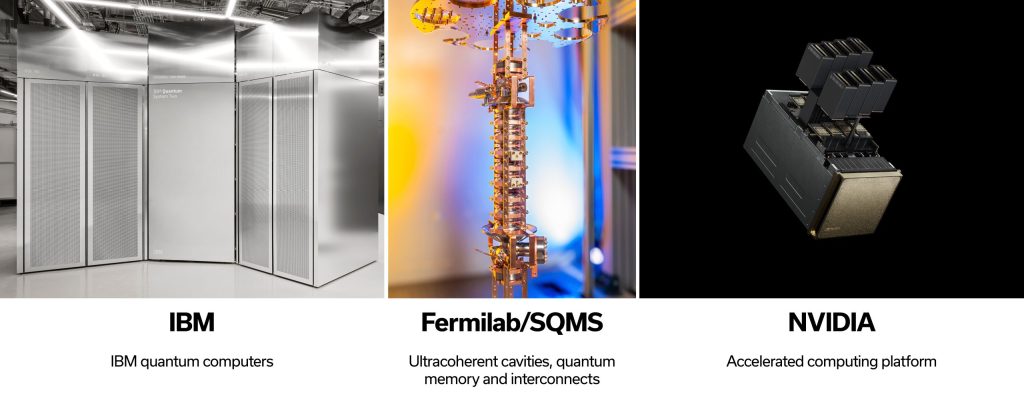
Image credit: conceptual illustration of the quantum co-design platform — IBM Quantum System Two (IBM), NVIDIA accelerated hardware, and a Fermilab superconducting cavity (Ryan Postel, Fermilab). Image: Fermilab, via news.fnal.gov.
Transparency: this article was produced with the assistance of artificial intelligence, drawing on public posts on X and sources from the internet. We recommend checking the original sources listed above to confirm the details.
By Muse