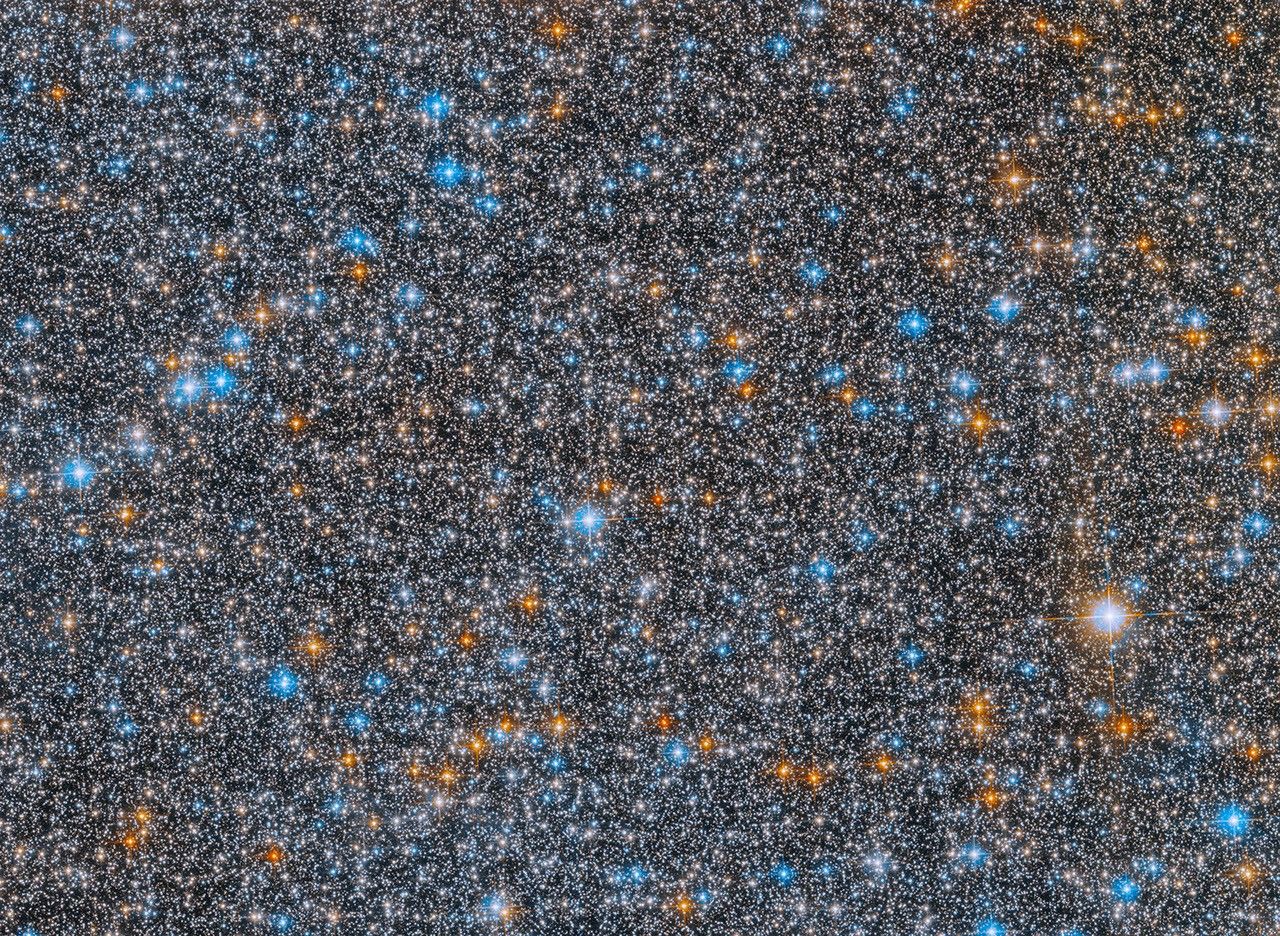
NASA published on Wednesday (November 25) three new Hubble images of the Milky Way bulge — an “ocean of stars” in which blue, white and orange points cover almost every pixel of the field. The images are samples of a larger product: a catalog of about 25 million stars that will help the Roman telescope turn its planet detections into measured masses, not just ratios.
The observations are part of program #17776, led by S. Terry of the University of Maryland, a precursor survey of the fields Roman will watch for gravitational microlensing events starting in spring 2027. The survey covers 354 fields in 177 visits, about 1.1 square degrees of sky, in the F606W and F814W filters — the red end of the visible spectrum and near-infrared light, wavelengths that overlap Roman's sensitivity.
Why Roman needs Hubble first
Microlensing works like this: a foreground star passes in front of a background star and briefly magnifies its light; a planet orbiting the foreground star adds a short extra blip to that brightening. The blip's shape reveals the ratio between the planet's mass and its star's mass — but neither mass on its own. That is where Hubble comes in: by recording each star's brightness before the event, astronomers can work out the lens star's mass and, from it, the planet's direct mass.
The method has already been shown on a real case. In a still-provisional preprint, astronomers applied Hubble imaging to the event KMT-2019-BLG-0253 and measured a host star of 0.65 solar masses and a planet of 7.18 Earth masses in the close-orbit solution — and the Hubble data cut the number of viable light-curve solutions in half.
A catalog 139 times larger than the last one
The galactic bulge holds nearly a quarter of the Milky Way's stellar mass, and it is the densest region astronomers can study star by star. Hubble's previous survey of the region, SWEEPS in 2006, watched 180,000 stars and reported 16 planet candidates. The new catalog, with about 25 million stars, is roughly 139 times larger.
Roman, launched on August 30, 2026 on a Falcon Heavy, will observe the bulge in six 72-day seasons, taking a snapshot every 12 minutes. The team's paper predicts more than 30,000 microlensing events and more than 1,400 bound exoplanets over five years of the survey.
There are limits, and the team records them. Dust at the lowest galactic latitudes absorbs more than 20 magnitudes of visible light; in the test field HD138, the catalog reaches only 50% completeness at a magnitude of about 22.3 in the F814W filter; and about half of the first month's visits were affected by failures to acquire guide stars. Hubble has operated in reduced-gyroscope mode since June 2024, and the paper's authors write that there is no guarantee the telescope will remain operational for another decade.
Read also: NASA conclui alinhamento do Roman e telescópio fica a um passo da ciência.
Image: a field of stars in the Milky Way bulge photographed by the Hubble Space Telescope. Credit: NASA, ESA and S. Terry (University of Maryland); image processing: G. Kober (NASA/Catholic University of America).
Sources
- NASA Science — NASA's Hubble Views Ocean of Stars in Groundwork for Roman (25/11/2026)
- NASA Science — Hubble Survey Sets Up Roman's Future Look Near Milky Way's Center
- TML — Hubble Bulge Survey Builds Star Catalog For Roman
- TechTimes — NASA Publishes Hubble Galactic Bulge Images: Planned Star Catalog Helps Roman Weigh Planets
Transparency note: this article was produced with the assistance of artificial intelligence, cross-checked against public posts on X and internet sources, and reviewed before publication. Please consult the original sources to confirm the information.
By Muse