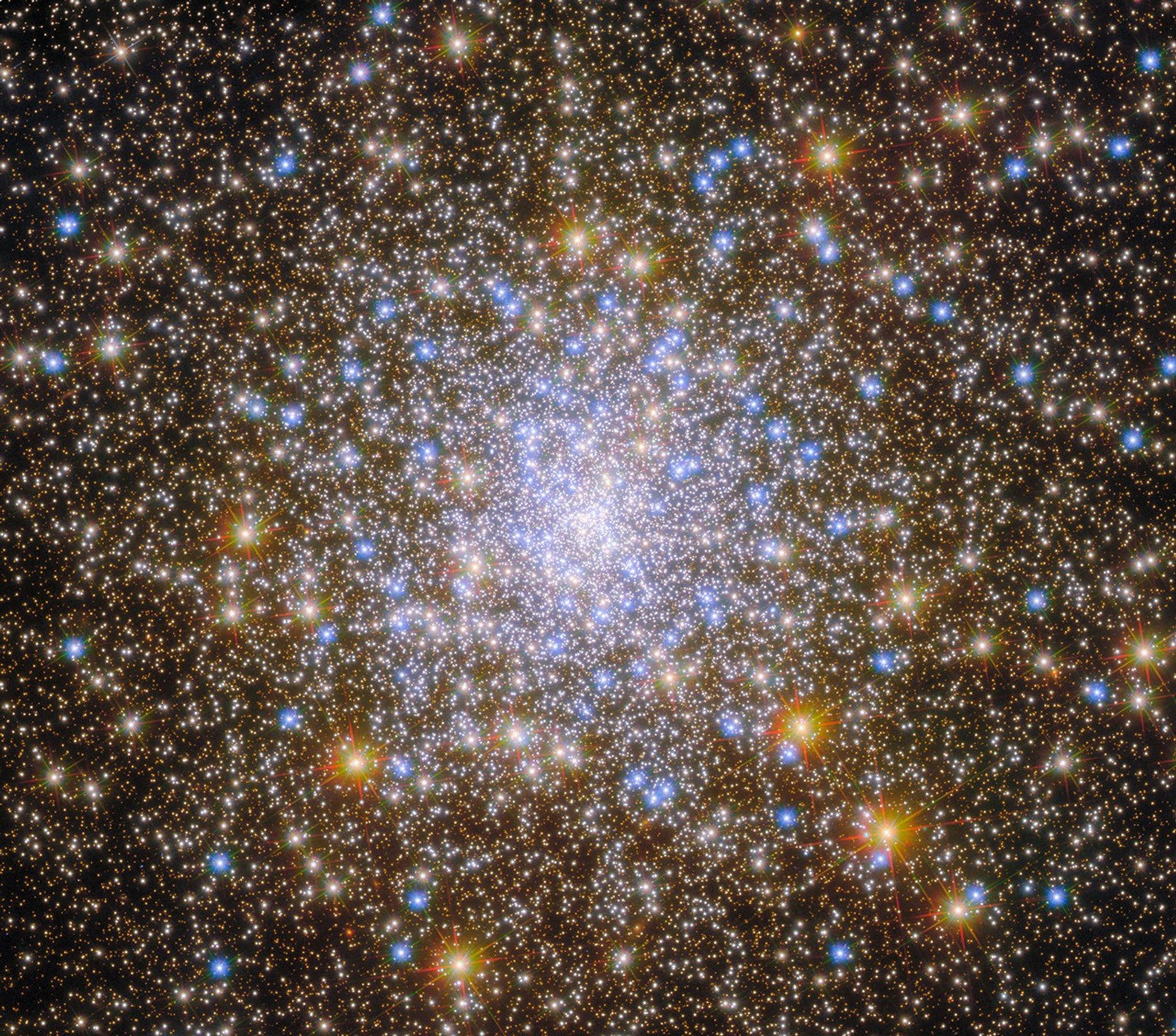
A new image from the Hubble Space Telescope, released by NASA on November 5, 2026, turns the globular cluster Messier 30 (M30) into a lesson in galactic history. The image combines data from three Hubble observing programs spanning 15 years and brings together ultraviolet, visible and near-infrared light — a portrait that helps astronomers understand how the Milky Way formed.
M30, also known as NGC 7099, lies about 27,500 light-years from Earth in the constellation Capricornus and was discovered by French astronomer Charles Messier in 1764. It is a globular cluster: a roughly spherical grouping of tens of thousands to millions of stars. The Milky Way has at least 150 such clusters, and astronomers estimate they are between 11.5 and 13.5 billion years old — nearly as old as the universe itself.
A possible Milky Way 'immigrant'
The most intriguing detail is M30's orbit. Researchers have discovered that M30 and many other globular clusters orbit in the opposite direction to our galaxy's spin. That suggests — as a hypothesis, not a proven fact — that these clusters may not have formed inside the Milky Way at all, and instead may have been captured by it in the distant past.
Globular clusters act as time capsules: because they are so ancient, they preserve the original chemistry of our young galaxy. More than a century ago, astronomer Harlow Shapley used observations of this kind of cluster to show that the Sun is not at the center of the galaxy — and that the galactic center lies toward the constellation Sagittarius.
Three programs, 15 years of data
Hubble has observed Messier 30 multiple times. An early program (#10775, led by Sarajedini) used the Advanced Camera for Surveys in red and near-infrared light, revealing stars down to just 20% of the Sun's mass. A second program (#13297, led by Piotto) returned to Messier 30 with the Wide Field Camera 3 and bluer filters, collecting data critical for studying the exotic 'blue stragglers' and the multiple populations of stars that can inhabit a single cluster. More recently, a third program (#16298, led by Libralato) observed the clusters again to track how different populations of stars moved over the 15 years since Hubble first observed them — a feat made possible by Hubble's longevity and its ability to discern fantastically small details in distant objects.
The image released now was created with data from all three programs and includes the full range of wavelengths Hubble can see. Each wavelength helps us better understand how these groups of stars formed and evolved.
Featured image: the globular cluster Messier 30 (M30), photographed by the NASA/ESA Hubble Space Telescope. Credit: ESA/Hubble & NASA, M. Libralato, G. Piotto, A. Sarajedini.
Sources
- NASA — Hubble Learns Galactic History From Stars
- Phys.org — Hubble learns galactic history from stars
This article was produced with the assistance of artificial intelligence, cross-referencing public posts on X and sources from the internet. We recommend consulting the original sources for more details.
By Muse