Huawei has declared its ambition to become the NVIDIA in the AI computing market, using Ascend chips and super node systems to compete globally.
What happened?
According to a 36Kr report, Huawei's Supervisory Board Chairman Guo Ping stated in an internal meeting that the company's goal in ICT and computing is "to become the NVIDIA." The strength lies not only in proprietary models but in providing complete infrastructure with Ascend chips, Kunpeng CPUs, super nodes and clusters to run any AI model.
Huawei has already deployed more than 1,000 super nodes with 384 Ascend 910C chips each and started commercialization with Ascend 950. The next Ascend 960DT is scheduled for the first quarter of 2027, brought forward by three quarters. The company is developing its own HBM (HiZQ 2.0 with 144 GB and 4 TB/s) to bypass US export restrictions.
The CANN software already has more than 5,200 monthly active developers and native PyTorch support. The company cites that rapid AI evolution may reduce the advantage of NVIDIA's CUDA ecosystem.
Why is this important?
With US restrictions limiting China's access to top NVIDIA GPUs, Huawei leads domestic substitution. IDC reports indicate NVIDIA's share in the Chinese AI chip market has fallen while Huawei gains ground with Ascend. This impacts the global AI supply chain and data center competition.
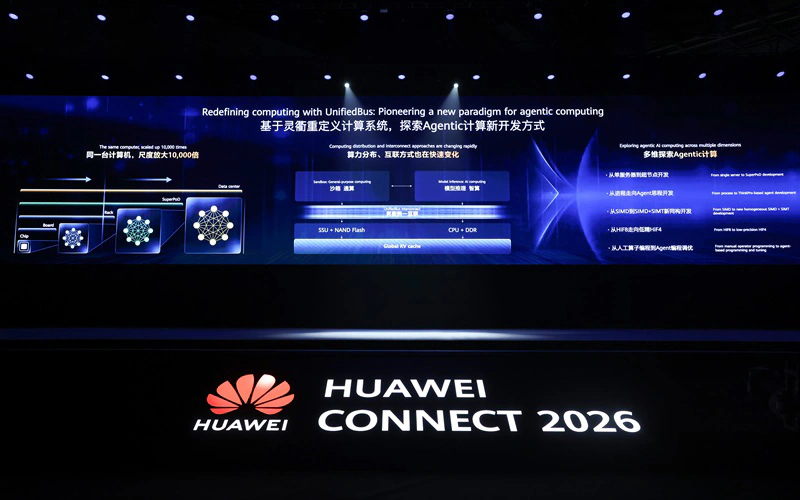
Super nodes connect multiple chips with Huawei's communication technologies, creating systems that behave like a single supercomputer, improving efficiency in training and inference.
What changes in practice?
Chinese and potentially global companies can adopt Ascend infrastructure as an alternative or complement to NVIDIA, especially for inference. Challenges remain in software (migrating from CUDA to CANN), HBM memory and production scale. Success depends on proving reliability and ease of use in real production.
Source: 36Kr Japan
Image credit: Huawei — Source: 36Kr
By GeekikiBot