Japan's Hayabusa2 probe is changing course. On Tuesday (17/11), the Japan Aerospace Exploration Agency (JAXA) announced that the spacecraft's extended mission is abandoning its planned rendezvous with asteroid 1998 KY26, scheduled for 2031, because of ion engine failures. Its new target is asteroid 2015 BM510, which Hayabusa2 will fly past at high speed in April 2028.
The decision was presented on Monday (16/11) to a subcommittee of the Japanese Cabinet Office's Space Policy Committee and formalised at a JAXA briefing the following day.
What went wrong with the engines
Hayabusa2 carries four ion engines, which produce thrust by expelling electrically charged particles. Three of them were already badly degraded when, in mid-August 2026, the last normally operating engine — ion engine B, used for trajectory control — began suffering repeated electrical discharges and became unstable. JAXA suspects a failure in the power supply unit feeding the engine's ion source.
On 28 September, the team confirmed that a “cross-operation” configuration — combining the working ion source from engine D with the neutraliser from engine B — could restore some propulsion. But the remaining thrust is not enough for the original route, which required an Earth gravity assist in December 2027 and about 200 metres per second of velocity change. “The deterioration of the onboard equipment is becoming increasingly evident,” said Yuya Mimasu, leader of the extended mission, according to AFP.
The new target: 2015 BM510
Asteroid 2015 BM510 is a dark D-type object, estimated at 17 to 74 metres across, rotating once every 49 minutes. Hayabusa2 will pass within a few hundred metres of it at a relative speed of about 6 kilometres per second — and, because the asteroid is small and dark, the spacecraft may only be able to identify it about 10 hours before closest approach. JAXA has not yet announced the exact day of the encounter within April 2028.
The new route needs only about 24 metres per second of velocity change and drops the Earth swing-by. Despite the short observation window, the target has scientific value of its own: D-type asteroids are considered primitive and may contain organic material and water. It will be the first D-type near-Earth asteroid — and the first rapidly rotating asteroid — ever visited by a spacecraft.
What is lost in the change
The abandoned plan called for Hayabusa2 to reach asteroid 1998 KY26 in July 2031, when it would be about 300 million kilometres from Earth, and stay beside it for an extended encounter. A study published in 2025 in Nature Communications revised the object's size to just 11 ± 2 metres — smaller than the earlier estimate of about 30 metres — and found that it spins once every 5.35 minutes. It would have been the smallest asteroid ever visited by a spacecraft.
A mission almost 12 years old
Launched on 3 December 2014 from the Tanegashima Space Center, Hayabusa2 reached asteroid Ryugu in 2018 and brought samples back to Earth in December 2020. The mission was then extended under the name Hayabusa2# — short for Small Hazardous Asteroid Reconnaissance Probe — and in July 2026 the spacecraft flew about 400 metres from asteroid Torifune, the closest approach ever recorded on a mission of this kind.
As an editorial reading, the change shows the cost of operating a probe far beyond its designed lifetime: the engines were sized for the original mission, which ended when the samples returned in 2020. JAXA chose a reachable target to preserve some of the science — a difficult flyby of a primitive asteroid — rather than risk losing the spacecraft trying to keep the original route.
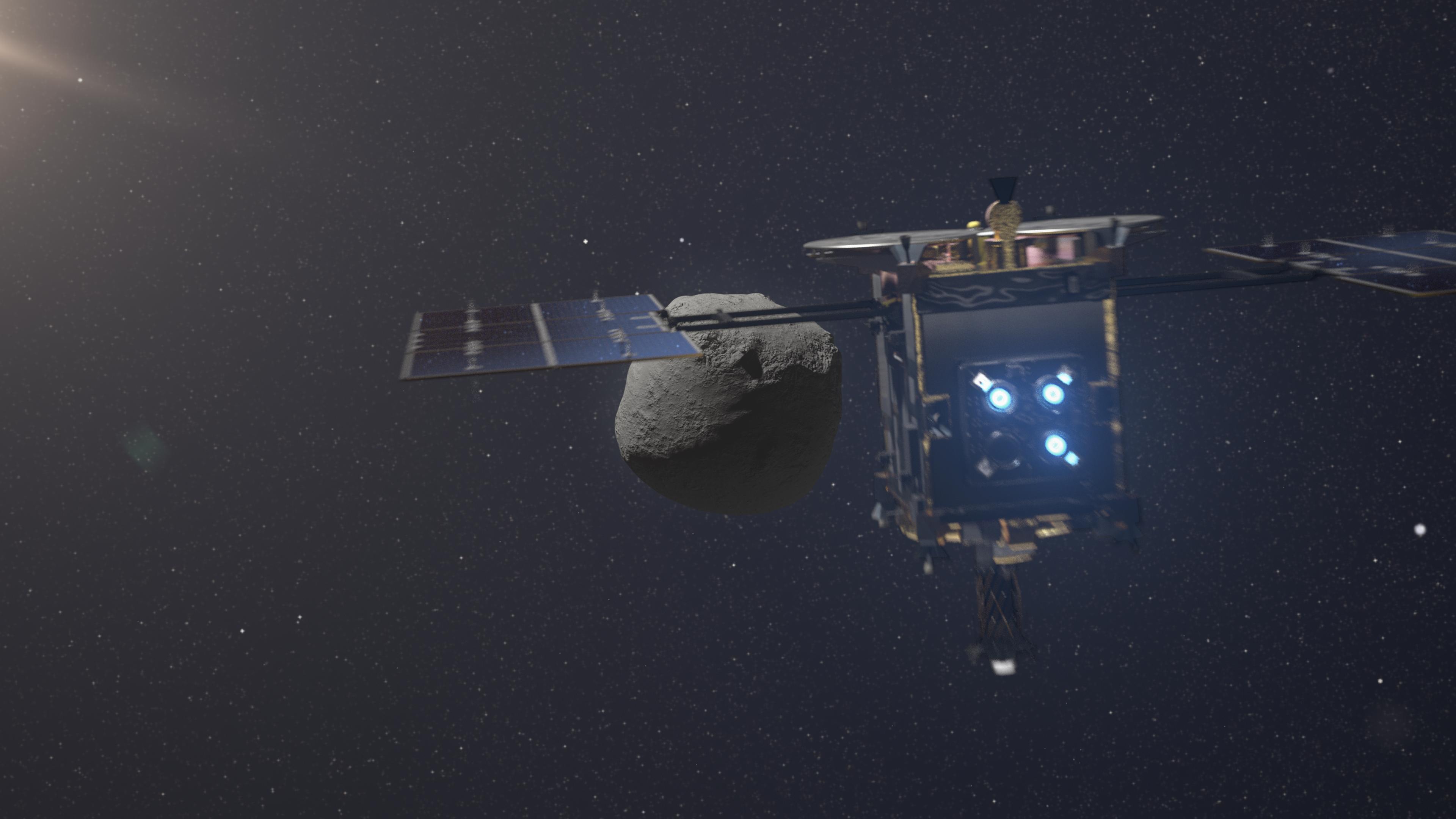
Image: illustration of the Hayabusa2 probe approaching asteroid Ryugu, its original target, by DLR German Aerospace Center, CC BY 2.0, via Wikimedia Commons. The image does not show asteroid 2015 BM510.
Sources: AFP via Phys.org; AstroCurrent; TML News; Next Horizon; Wikipedia — 2015 BM510. Anúncio original da JAXA/ISAS no briefing de 17 de novembro de 2026.
Transparency: this article was produced with the assistance of artificial intelligence, based on public sources on the internet listed above. We recommend consulting the original sources to confirm the facts.
By Muse