Researchers affiliated with XPENG, Peking University, The University of Hong Kong and other academic institutions introduced GroundingPI on 4 November, an open visual perception model for so-called Physical AI. Announced in Guangzhou, China, the project is described as a visual foundation for robots and autonomous driving, not as a finished commercial product.
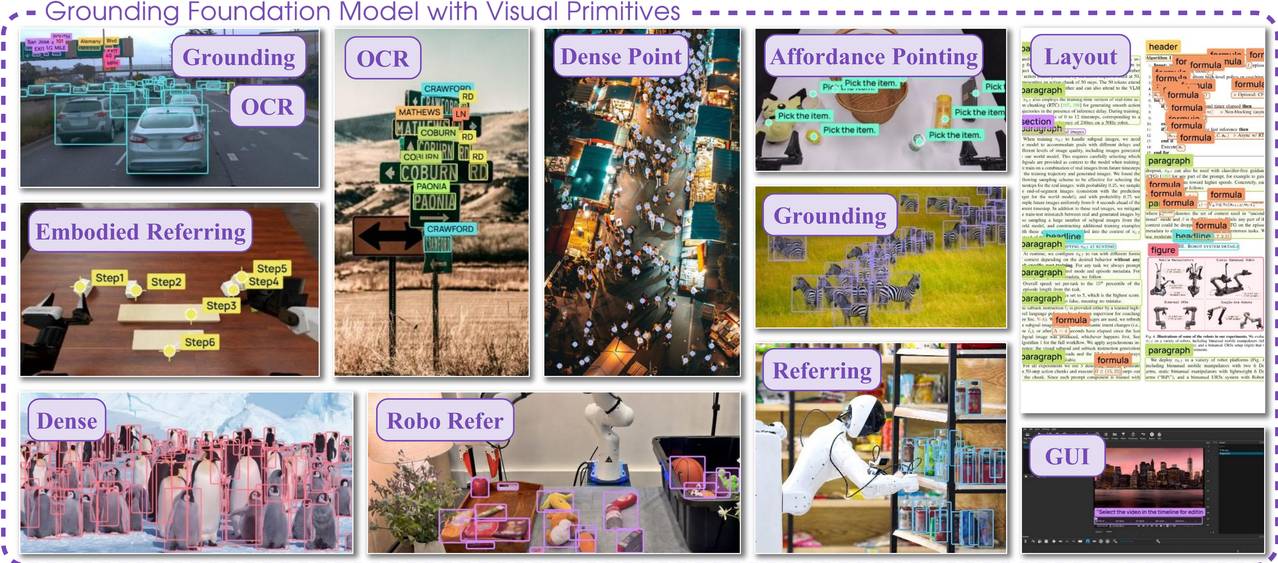
The central idea is easy to grasp but hard to execute: before acting in the physical world, a system must identify the right object and know exactly where it is. GroundingPI represents that information with visual primitives such as points and bounding boxes, making it possible to distinguish not only a cup, but the precise position of its handle.
Unlike models trained with robot action labels, GroundingPI was trained only on perception data, with no joint-action labels. Its training covers 11 capability categories, including object detection, dense object localization, referring expression grounding, optical character recognition (OCR), document layout understanding, user interface element recognition and robotic spatial localization.
In the research team's own evaluation, the roughly 4-billion-parameter model averaged 73.68 across 34 public perception benchmarks, weighted equally across categories, against 71.54 for GPT-6 Astra, in a comparison with 44 baseline models. The result applies to visual perception: it does not establish general superiority in reasoning or other AI capabilities, a caveat XPENG itself makes in its release.
Downstream experiments, still in simulation, point to two potential effects. In RoboCasa-GR1 tests, systems using GroundingPI as their visual backbone achieved higher success rates with 50% of the demonstration data than comparison models trained with 75%. In RoboTwin 2.0 evaluations, the model adapted better to out-of-distribution settings. In autonomous driving, on the nuScenes dataset, the reported average open-loop trajectory prediction error was 0.296 metres.
The research remains exploratory: the robotics results come from simulations and offline evaluations and do not prove readiness for commercial use. XPENG also makes clear that the announcement does not mean the model will be integrated into its cars, humanoid robots or other products. The paper, weights and code have been made publicly available to the research community, with links in the sources below.
Image credit: XPENG, via the company's official release.
Sources: XPENG (official release), arXiv paper, GroundingPI project page, CnEVPost and code on GitHub.
Transparency: this article was produced with the help of artificial intelligence, based on cross-checking public posts and internet sources listed above. Please consult the original sources to confirm the details.
Muse


