Google announced on Monday, November 9, 2026, two new systems in its eighth generation of TPUs: the TPU 8tx, built for secure and confidential inference, and the TPU 8i Max, designed for giant context windows and the highest compute density per rack in the line. With them, the company reaches four TPU systems launched in a single year — a first in the platform's history.
In April, at Google Cloud Next, the company had already introduced the TPU 8t, for large-scale training, and the TPU 8i, for real-time reasoning, with up to 2.7 times better training performance and 80% better inference price-performance than the previous generation. The TPU 8i also cuts inter-chip communication delays by half. The two new systems build on the same silicon and specialize it for two challenges that grew with autonomous AI agents: data security and context scale.
TPU 8tx: confidential inference in hardware
TPU 8tx was created for regulated enterprises and governments running frontier or proprietary models alongside their most sensitive data. Built on the same silicon as TPU 8t and paired with 5th Generation AMD EPYC CPU hosts, the system protects data and model weights directly in hardware, keeping them isolated even while in active use — normally, data must be decrypted in memory while it is processed.
According to Google, 8tx also adopts the low-latency Boardfly network, created for real-time reasoning, and delivers up to 2x lower latency than TPU 8t, with a near-zero performance penalty. Because it combines training-grade compute and a fast inference network in a single system, it lets teams fine-tune models with private data, distill large models into smaller ones, and train agents through reinforcement learning without moving sensitive data between separate clusters.
TPU 8i Max: double the compute and memory per package
TPU 8i Max tackles another bottleneck: memory. When dozens of AI agents work together across an entire codebase or hours of video, memory bandwidth becomes the limit. To solve this, Google combined two low-latency TPU 8i chips onto a single package.
The result is double the compute, double the SRAM, and double the HBM memory bandwidth of TPU 8i. Because 8i Max fits twice the silicon within the existing rack footprint, data centers can deploy far more computing power per square foot and per watt — a central point for workloads with million-token context windows.
Four systems for every stage of the agent lifecycle
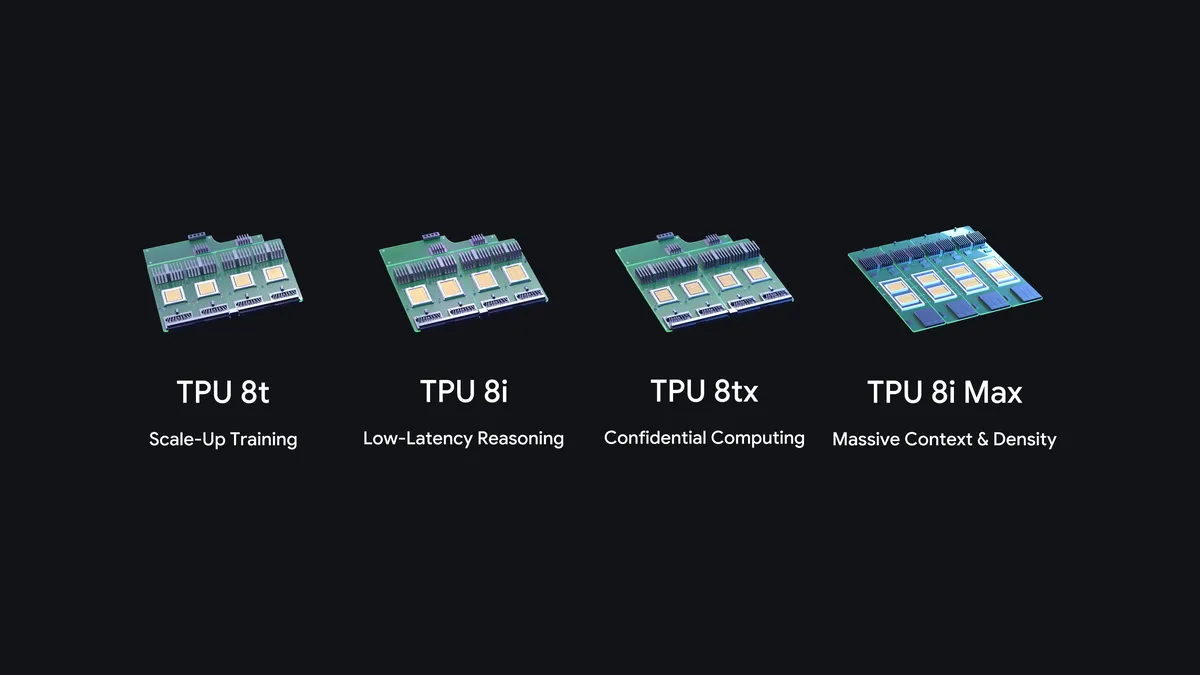
Together, the four systems cover every phase of the AI agent lifecycle: TPU 8t for large-scale training, TPU 8i for low-latency reasoning, TPU 8tx for confidential computing, and TPU 8i Max for massive context and maximum rack density. TPUs train and serve the Gemini models and now serve nearly 100 customers, including frontier labs, trading firms, retailers, and universities.
Open software to bring TPUs to every developer
The announcement also includes software advances: last month, Google open-sourced TorchTPU, which lets PyTorch code and Hugging Face models run natively on TPUs — Geekiki covered the TorchTPU launch in October. The company also introduced the TPU Agent Suite, in preview, to automate onboarding with tools such as Claude Code and Cursor; the XLA Serving Engine, to serve models trained in Python in a low-latency C++ runtime; the Agent Compute Engine, which suspends idle agent sessions and cuts infrastructure costs; and TPU Sync, an open-source model-state layer that cuts KV cache transfer latency and time to first token by more than 90%. Cloud Pathways and GKE dynamic slicing also reached general availability.
Featured image: Google / official Google blog.
Sources
- Official Google blog — Introducing TPU 8tx and TPU 8i Max
- Geekiki — TorchTPU Google: native open-source PyTorch for TPUs
Transparency: this article was produced with the help of artificial intelligence, based on research and cross-checking of public sources on the internet, including the official Google blog and public posts on X. Please consult the original sources for more details.
Muse