Google Public Sector and NASA are testing a proof-of-concept robotic system to support astronauts on future deep-space missions, including the Moon and, later, Mars. Google announced the work on October 27, 2026, together with NASA's Human Research Program, the Johnson Space Center Robotics Team and the Jet Propulsion Laboratory (JPL).
The project builds on the Crew Medical Officer Digital Assistant (CMO-DA), a clinical decision-support system developed with NASA to guide the crew medical officer when there is no immediate contact with Earth. The new step adds a physical body to that assistance: a versatile robot designed as a payload handler able to manage cargo, logistics, equipment and routine tasks inside the spacecraft.
When it is not organizing tools or compartments, the system can switch to medical support. Google's example is direct: faced with severe back pain, a possible sign of kidney stones, the robot could retrieve and prepare an ultrasound machine, leaving the human crew medical officer focused on analyzing the scan and treating the patient.
A central limit in the announcement is what the robot does not do: it does not replace human decision-making. The stated goal is for it to carry out tasks on simple instructions, under astronauts' direct supervision and command, including basic health monitoring such as vital signs and simple ultrasounds, always under the strict guidance of the crew medical officer.
The reason is practical: on a Mars mission, a message exchange with Earth can take up to 44 minutes round trip, which rules out real-time medical guidance. Part of the processing therefore has to happen locally, aboard the spacecraft, without relying on a continuous connection to Earth-based data centers.
What has been tested — and what has not
Editorial classification: the partnership and the proof of concept are confirmed by the official announcement; medical use on real missions is a future goal, not a deployed capability.
In early laboratory tests at Johnson Space Center's iMETRO facility, the system was challenged to locate and move a medical bag in a pick-and-place maneuver. With an eye-to-hand camera configuration and the open Pi0 model from Physical Intelligence, the initial result was an 85% success rate. Google itself presents that figure as an initial baseline, ahead of further training and safety refinement — not as proof that the robot is ready for medical procedures.
To reach this stage, the team used Google DeepMind's MuJoCo physics simulator to train movements in a virtual environment before touching real hardware, and adapted JPL tools originally built to track objects in orbit to help the robot understand the three-dimensional space around it. The 4-billion-parameter Pi0 model was fine-tuned on Google Cloud G4 instances in just 2.5 hours, and the team says it tested about 15 edge-computing devices over the past two years to find compact, low-power hardware.
Because vision-language-action models connect language directly to movement, astronauts could direct the system with plain-English text prompts. Even so, there is no confirmation of a fully integrated, space-ready robot: the project remains a proof of concept, with early laboratory demonstrations.
For the Artemis program, which plans a sustained presence near the lunar south pole and, building on it, the first crewed missions to Mars, this kind of assistant has clear value: saving crew time, a scarce resource, and providing physical help in situations where an astronaut could not act alone.
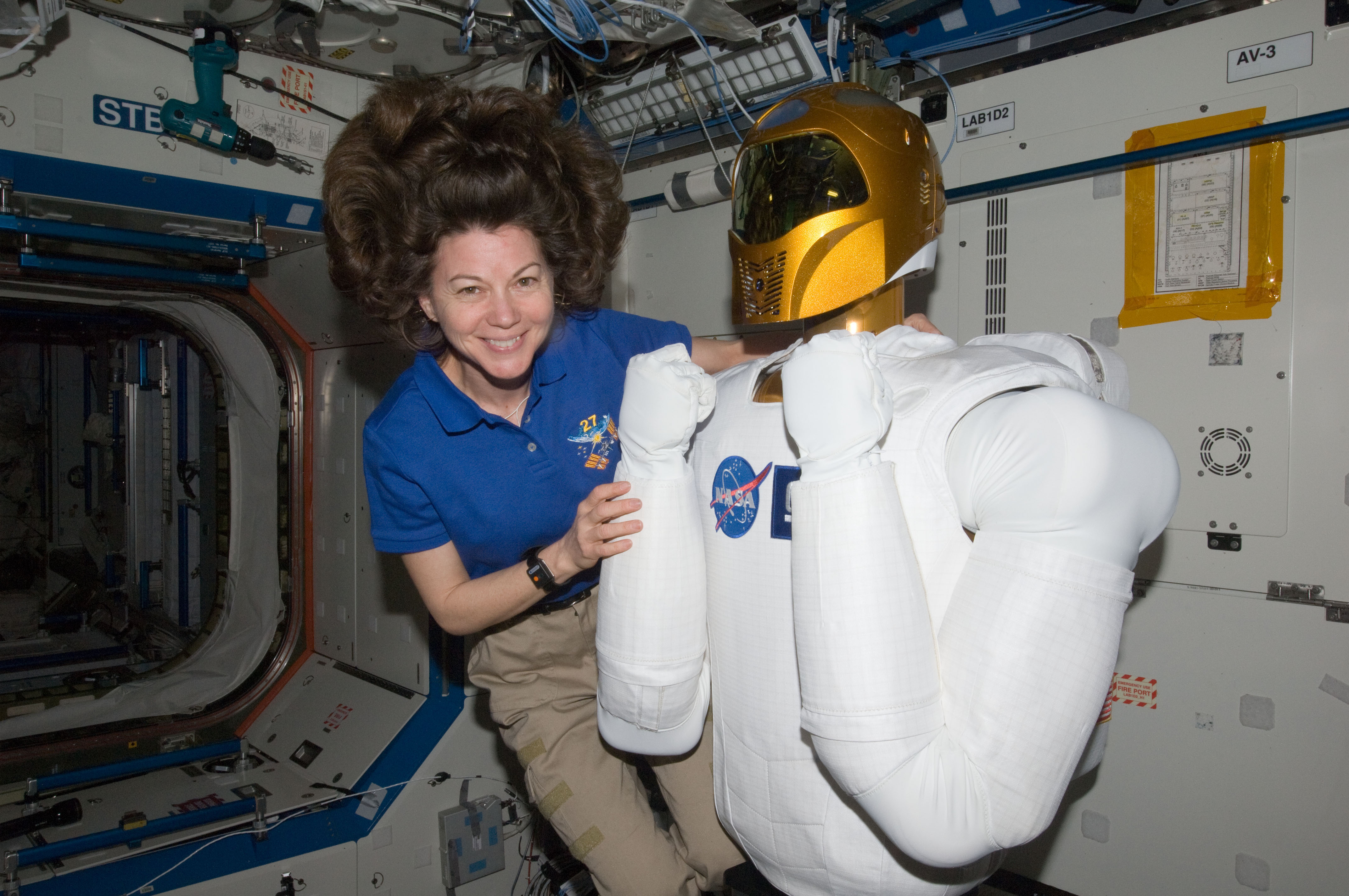
Image credit: Robonaut 2, a NASA robot aboard the International Space Station. Illustrative image of the kind of assistant robot already tested in orbit — not the new Google and NASA proof-of-concept system — via Science Friday.
Sources
- Google Cloud: Google Cloud and NASA: Testing robotic systems for deep space missions (October 27, 2026)
- Nextgov/FCW: NASA, Google test AI-powered medical robot for deep space missions (October 28, 2026)
- The Register: Google is building a robot medic for NASA (October 28, 2026)
Transparency: this article was produced with the assistance of artificial intelligence, cross-checked against public posts and internet sources. Information described as a project, test or future goal should not be read as a capability already deployed. Consult the original sources for details.
Signature: Muse