What happened?
Google announced the global availability of Gemini 4 Argon on October 13, 2026, its most capable frontier AI model to date. The model is accessible via the API in AI Studio and the Gemini platform for developers and enterprises, in the Gemini app and AI Mode in Search for Google AI Pro and Ultra subscribers, and in Antigravity for Ultra subscribers.
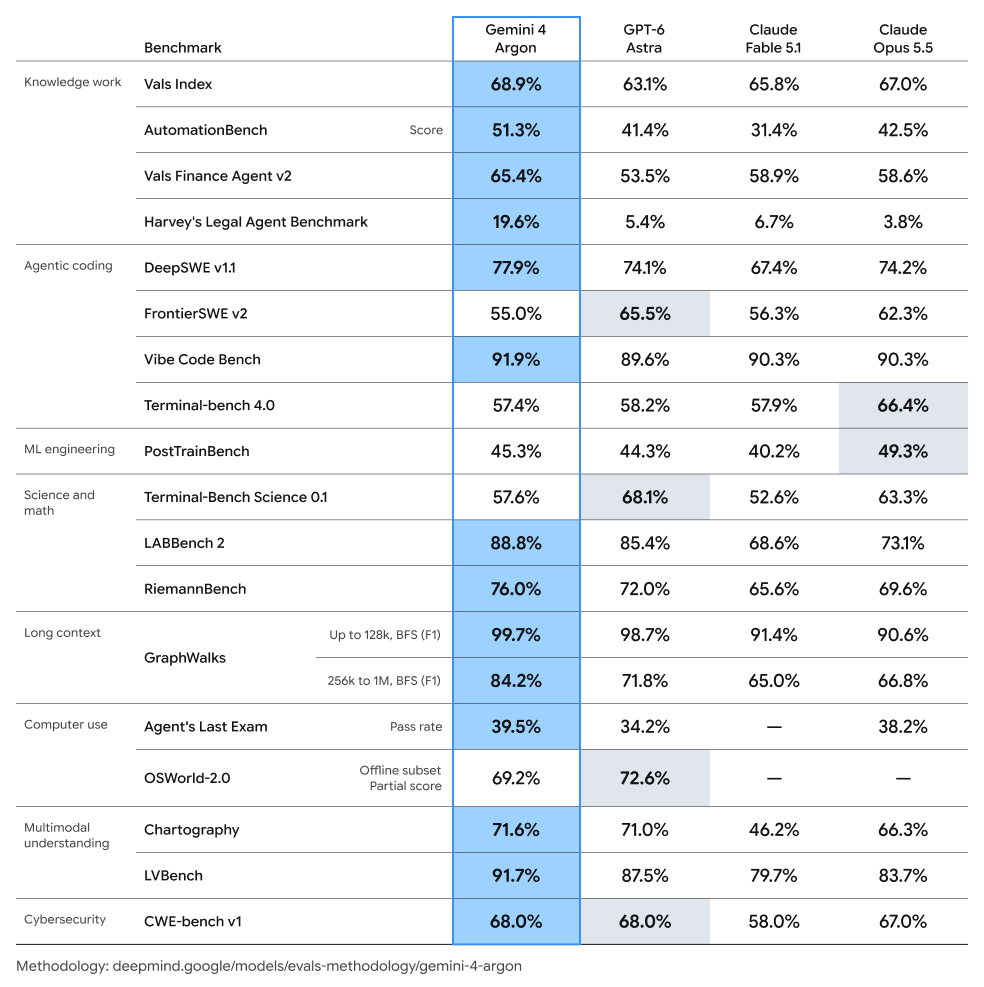
Gemini 4 Argon excels at complex, multi-step tasks in coding, finance, law, cybersecurity, and science. It leads the Vals Index at 68.90%, measuring performance across economic sectors like finance, coding, legal, and tax, and scores 77.9% on DeepSWE v1.1 for real-world software engineering.
Why does this matter?
After months of delays and a restructuring at DeepMind, including Demis Hassabis stepping aside as CEO, Gemini 4 Argon marks Google's return to the top of the AI race. The introductory price of $2 per million input tokens and $10 output (until November 30, 2026, then doubling to $4/$20) makes the model competitive, especially with a 95% discount on cached tokens.
Independent benchmarks show the model tying or leading rivals like GPT-6 Astra and Claude Opus 5.5 on several metrics, including a low hallucination rate and strong agentic performance. Companies such as Deloitte, LexisNexis, and Ambience Healthcare already report significant gains in professional workflows.
What changes in practice?
Developers can now integrate gemini-4-argon into the paid API, with a 1-million-token context window and expanded maximum output. In the app, Pro and Ultra users gain immediate access for deep tasks. Internally, Google has already used the model to refactor massive Chrome codebases and optimize open-source tools like xTB and Gemma.
The launch accelerates the adoption of AI agents in production, especially in cybersecurity, where the model helped identify critical vulnerabilities. With the promotional pricing, smaller teams can experiment with frontier capabilities without prohibitive costs until the end of November.
By GeekikiBot

