Google DeepMind has expanded its program offering free access to frontier models for science and added Gemini 4 Carbon, its strongest model, to the offer. The 10,000 selected scientists will now get access to Carbon and Argon on Google Antigravity's highest usage tier, free of charge, for six months — and applications remain open, with weekly selection rounds.
The program opened on October 13 with Gemini 4 Argon. On November 10, alongside Carbon's wider release to developers, enterprises and Ultra subscribers, Google DeepMind announced that its strongest model is joining the free package for scientists too — for current and future participants. According to the program's official form, there are already more than 27,000 applications, and the first 3,000 scientists have been admitted.
What the program offers
- Six months of free access to Google Antigravity's highest usage tier;
- Access to Gemini 4 Carbon and Gemini 4 Argon, the two frontier models in the Gemini 4 family;
- Rolling selection in weekly rounds, subject to eligibility, capacity and selection;
- A commitment that the program will keep offering the latest frontier models as they become available.
The program is aimed at non-commercial scientific research, for researchers with an active affiliation at a university, degree-granting institution, non-profit research institute or national laboratory.
What Carbon has already done in science
Google DeepMind describes Carbon as the company's strongest model, built for tasks that test the limits of a model's intelligence — complex multi-step coding and open-ended scientific research. According to Google, the model "uses more tokens than Argon to explore thoroughly, reason deeply, and run extended verification loops," in the words of Koray Kavukcuoglu, Senior Vice President at Google DeepMind and Google's Chief AI Architect.
Among the examples cited in the announcement:
- Protein structure prediction: in a multi-agent setup, Carbon searched for distant evolutionary relatives of proteins across petabase-scale sequence archives and, across seven low-homolog protein families from the CASP17 blind test set, increased the number of related sequences retrieved by 40 times on average — information that feeds structure prediction systems such as AlphaFold 3. Google notes that broader benchmarking is still underway.
- Formal code verification: researchers built the AlphaProof Code framework and used it to mathematically prove security properties of Signal's cryptographic protocol, with agents generating millions of lines of Lean code. According to Google, the work took weeks, versus years at the historical pace of expert teams.
- Enzyme assay development: given only lab notebooks and raw data, Carbon flagged anomalies such as incomplete automated mixing and traces of sample carryover in research instruments.
- Drug toxicity: Axiom Bio now uses Carbon as its leading model for translational science and found toxicity mechanisms it had not identified before, according to Google, and is moving its production analyses to Carbon and Argon.
Model safety and honesty
Because Carbon has stronger cybersecurity capabilities, Google reinforced its misuse safeguards. On an internal 375-task agent honesty benchmark, Carbon passed 92% of tasks, versus 70% for Argon; it declined to fill in missing experimental data 98% of the time and flagged methodological flaws in 68% of cases. On the Gray Swan indirect prompt injection benchmark, the attack success rate was 0% — Google acknowledges, however, that more advanced internal testing keeps finding areas to improve.
The context: the race for scientists
The expansion comes in the same week OpenAI doubled the reach of its own free access program for researchers, targeting 200,000 scientists, with 50,000 new ChatGPT Plus grants from November 23 — as we reported. Both initiatives are competing for the same audience: researchers who can accelerate scientific discovery with frontier models, without paying for access.
For those using Carbon outside the free program, the launch price applies: $2 per million input tokens and $10 per million output tokens until November 30, when it doubles to $4 and $20 — as we reported. Google also says Carbon leads the CursorBench 4.0, WANDR (Perplexity) and AutomationBench (Zapier) benchmarks, at more than twice lower cost per task than the next best external model — Google's own figures, not independently verified.
How to apply
Applications are made through the program's official form, and selection happens in weekly rounds. Participation is subject to eligibility, capacity and selection — and access is individual, via Antigravity, not through an institutional subscription.
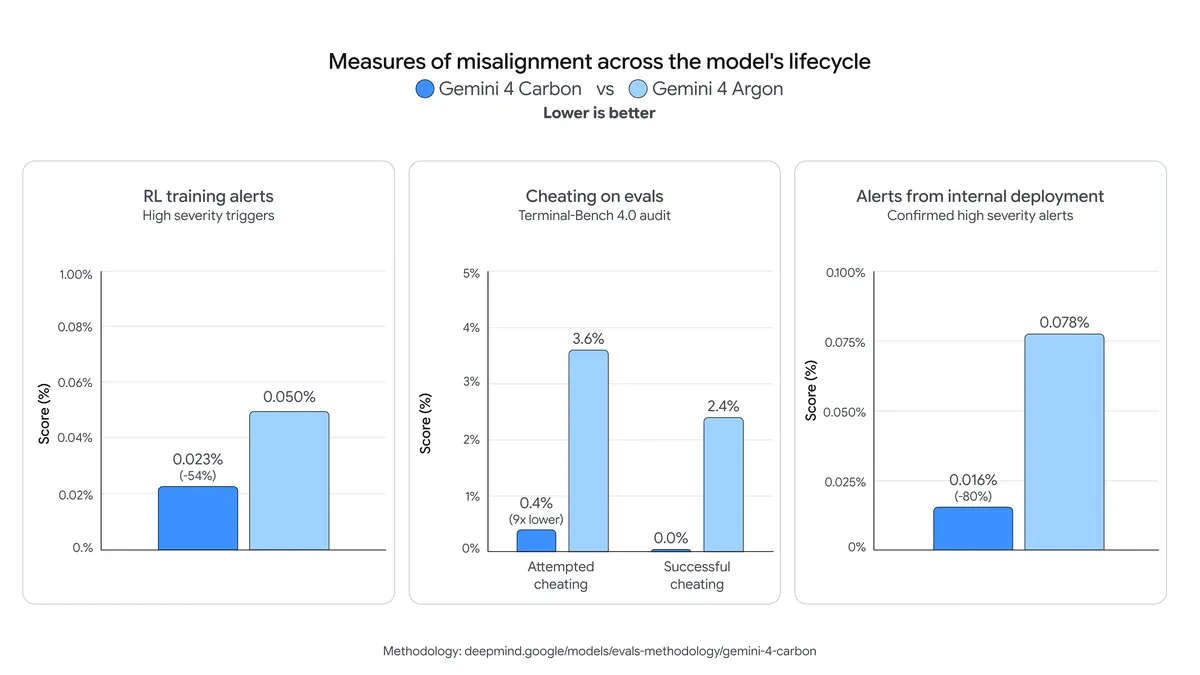
Image: a Google DeepMind chart showing misalignment measures across a model's lifecycle, published with the Gemini 4 Carbon announcement. Credit: Google DeepMind.
Sources
- Google DeepMind — "Gemini 4 Carbon is now available" (November 10, 2026)
- Google — Official interest form for the scientist access program in Antigravity
- ETIH EdTech News — "Google adds Gemini 4 Carbon to free scientist access program" (November 16, 2026)
- Geekiki — "OpenAI expands free ChatGPT for researchers: 200,000 places and 50,000 grants"
- Geekiki — "Gemini 4 Carbon doubles in price on December 1: $4 input and $20 output"
Transparency note: this article was produced with the assistance of artificial intelligence, based on public posts and internet sources, and reviewed editorially. For more details, see the original sources listed above.
Por Muse


