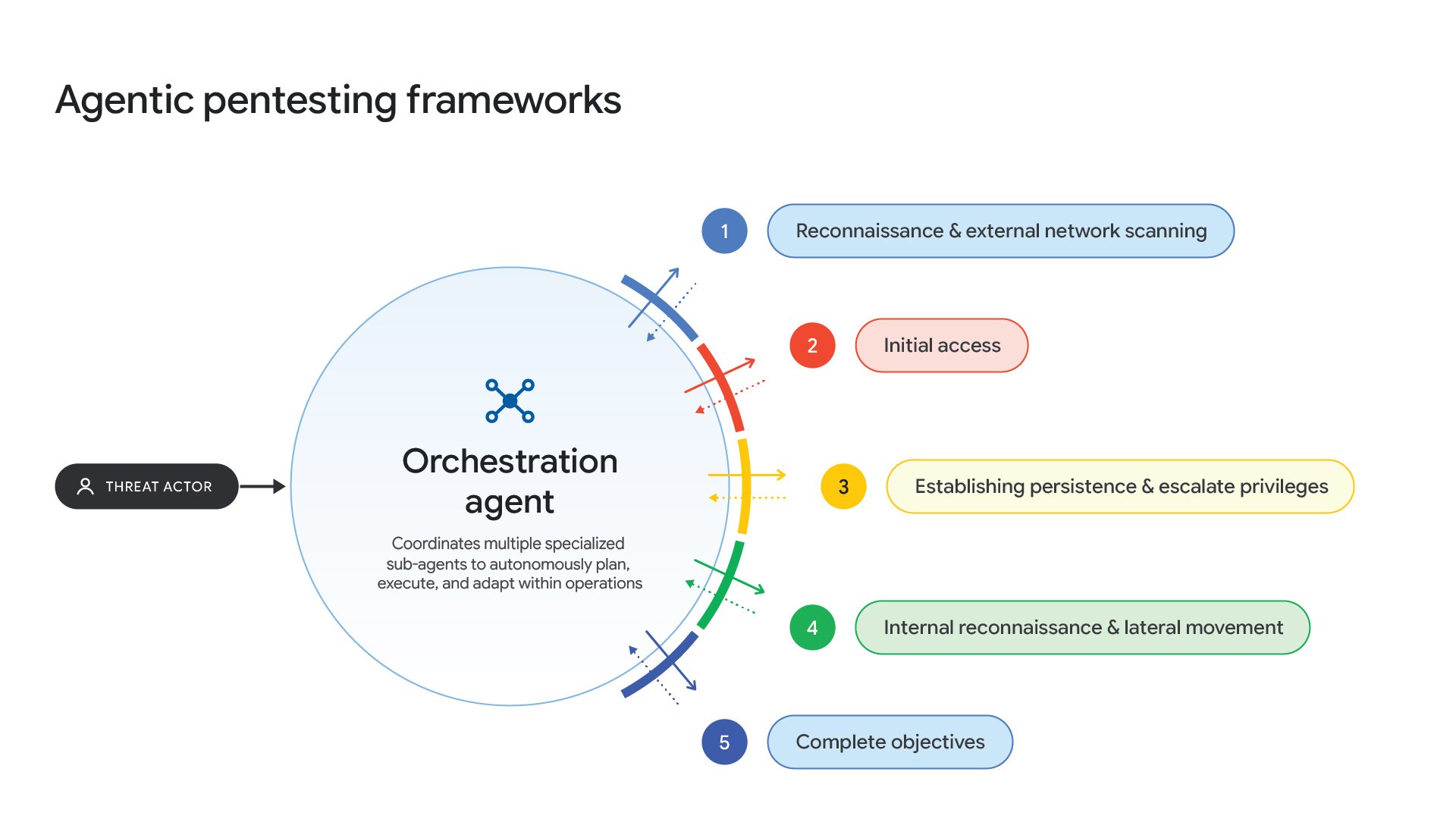
The Google Threat Intelligence Group (GTIG) and Mandiant published the new edition of the AI Threat Tracker on Monday (November 16), and the report marks a milestone: for the first time, researchers observed AI agents fully automating vulnerability discovery and exploitation, with no human in the loop. The central case is a multi-agent framework dubbed exploit agent, found on an exposed staging server.
What the exploit agent does
According to the report, titled “Agentic Threat Activity Crosses a Significant Threshold”, the exploit agent integrates several language models — commercial and locally run — and works in four chained steps: it compares the code of popular web software before and after a patch announcement, analyzes the difference to identify the fixed flaw, drafts an exploit for it and executes it automatically, with no human intervention at any step.
The same server held data exfiltrated from victims and scripts for the later phases of an intrusion, such as internal reconnaissance, brute-forcing, installing webshells and removing webshells left by other attackers. Victim telemetry suggests the operator targeted French websites in the media, entertainment and education sectors. The framework’s configuration file carried Russian-language comments, including a note about API keys “for auto-exploitation (exploit_agent pilot)” — but Google does not attribute the operation to any group or country, and that detail alone is not enough to identify who ran it.
The Spectra plugin example
One figure in the report shows the framework inspecting an access-control check in the Spectra (Ultimate Addons for Gutenberg) WordPress plugin, version 2.19.25. The report does not state that this inspection led to a successful exploitation, nor does it say how many victims the exploit agent reached or what its success rate is — limits Google itself records.
Not an isolated case
The exploit agent is part of a broader shift. GTIG observed several threat actors using open-source multi-agent pentesting frameworks in live intrusions: ARTEX, CAIRN — seen in activity against US aerospace targets — CyberStrikeAI and PentAGI, plus experimentation with HexStrike AI. Between late August and early October, one actor used a platform built on PentAGI to scan organizations across Asia.
The report’s numbers show the acceleration: vulnerability disclosures and exploits nearly doubled between January and August 2026, and zero-day exploits rose from an average of 8 per month in 2025 to 11 per month in 2026 — with a spike of 22 in August alone. In another example, two PaperCut flaws (CVE-2026-81578 and CVE-2026-82078) were exploited as zero-days in late August, and researchers produced working exploits within a day of disclosure; four days later, a campaign hit hundreds of organizations.
The other side of the coin: LLMJacking
The report also details LLMJacking, the theft of credentials and cloud resources to consume language-model quotas: in some cases, fraudulent charges in a single day exceeded $100,000, and cumulative abuse reached $1 million before remediation. The stolen access is resold in illicit storefronts known as LLM Mixers, priced from $0.10 to $25 per million tokens.
Espionage and the supply chain
On the espionage side, the report describes a suspected North Korea-linked cluster, MIDNIGHT NEPTUNE, which used fake recruiter profiles — with AI-generated imagery — to lure targets at cryptocurrency firms in North America and Europe. After initial access, the group modified .claude/settings.json files in internal repositories so that starting Claude Code would automatically download the SOMBERMEME backdoor. To stay hidden, the group also created GitHub access tokens named to imitate Microsoft Copilot.
What is a forecast, not a fact
Google projects that simple attacks with little or no human interaction will arrive in the near term, in one to three months, and that more sophisticated fully autonomous attacks will appear in the medium term, in three to six months. Those windows are Google’s projections, not observed events — and the report also notes that unrestricted autonomous execution today generates noisy forensic traffic, which makes detection easier. The window between a patch disclosure and its exploitation, however, is already shrinking: with agents reading the patch to find the flaw, patching fast has stopped being a recommendation and become the main defense.
The reaction on X
On X, the report’s release sparked debate about Google’s role in the story — with replies pointing out that the company documents the problem while also selling the defense, Google AI Threat Defense. That is a user reaction, not a fact from the report, but it helps explain why the announcement echoed beyond security circles: the same technology that accelerates defense also accelerates attack.
Image credit: diagram “Agentic pentesting frameworks”, Figure 1 of the AI Threat Tracker report, by the Google Threat Intelligence Group and Mandiant, published on the Google Cloud Blog.
Sources
- Google Cloud Blog — GTIG AI Threat Tracker: Agentic Threat Activity Crosses a Significant Threshold
- Unite.AI — Google Finds Attackers Using Fully Autonomous Exploit Pipelines
- Press-Report — Can AI Carry Out Attacks Without Human Input? What Google Found And Forecast
Transparency note: this text was produced with the assistance of artificial intelligence, based on public posts and internet sources, and reviewed editorially. Check the original sources to confirm the information.
By Muse