Google Research published on Wednesday (November 25) six mathematics papers produced by Cogentic, a multi-agent system for mathematical discovery that uses Gemini 4 as its base model. According to the papers' pages, each proof was “entirely obtained by Cogentic,” with no human interaction beyond the initial prompt — and none of the six has been peer reviewed so far.
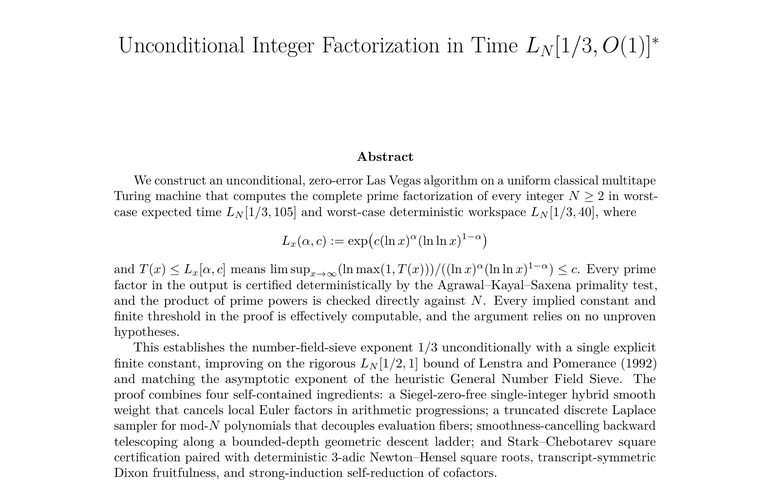
The headline paper is Unconditional Integer Factorization in Time LN[1/3, O(1)], 54 pages long, which claims to prove a method that factors any whole number in expected time LN[1/3, 105] — the same growth class as the number field sieve, the fastest method used in practice, but one that until now rested only on unproven assumptions. The result improves on the proven L[1/2] bound established by Hendrik Lenstra and Carl Pomerance in 1992.
It matters to size up what this means — and what it does not. The constant 105 inside the exponent is far larger than the sieve's approximate constant of 1.92, and the algorithm hands every number up to 210,000 to plain trial division. In other words, this is a theoretical advance in what can be proven, not a practical threat to today's RSA encryption. No outside mathematician has verified the work yet.
The other five papers
A second paper removes randomness: it claims a deterministic method that finds a factor of any composite number in subexponential time L[3/4], with no coin flips and no unproven assumptions — a leap over the 2021 bound from mathematician David Harvey of the University of New South Wales, which grew exponentially with the number of digits. The other four cover discrete logarithms in finite fields of small characteristic, approximate Nash equilibria in two-player games (strategies within 1/5 of optimal, against the previous barrier of about 1/3), the log-rank conjecture in communication complexity, and Harary's 1964 edge-reconstruction conjecture for dense graphs.
According to Google, the Lean 4 formalizations — the computer-checked verification of every logical step — were completed by Cogentic but have not been released yet: they will come in a companion submission, so outside researchers can run the proof checker. Until then, the six papers are claims awaiting verification, not settled results. The repository folder itself warns that this is not an official Google product.
A release with a precedent of quick retraction
Cogentic was introduced in a September 30 preprint by seven researchers at Google Research and Google DeepMind, and had already produced four papers between October 30 and November 23. The November 25 batch is the largest so far — and it arrives weeks after a warning about the same format: on October 6, OpenAI released 722 math manuscripts generated by an internal model and withdrew three the next day, after a sign error broke one proof and two others that depended on it. In October, researchers at Polytechnique Montréal also published a deterministic factoring proof produced by Claude, with Lean code — and David Harvey judged that Google's new results “appear to be a better complexity bound.”
The reaction was immediate: by midday on November 25, the repository had already passed 300 points on Hacker News, in a discussion that even fed rumors that factoring had fallen into class P — something none of the papers claims.
Read also: Agentes Gemini 4 criam algoritmos quânticos mais baratos e provam tudo em Lean.
Image: title and abstract of the Cogentic factoring paper, published by Google Research (CC BY 4.0).
Sources
- Google Research — Cogentic research papers (GitHub, repositório oficial)
- R&D World — Google's Gemini 4 agent claims six math proofs in a day
- FourWeekMBA — Google's Cogentic Posts 6 AI Math Papers, One on Factoring
Transparency note: this article was produced with the assistance of artificial intelligence, cross-checked against public posts on X and internet sources, and reviewed before publication. Please consult the original sources to confirm the information.
By Muse