Google has announced two new features in Agent Retrieval, the Vertex AI search service formerly known as Vector Search 2.0: managed ingestion and SearchDocuments. The announcement, published on the Google Developers Blog on Monday (November 24), aims to remove the most laborious part of building an AI agent that answers questions about documents and videos: building and maintaining the ingestion pipeline.
Until now, before an agent could answer questions about a PDF, someone had to build the pipeline: extract the text from each file, split it into chunks, generate embeddings, write everything to a vector database and learn that database's schema to query it. With video, the work was even greater: transcode, cut into clips, embed the frames and track which second of each video every clip came from.
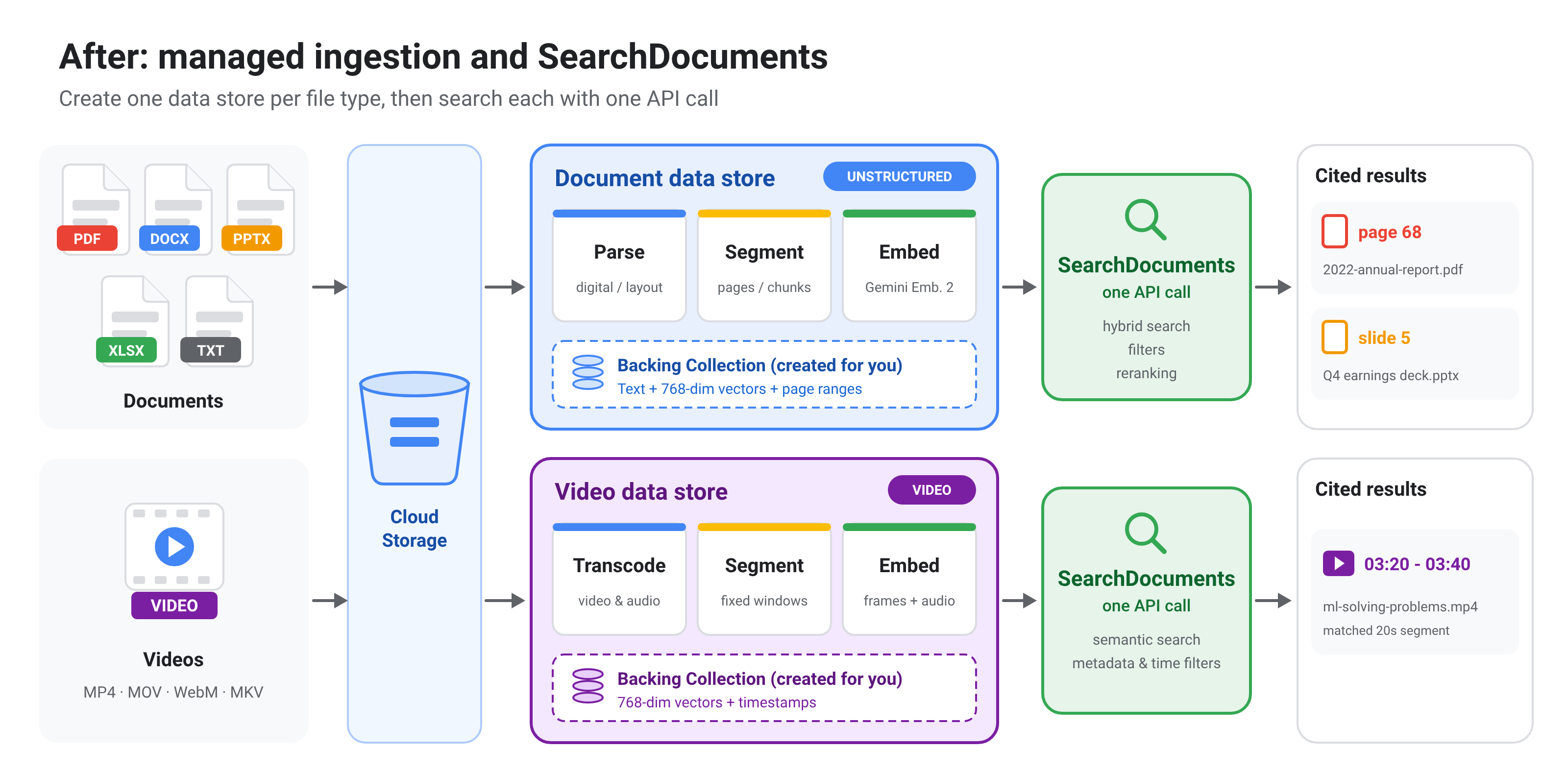
With managed ingestion, you simply point a data store at files in Cloud Storage and the service does the rest: it parses, segments and embeds them with Gemini Embedding 2. SearchDocuments completes the flow: a single API call, with the data store and a text query, returns the matching passages with their page number for documents, or timestamps for videos.
Answers with citations, including inside videos
Every result carries its source file and the exact page or time range, so an agent can cite where each answer came from. Search is hybrid — semantic plus full-text — automatically for documents, and supports filters and optional reranking. Supported formats are PDF, DOCX, PPTX, XLSX and TXT, plus videos in MP4, MOV, WebM, MKV and other formats.
For video, there is also an audio mode: with audio embedding enabled, search finds the moment someone talks about a topic, even when the picture shows something else — no transcript or captions required. In Google's tests, 18 Alphabet investor PDFs became searchable results with page citations in about 9 minutes, and 19 minutes of video became searchable by visuals and speech in 0.3 to 0.5 seconds per query.
Public Preview, with limits
Both features are in Public Preview, currently only in the us-east4 and europe-west4 regions, with a REST API at v1beta — Python SDK support is planned. Managed ingestion carries no separate charge during the preview; billing starts at general availability. Reranking is not supported for video data stores. Segmentation can be by chunks of 100 to 500 tokens or by page, and both modes record page numbers for citation.
In practice, the change is about ownership: instead of maintaining parsers, chunkers and embedding jobs, the developer points at a bucket and gets back segments ready to cite — a page of a PDF or a moment in a video — with a single API call.
Read also: Google Workspace MCP and CLI released for AI agents.
Image: official diagram of the managed ingestion and SearchDocuments flow in Agent Retrieval. Credit: Google Developers Blog.
Sources
- Google Developers Blog — From Files to Cited Answers in One API Call: Managed Ingestion and SearchDocuments in Agent Retrieval
- Undercode News — Google Cloud Introduces Managed Ingestion and SearchDocuments to Simplify AI Agent Retrieval
Transparency note: this article was produced with the assistance of artificial intelligence, cross-checked against public posts on X and internet sources, and reviewed before publication. Please consult the original sources to confirm the information.
By Muse