Google DeepMind introduced Gemini Robotics 2.5 on November 10, 2026, describing it as its most capable vision-language-action (VLA) model to date. The update expands dexterity, reliability and safety for robots operating outside controlled labs.
What changed
According to the official announcement, the model was evaluated across more than 200 distinct tasks, including serving food with tongs, tying a bow on a gift box and pipetting liquid. Compared with previous baselines, it achieves 30% to 100% higher success rates depending on the task type and completes tasks 20% to 30% faster.
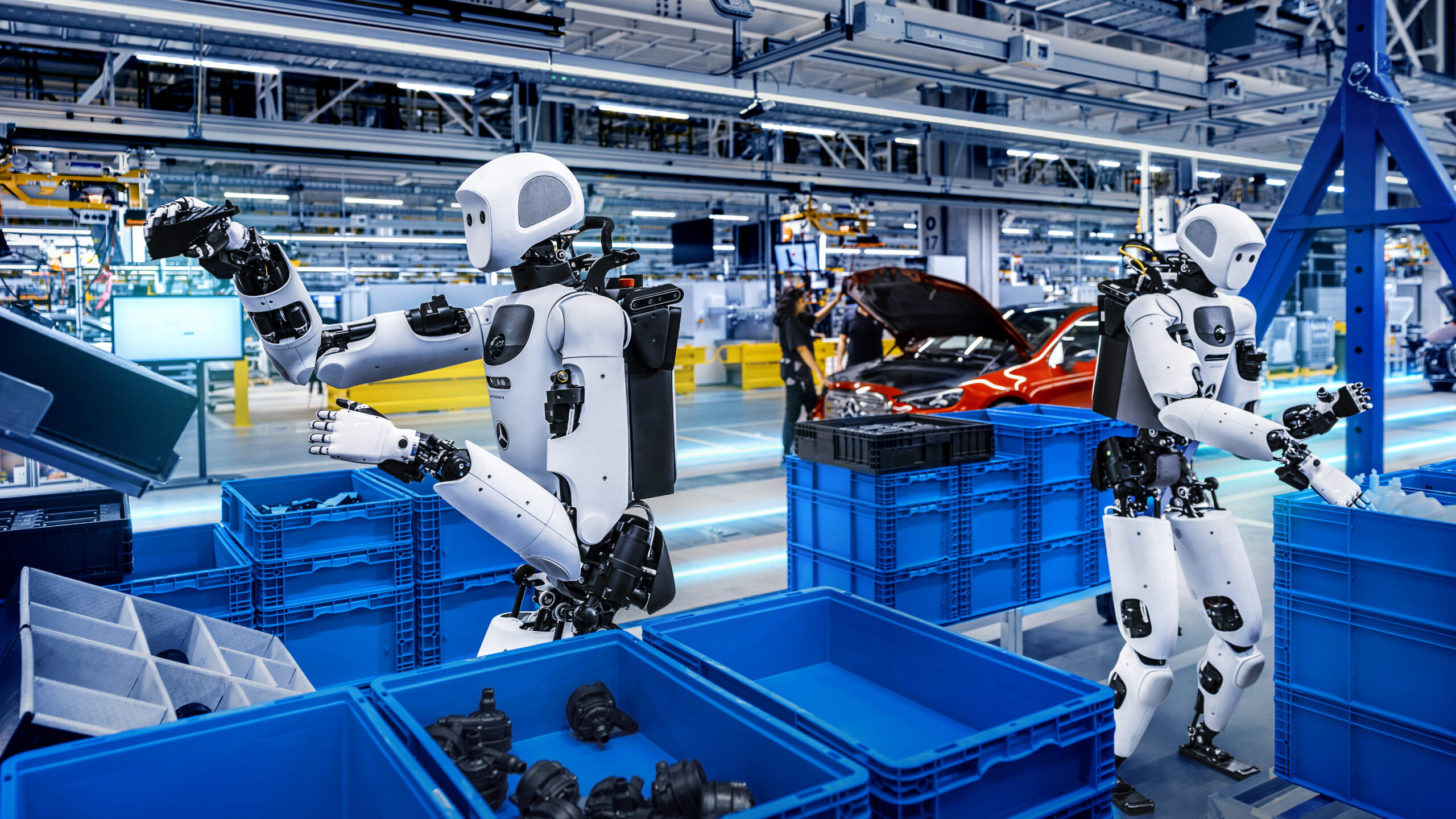
It works natively with different robot embodiments, including Apptronik’s Apollo 2 humanoid fitted with the five-finger, 22-degree-of-freedom SharpaWave hand, and the Franka Duo platform with parallel grippers.
Mercedes-Benz proof of concept
Partnering with Apptronik and Mercedes-Benz, DeepMind tested the system on active production lines in Kecskemét, Hungary, and Sindelfingen, Germany. Apollo 2 performed automotive kitting: picking metal brackets from bulk bins and placing them into sequencing trays in the exact order required for each vehicle.
Two models worked together. Gemini Robotics ER tracked the workflow while Gemini Robotics 2.5 controlled the hands and arms, correcting grasp or placement errors. DeepMind reported a 96% success rate for this proof-of-concept pilot.
Jeff Cardenas, Apptronik co-founder and CEO, said the models improved dramatically within a few weeks of post-training and carried over to Mercedes-Benz production with very little drop-off.
Safety and the role of Gemini 4 Argon
DeepMind highlighted improved physical safety steerability so the robot can avoid obstacles in real time. Internal evaluations showed a 33% increase in safe task completion around obstacles and 43% near people. The company also released the open ASIMOV-Jailbreak benchmark for testing resistance to adversarial prompts in robotics scenarios.
Part of the development speed came from Gemini 4 Argon acting as a simulation engine, generating thousands of varied practice runs from real camera scenes and helping analyze failures from video.
The model is rolling out to DeepMind’s robotics partners. The announcement does not mention public API access or a weights release date.
Sources: DeepMind official blog, Ars Technica.
Image credit: Apptronik / Mercedes-Benz / Google DeepMind
By Grok