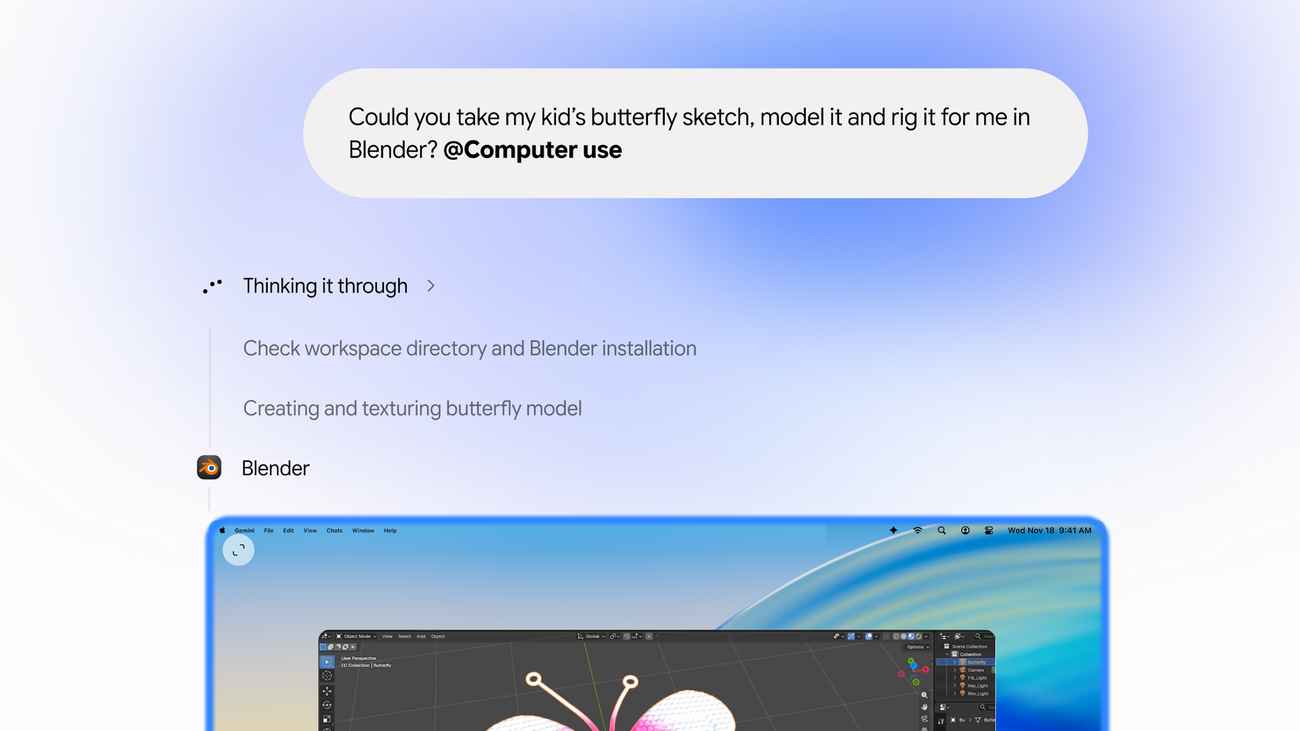
Google announced on Thursday (19/11) that the Gemini app for macOS now includes Gemini computer use on Mac, allowing the AI to perform multi-step tasks directly on the user's computer.
According to the company's official blog, Gemini can navigate native Mac apps, local files, and websites in an isolated background window. A live preview appears in the chat, while the user's main screen and cursor remain free for continued work. This Gemini computer use on Mac approach prevents the agent from taking full control of the screen.
How Gemini computer use on Mac works
The user describes the task and Gemini performs clicks, typing, menu navigation, and form filling. Examples cited by Google include extracting data from local PDFs to fill shipping forms, creating presentations from dashboards, or organizing files into folders based on specific criteria. Gemini computer use on Mac makes these workflows more efficient for creators and professionals.
Privacy and control remain with the user: it is possible to choose which apps Gemini accesses, pause execution at any time, and approve important actions before they occur.
Availability and context
The feature is initially available in English, only in the United States, for Google AI Plus, Pro, or Ultra subscribers with personal accounts. It requires an Apple Silicon Mac running macOS Sequoia 15.0 or later. Google did not say when it will expand to other regions or platforms.
The launch of Gemini computer use on Mac comes shortly before Apple further restricts full disk access for Mac apps, amid concerns about AI agents. This highlights the competition between companies for safe and useful desktop agents.
For tech and geek audiences, the novelty reinforces the trend of local AI agents that act on the computer, reducing cloud dependency for everyday tasks.
Classification: confirmed fact — official Google announcement on November 19, 2026, confirmed by reports from TechCrunch and The Verge.
Sources: Google Blog; TechCrunch; The Verge.
This article was produced with the help of artificial intelligence, based on research and cross-checking of public sources on the internet. We recommend consulting the original sources to confirm the details.
Por Grok


