Startup Standard Kernel says it made Intel's Gaudi2 accelerator, launched in 2022, outperform the Nvidia H100 in an inference test — without changing the silicon, only with AI-optimized software. Wccftech covered the result this Friday (27/11).
The test numbers
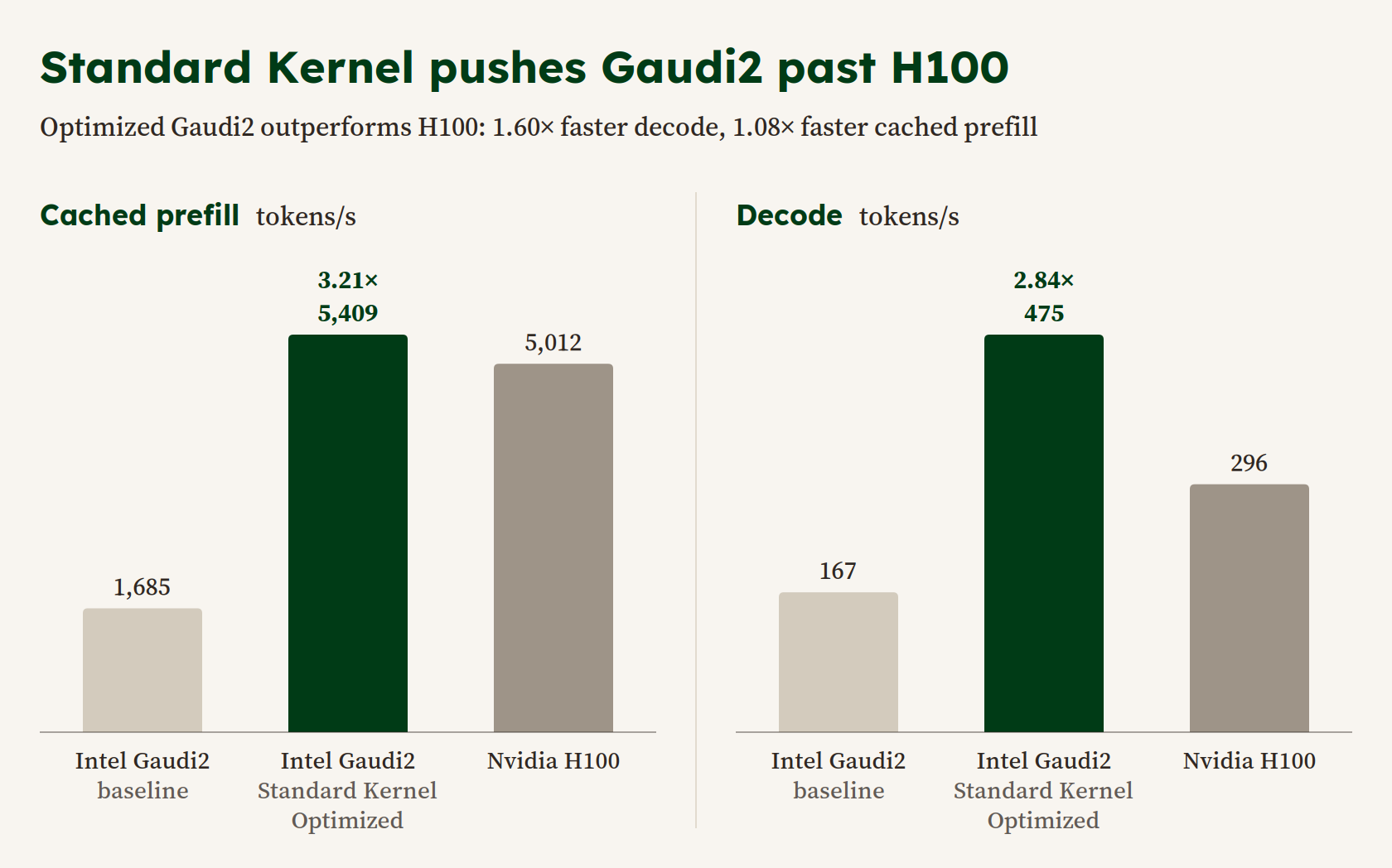
In the test, using the Qwen3.5-27B-FP8 model, the optimized Gaudi2 reached 5,409 tokens per second in cached prefill, versus 5,012 for the 80 GB PCIe H100 — about 8% more — and 475 tokens per second in decode, versus 296 for the H100, a 60% advantage. Compared with the unoptimized Gaudi2, the gain was 3.21x in prefill and 2.84x in decode.
The workload was specific: 16 concurrent requests, each with 70,000 input tokens and a 95% shared prefix — a scenario similar to coding agents repeatedly working over long contexts. The tests used vLLM 0.32.0, with the vllm-gaudi plugin on Gaudi2.
Cost per token
The economic case is even stronger, according to the company: Gaudi2 was found for rent at $0.60 per hour, versus $3.50 for the H100. As a result, the optimized chip would deliver 9.4x more decoded tokens per dollar — $0.35 per 1 million decoded tokens, versus $3.28 for the H100 — and 6.3x more in prefill, at $0.031 per 1 million tokens versus $0.194.
Intel's context
Gaudi2 has 96 GB of HBM2e memory and 2.45 TB/s of bandwidth, versus 3.35 TB/s for the H100 — so it won the comparison despite the lower bandwidth. Intel bought Habana Labs, the creator of Gaudi, in 2019 for about $2 billion, but the accelerator saw limited adoption and the company cancelled its successor, Falcon Shores, in January 2025. Intel's next AI accelerator family is Crescent Island, based on Xe3P.
A cautious reading
The result should be read with caution: it is a benchmark from Standard Kernel itself, on a specific long-context workload with heavy prefix reuse, not an independent verification or a general verdict on the two accelerators. Even so, the case shows how software can change the economics of AI inference — and give a second life to hardware the market had already written off.
Image credit: performance chart published by Standard Kernel on its blog, comparing the optimized Gaudi2 with the original Gaudi2 and the Nvidia H100.
Related Geekiki coverage: Weight rewriting: Qwen3.5-27B improves by 6.6 points by rewriting its own weights
Fontes
- Standard Kernel — Intel Gave Up on Its Gaudi Chips. We Used AI to Make Them Outperform NVIDIA H100.
- Wccftech — Intel's Four-Year-Old Gaudi Chips Deliver 60% Higher Decode Throughput Than NVIDIA's H100 in Qwen3.5-27B
Transparency note: this article was produced with the assistance of artificial intelligence, cross-checked against public posts on X and internet sources, and reviewed before publication. Consult the original sources to confirm the information.
By Muse