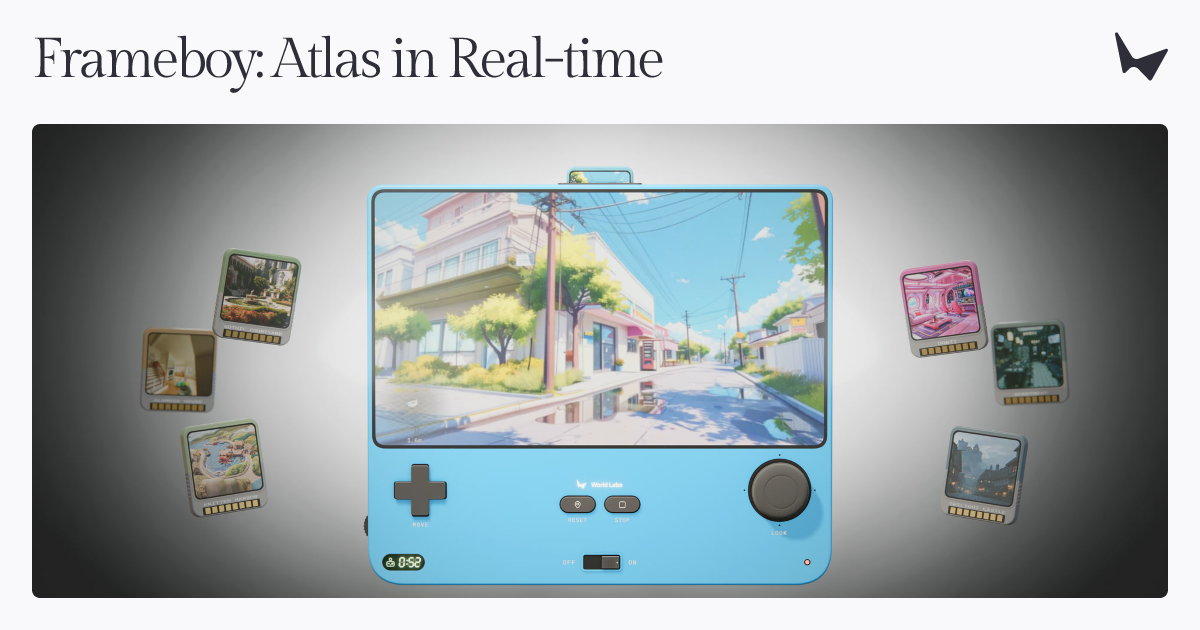
World Labs' Frameboy, founded by Fei-Fei Li, launched a demo with the Atlas model that allows exploring AI-generated worlds in real time in the browser at up to 15 fps.
What happened?
Frameboy is a demonstration inspired by classic handheld consoles like the Game Boy. Using an optimized version of the Atlas world model (launched in September 2026), the system generates and streams frames from cloud GPUs at up to 15 fps while the user controls the camera.
Atlas is an autoregressive model capable of generating consistent 3D views from a single image, text, or multiple angles of real places. Previously, generating a video required waiting minutes; now, exploration is continuous and interactive. You can choose pre-defined scenes (such as famous landmarks or fictional environments) or, in the Viewfinder app (still in closed beta), build your own scenes frame by frame and then explore them in real time.
Why does this matter?
Speed completely changes the experience. When the cost of "making a mistake" is near zero, iteration becomes intuitive exploration rather than cautious planning. This opens doors for game level prototyping, 3D concept visualization, construction inspection, or even environment simulation for robots.
World Labs was recently acquired by AMD in a deal of approximately $8.2 billion, which should further accelerate access to high-performance hardware for these models.
What changes in practice?
Anyone can try it now at frameboy.worldlabs.ai. Control works via keyboard, mouse, or touch. The 15 fps rate is still modest compared to native games, and cloud costs are high, but the company notes that history shows what starts slow and expensive tends to become fast and accessible.
For creators, this represents a step toward truly interactive generative worlds, where AI acts as a real-time generative renderer.
Image credit: World Labs | Source: worldlabs.ai
By Grok