Researchers at MIT and New York University (NYU) have introduced FLEX, a system that lets robots interpret the intent behind a correction spoken in natural language — rather than just following the order literally. The work was announced by MIT News on November 9, 2026, and will be presented at the Conference on Robot Learning (CoRL) 2026 later in November.
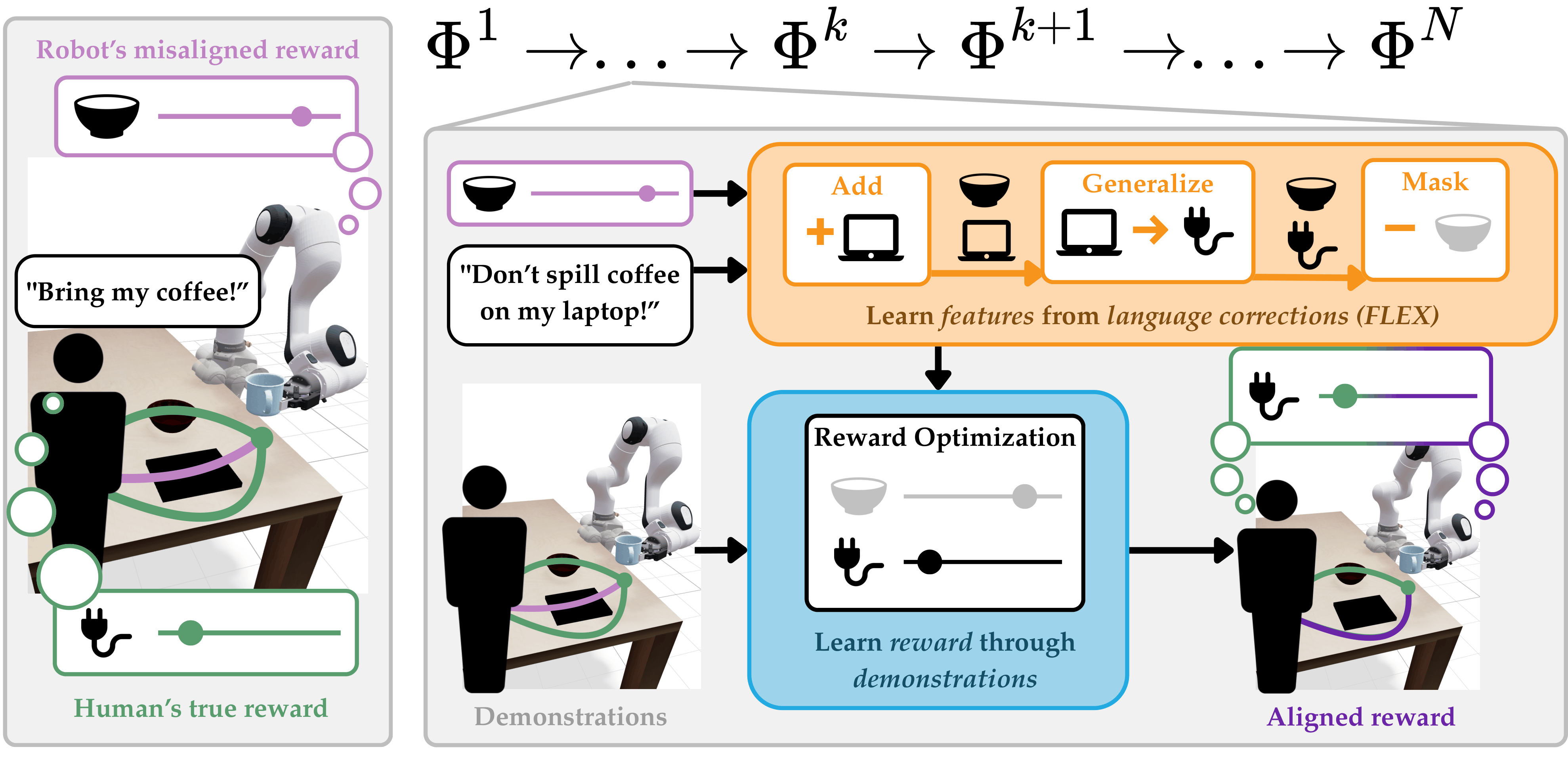
The researchers' example is simple: a robot arm carries a cup of coffee over a cluttered table and the person types, "Don't spill on the laptop!" Instead of merely adding the laptop to its obstacle list, FLEX grasps the reason — liquids and electronics do not mix — and starts steering around a nearby phone too, without anyone having to say so explicitly.
How FLEX works
FLEX, short for Flexible Feature Editing Pipeline, works in three steps that together take about five seconds:
- Add: the robot adds to its list of environmental features whatever the correction mentions, such as a mug that must not be hit.
- Generalize: a language model — GPT-4o in the study — looks for the pattern behind the corrections and broadens the rule. A mug becomes "fragile objects"; a laptop becomes "electronics".
- Mask: the robot's vision system checks what is no longer in the environment and removes features that have stopped being relevant.
"The idea is that there is some higher-level intention behind the words that you say," says Nathan Dennler, a postdoc at MIT's Computer Science and Artificial Intelligence Laboratory (CSAIL) and one of the study's authors. The research was led by Andreea Bobu, an MIT assistant professor who heads the Collaborative Learning and Autonomy Research (CLEAR) Lab. Audrey Lee of MIT and Ilia Sucholutsky of NYU are co-authors.
Results in simulation and with volunteers
The team tested FLEX in 9-by-9 navigation grids and in simulated manipulation tasks with a seven-degree-of-freedom Franka arm, serving coffee, carrying a lit candle and transporting a bowling ball. In the scenario requiring all three operations at once, FLEX reached an average normalized reward of 0.99 — on a scale where 1 is optimal behavior — versus 0.69 for the add-only method ALGAE, 0.83 for MFE and 0.78 for an unscaffolded baseline.
In a study with 12 volunteers, who typed natural-language corrections during simulations, FLEX received the highest average rating on all five questionnaire dimensions. For intent understanding, on a 1-to-7 scale, the averages were 6.3 for FLEX, 5.0 for ALGAE and 4.5 for MFE.
Limits of the study
It is important to state what FLEX is not yet: the volunteer tests ran in simulation, not on a physical robot operating in closed loop, because some comparison methods produced erratic arm motions. The team only ran a hardware feasibility check, using expert demonstrations collected on a real Franka. The method also currently covers only quasi-static manipulation of rigid objects whose relevant properties can be expressed in language. The code and dataset have not been released yet — the project page lists them as coming soon.
Even with those caveats, FLEX points to a concrete path toward household and assistive robots that learn each home's preferences from a sentence or two, instead of requiring the user to spell out every rule. "No robot comes out of the box knowing what matters to you," says Bobu. "What excites me about FLEX is that it can pick that up from a sentence or two."
Also on Geekiki: VLA-Stem gives AI robots reflexes and reduces collisions without retraining the model.
Image credit: MIT CLEAR Lab, official FLEX project page.
Sources
- MIT News — AI-assisted learning platform helps robots reason beyond literal commands
- Official FLEX project page — MIT CLEAR Lab
- arXiv paper — Flexible Language-Guided Representation Editing for Adaptive Robot Behavior
- Unite.AI — FLEX Teaches Robots to Generalize From Human Corrections
Transparency: this article was produced with the help of artificial intelligence, cross-checked against public posts on X and internet sources. Please consult the original sources listed below to verify the information.
By Muse