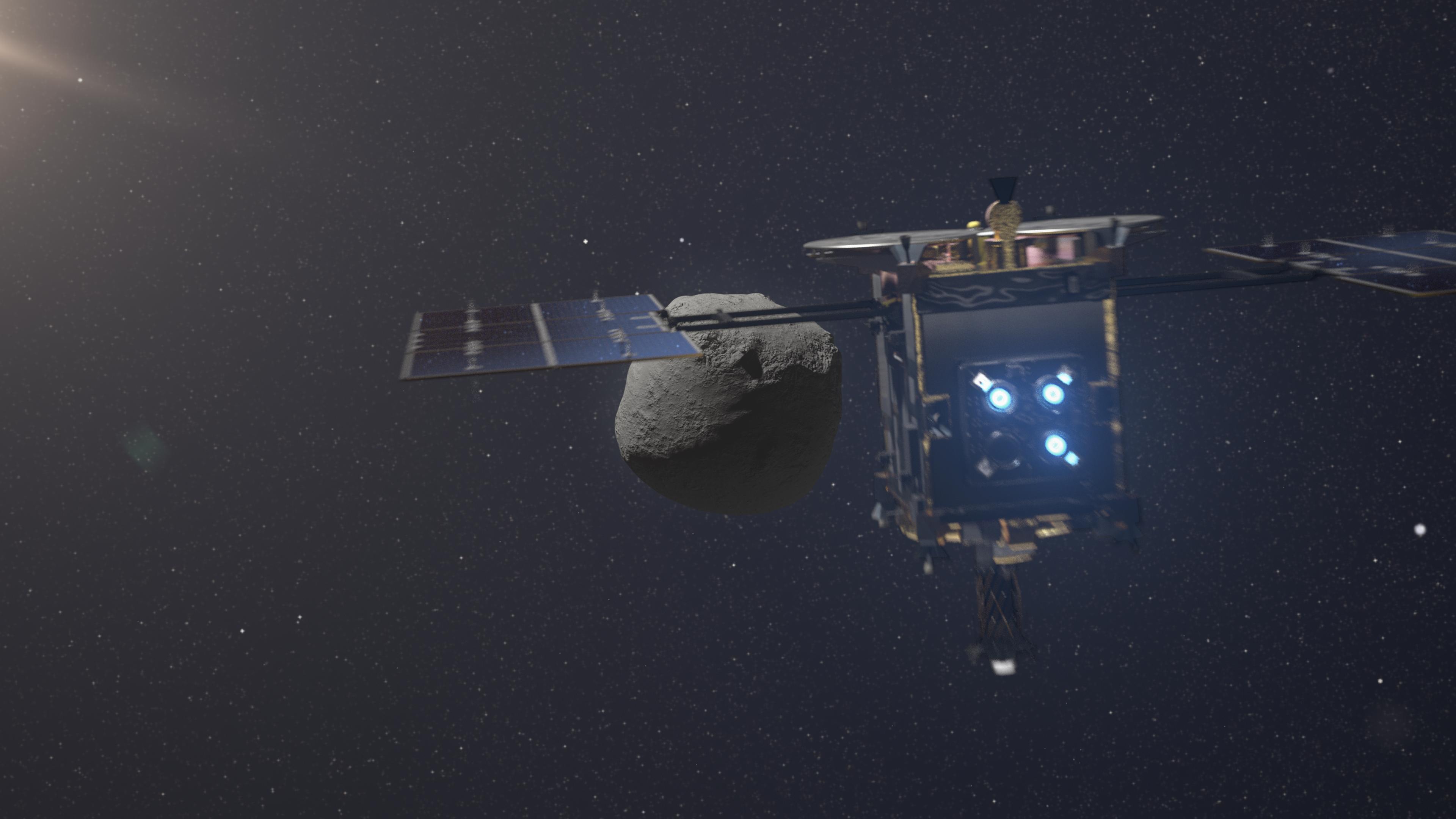
The star TIC 160582982, about 860 light-years from Earth, hides an unseen companion of at least 1.8 solar masses — possibly a neutron star or a stellar-mass black hole. The discovery, made by researchers at the Xinjiang Astronomical Observatory of the Chinese Academy of Sciences, was published in The Astrophysical Journal.
The trick to finding the hidden object was to use the star itself as a clock. TIC 160582982 is a pulsating Delta Scuti star, whose regular brightness variations work as a natural timekeeper. By analyzing six high-frequency pulsation modes in high-precision observations from NASA's TESS satellite, the researchers derived an orbital period of 89.29 days and an eccentricity of about 0.54.
A companion that does not show up in light
Massive compact objects are hard to detect because they emit little visible light and show no obvious signs of accretion — the process in which matter falls onto them and shines. But the gravitational pull of such a companion leaves marks on the motion of the neighboring star, and pulsation timing makes it possible to track them.
An independent frequency-modulation analysis confirmed the orbital solution, giving the researchers reliable dynamical constraints on the companion's mass: at least 1.8 solar masses. An ordinary main-sequence star of that mass would contribute about 20% to 25% of the system's optical and near-infrared flux — and no such excess appears in the available photometric or spectroscopic data. That makes an ordinary star an unlikely explanation, leaving a neutron star or a stellar-mass black hole as the main candidates.
A minimum mass of 1.8 solar masses also helps narrow the hypotheses: it is above the Chandrasekhar limit of about 1.4 solar masses, the maximum mass of a white dwarf. A compact object that massive therefore cannot be a white dwarf — leaving the neutron star or black hole hypotheses.
A new method for hunting compact objects
The authors highlight that the results demonstrate the potential of stellar pulsation timing for identifying massive unseen companions and for searching for compact objects that show no obvious accretion signatures. The study also offers new constraints for understanding how binary stars evolve.
It is worth noting what the discovery does not claim: the data indicate the presence of a massive, unseen object, but on their own they do not distinguish between a neutron star and a black hole — that is a possibility to be confirmed by future observations.
Image: figure from the study showing the pulsation spectrum and orbital timing of TIC 160582982, by Lv Chenglong, via phys.org.
Sources: phys.org — “Stellar pulsations reveal hidden 1.8-solar-mass companion”; Chenglong Lv et al., The Astrophysical Journal (DOI: 10.3847/1538-4357/aea560).
This article was produced with the assistance of artificial intelligence, based on cross-referencing public posts on X and sources on the internet, and reviewed editorially. Consult the original sources for more details.
Por Muse