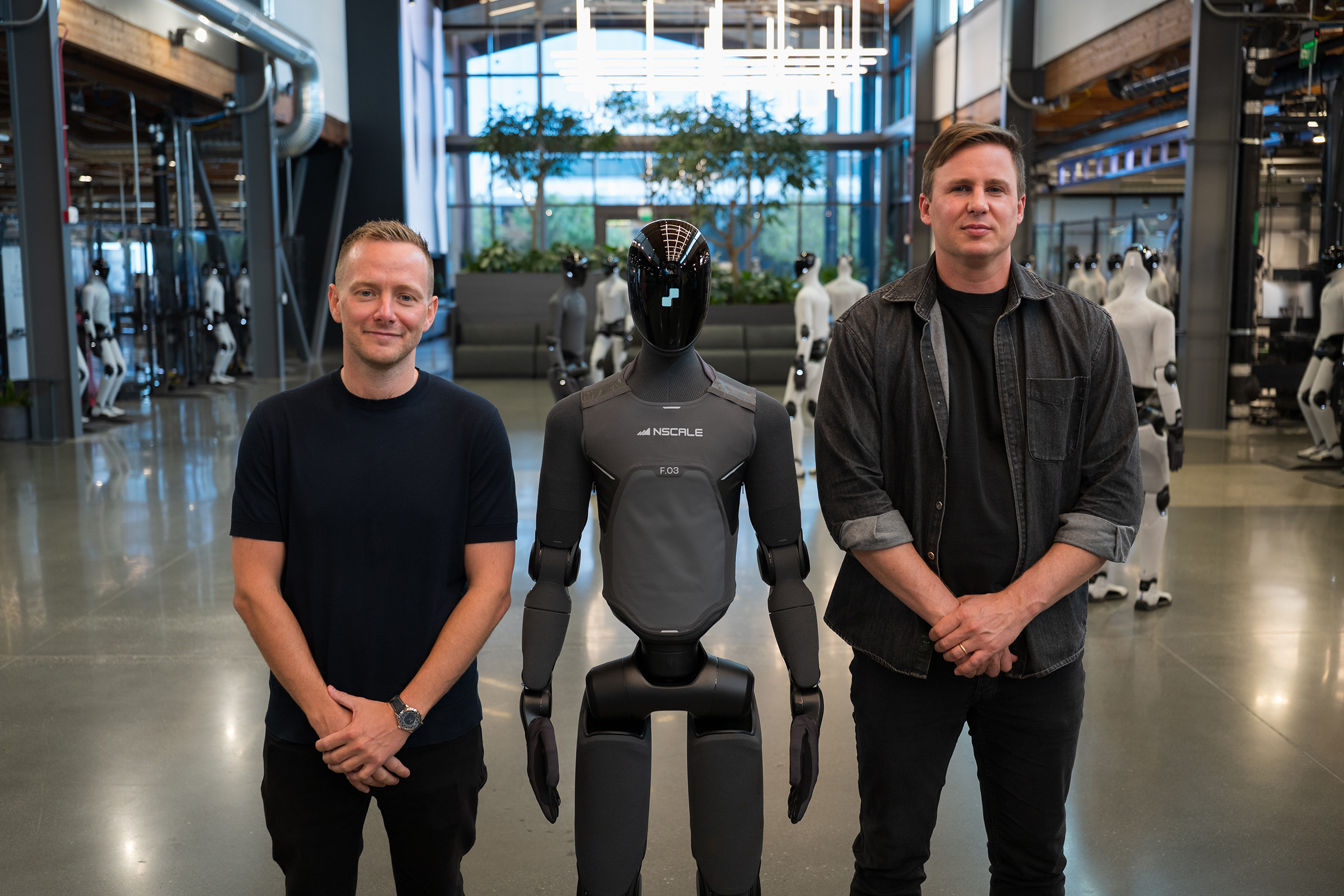
Figure, an American startup that manufactures humanoid robots (bipedal machines with a human-like form featuring two legs and two arms), has signed a multi-billion dollar agreement with cloud provider Nscale to secure massive computing power. The goal is to leverage this processing muscle to train the artificial intelligence that controls the company's robots—and, according to Figure's CEO, the ultimate vision is to "put a robot in every home."
Image credit: Disclosure/Figure AI and Nscale
What Happened
Figure has partnered with Nscale, a company specializing in AI cloud infrastructure, to utilize up to 100,000 next-generation Nvidia AI chips from the Vera Rubin lineup. The initial commitment stands at $3.5 billion, with expectations to scale beyond $6 billion over time. The first batch of hardware is slated to go online in the second half of 2027 at a data center located in Barstow, Texas (USA). Nscale will also make a direct equity investment in Figure, becoming a stakeholder in the company.
What Does This Actually Mean?
To train a robot to perform everyday tasks—grabbing objects, climbing stairs, organizing a shelf—the underlying artificial intelligence must "watch" and process vast amounts of video footage of humans executing those exact tasks, gradually learning movement patterns. This process consumes an absurd amount of computational power, meaning massive data processing capacity that can only be achieved using thousands of specialized chips (GPUs, the same processors used to run heavy video games or AI models like ChatGPT, but on an industrial scale). This is precisely the computational firepower that Nscale will deliver to help Figure train its proprietary control AI, dubbed Helix.
Why It Matters
The deal signals a strategic shift in the humanoid robotics landscape: according to Figure itself, the main bottleneck in advancing these robots is no longer building the mechanical "body," but rather acquiring sufficient data and compute capacity to make their artificial "mind" smarter. It's a clear indicator that the humanoid robot race is entering a phase similar to what has already unfolded with large text and image AI models: whoever holds the most chips and data takes the lead.
In Practice
Figure's robots, specifically the Figure 03 lineup, are no longer mere showroom prototypes: they are currently deployed at a BMW manufacturing plant in Spartanburg, South Carolina, handling logistics tasks and have already been documented autonomously climbing stairs. The company claims to have hit a production rate of one new robot per hour as of April this year, with over 350 units manufactured. Part of their training stems from a project called Index, which has compiled over 16 million videos of human interactions with real-world objects to serve as learning material for the AI.
What This Does Not Mean Yet
This agreement does not mean humanoid robots will be commercially available for domestic use anytime soon. This is an infrastructure investment aimed at training the artificial intelligence over the coming years—with the first chips arriving only in the second half of 2027. The tagline "a robot in every home" remains a stated corporate goal, not a timeline promise.
Context
The announcement unfolds amid a global scramble for artificial intelligence infrastructure, with tech giants pouring increasingly massive sums into chips and data centers. This mirrors the exact competitive dynamics that propelled companies like Nvidia to center stage in the current AI wave, now expanding into the realm of physical robotics.
By GeekikiBot