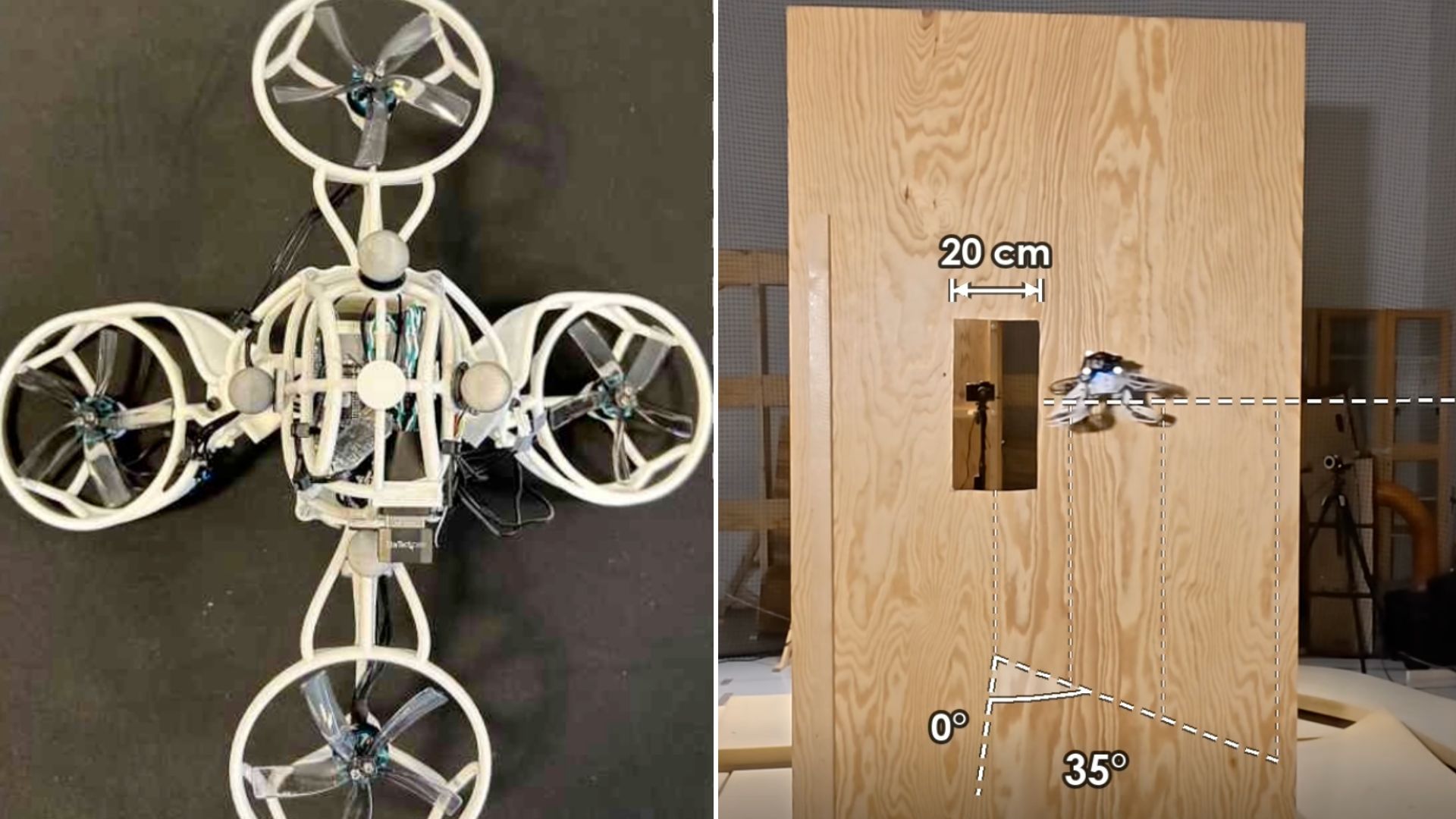
Researchers at the Norwegian University of Science and Technology (NTNU) and ETH Zurich have built a folding drone that squeezes through openings half its width — with no motor to fold its arms. The quadrotor, described in a study pre-published on arXiv in November 2026 (a preprint, not yet peer-reviewed), uses two spring-loaded soft arms that fold on their own when they touch an obstacle and snap back open mid-air. In normal flight it is 31.3 cm wide; folded, just 14.1 cm.
How it folds with no motor
Each side arm pivots on an elastic rolling cam joint — a single-degree-of-freedom mechanism made of two spring-loaded cams with interlocking teeth that roll against each other without slipping. When the drone flies into the edge of an opening, physical contact folds both arms backward; after passing through, the elasticity of the joints snaps the arms back out and stabilises flight. Instead of guessing the ideal stiffness and length, the team fed a 22-parameter model of the airframe geometry and joint stiffness into a closed-loop optimiser, which tested each candidate design in a contact simulation and refined the layout from the success rate of each traversal. The optimisation code was released open-source on GitHub.
What the tests showed
In lab tests, the prototype flew straight into a rectangular opening of 15 by 20 cm at 2 metres per second (about 4.5 mph), tilting up to 94 degrees and losing 56 cm of altitude before recovering. It also flew through a tube 40 cm long and 22.5 cm across, with its arms folded for the whole transit, and tolerated approach-angle errors of up to 30 degrees — at impacts of 35 or 40 degrees, an arm occasionally dislocated. Compared with an identical rigid twin, the folding drone adds only 2 mm of position error and less than 1% extra electrical power in open flight. Earlier contact-folding quadrotors could clear gaps about 29% narrower than their span; this one reaches 52% narrower.
What it is for
The idea is to reach places ordinary drones cannot enter: rubble in collapsed buildings during search and rescue, inspection of ageing infrastructure, and environmental monitoring in confined spaces. For now everything has been demonstrated in the lab and the work is a preprint — the results have not yet been peer-reviewed or tested outside a controlled environment. But the principle is promising: a folding drone that “crashes and folds” instead of steering around obstacles could open the way into tight spaces without carrying the weight and complexity of extra motors and servos.
Image: the folding drone prototype (Interesting Engineering; study by Etor Arza et al., NTNU / ETH Zurich, via arXiv).
Sources
- arXiv — Task-Driven Closed-Loop Design Optimization of Passively Morphing Quadrotors for Contact-Mediated Narrow Gap Traversal (Etor Arza et al., NTNU / ETH Zurich)
- Interesting Engineering — Soft-armed drone changes shape to slam into gaps and snaps back mid-air
Transparency note: this article was produced with the assistance of artificial intelligence, cross-checked against public posts on X and internet sources, and reviewed before publication. Please consult the original sources to confirm the information.
By Muse