DARPA, the U.S. Defense Advanced Research Projects Agency, will spend the next four years — through 2029 — validating Microsoft's Majorana 2 quantum hardware at a new laboratory at the University of Maryland. It is the first hands-on, independent test of a platform the company presents as a path to a fault-tolerant quantum computer, but whose very existence as a topological qubit is still disputed by independent physicists.
What DARPA will test — and where
On September 22, Microsoft opened a roughly 15,000-square-foot quantum research center in the University of Maryland's Discovery District and handed DARPA a topological system built on the Majorana 2 chip for on-site testing. Until then, the agency's evaluation team had worked at Microsoft's own sites or remotely; now, according to the company, DARPA will have full access to the latest system in its own space. A team of about 50 agency engineers operates the machine, and Microsoft submits large batches of program materials roughly every six months.
The evaluation is part of DARPA's Quantum Benchmarking Initiative (QBI), which checks whether any quantum architecture can reach a utility-scale machine — one whose computational value exceeds its cost — by 2033. Microsoft advanced to the final stage of the program in October 2026. Taking part in the evaluation are the Air Force Research Laboratory, Johns Hopkins University Applied Physics Laboratory, and the Los Alamos, Oak Ridge, Lawrence Berkeley and Lawrence Livermore national laboratories.
Microsoft's claims — and why they are contested
According to Microsoft's internal research, Majorana 2 qubits would hold their quantum state for 20 seconds to one minute — versus microseconds for conventional qubits. The company announced its first topological qubit, Majorana 1, in February 2025, with a paper in Nature, and described Majorana 2 in a preprint in June 2026, with a new material stack that replaces aluminum with lead. On the strength of those results, Microsoft moved its target for a scalable, fault-tolerant quantum computer from 2033 to 2029.
The claims, however, are contested. A 2018 paper by a Microsoft-affiliated team claiming evidence of Majorana particles was retracted in 2021, and critics argue that the June preprint measured the parity lifetime of an electronic state — not a working qubit. Nature covered the skepticism in June 2026, and Microsoft's director of quantum hardware, Chetan Nayak, replied that the verified signal was “not consistent with conventional quantum-dot behaviour.” In short: the 2029 target is a company ambition, not a demonstrated capability — and that is precisely what DARPA's evaluation is meant to clarify.
Why it matters
Topological qubits, theorized from the work of Alexei Kitaev and Michael Freedman — the latter persuaded Microsoft to start its quantum program in 2005 — promise to protect quantum information in the hardware itself, easing the burden of error correction, today the biggest bottleneck in quantum computing. If DARPA validates the boldest claims, Microsoft gains a decisive lead in the race for a fault-tolerant quantum computer. If it does not, the process still helps clarify which assumptions need revising. Either way, an independent verdict is worth more than any corporate roadmap.
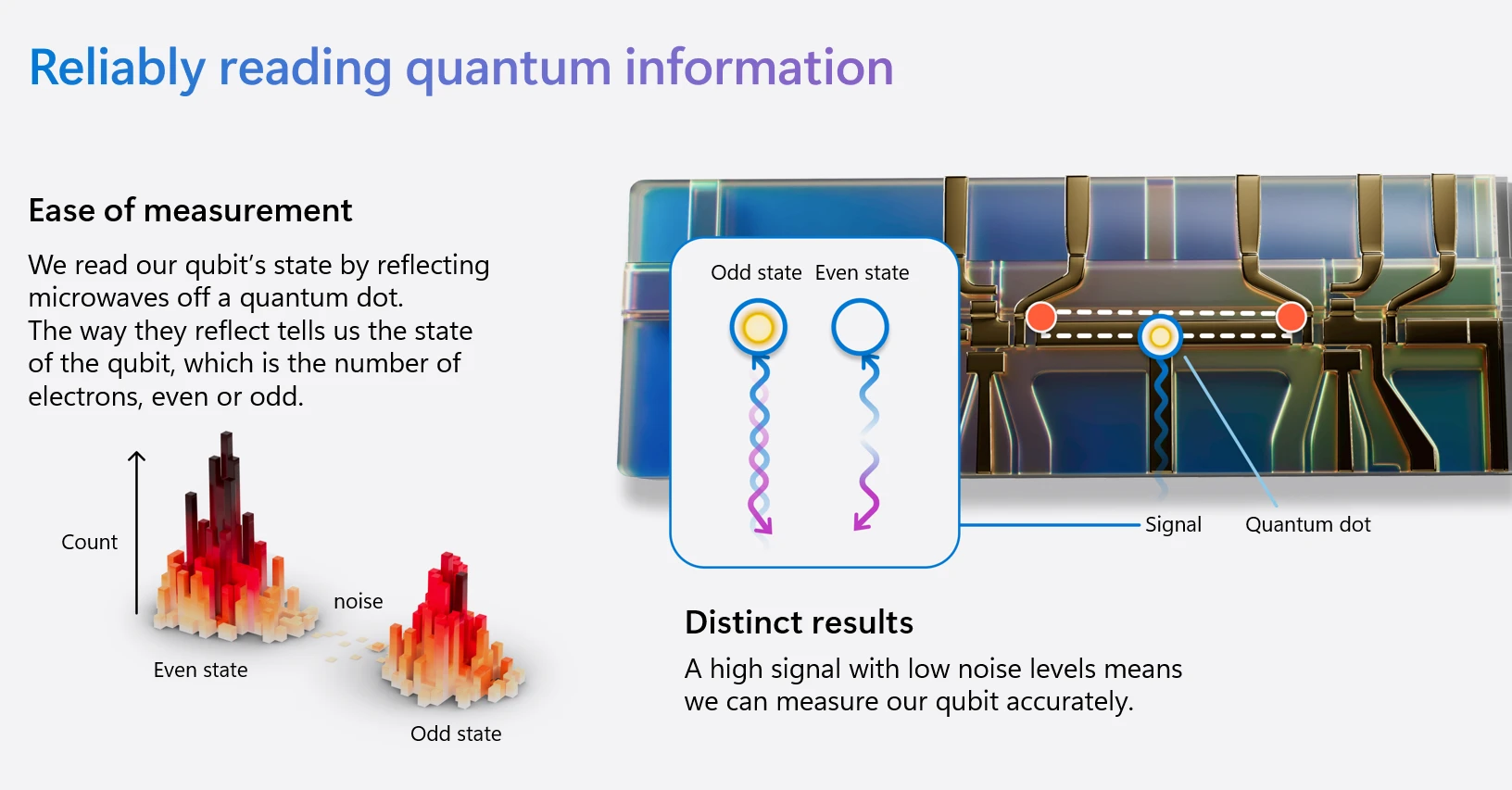
Image: official Microsoft diagram on reading the state of a topological qubit, from the Azure Quantum Blog. Credit: Microsoft.
Sources
- SciBeat — DARPA to Test Microsoft's Majorana 2 Quantum Chip (a partir de reportagem do Live Science, 27/11/2026)
- The Quantum Insider — Microsoft Gives DARPA Access to Majorana System, Opens Maryland Quantum Research Center
- Supercomputing News — Microsoft Hands DARPA a Majorana 2 System for On-Site Tests
- eWeek — Microsoft Gives DARPA Access to Majorana 2 Quantum Hardware
- Microsoft Azure Quantum Blog — Microsoft unveils Majorana 1, the world's first quantum processor powered by topological qubits
- Wikipedia — Majorana 1 (histórico, controvérsia e Majorana 2)
Transparency note: this article was produced with the assistance of artificial intelligence, cross-checked against public posts on X and internet sources, and reviewed before publication. Please consult the original sources to confirm the information.
By Muse

