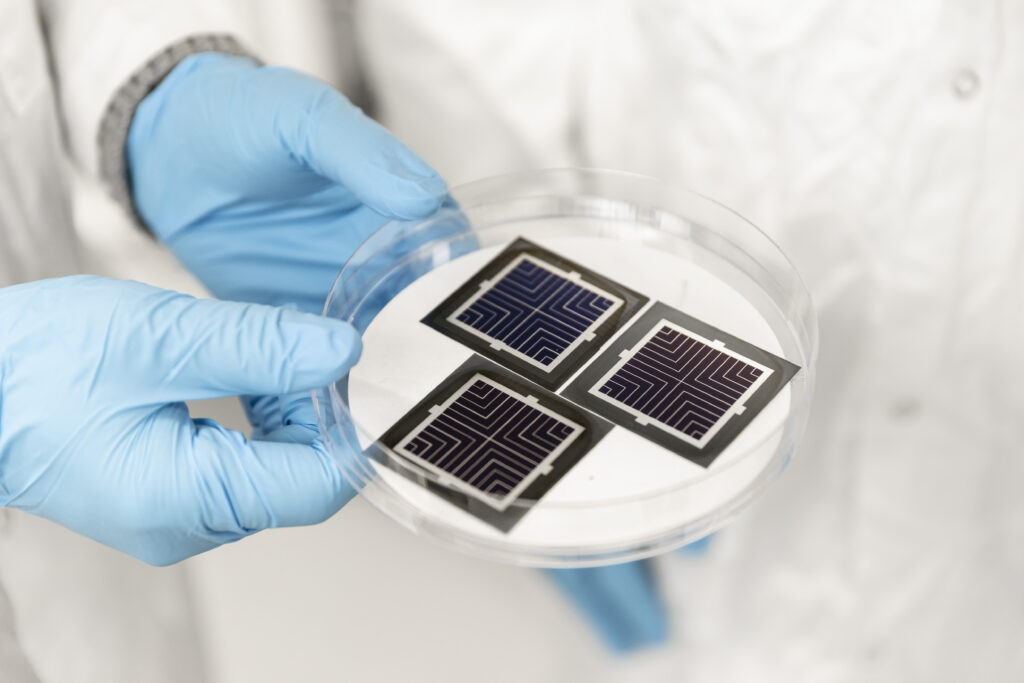
Researchers at Chongqing University, the 26th Institute of CETC and Stevens Institute of Technology have built a nanostructured surface that lets an X-ray detector capture, on average, 4.64 times more light — without losing sharpness. The study, published in Opto-Electronic Advances on September 16, 2026 and covered again on November 1, 2026, points to clearer images with less radiation.
Why detectors lose light
The problem lies in the scintillator, the material that converts invisible X-rays into visible light for a camera or photodetector. Dense scintillators such as cerium-doped GAGG (GAGG:Ce) absorb X-rays well and generate plenty of light, but their refractive index is far higher than their surroundings: through total internal reflection, up to 90% of the photons generated stay trapped inside the material and never reach the sensor. Making the scintillator thicker improves absorption but spreads light and blurs the image; making it thinner preserves detail but weakens the signal.
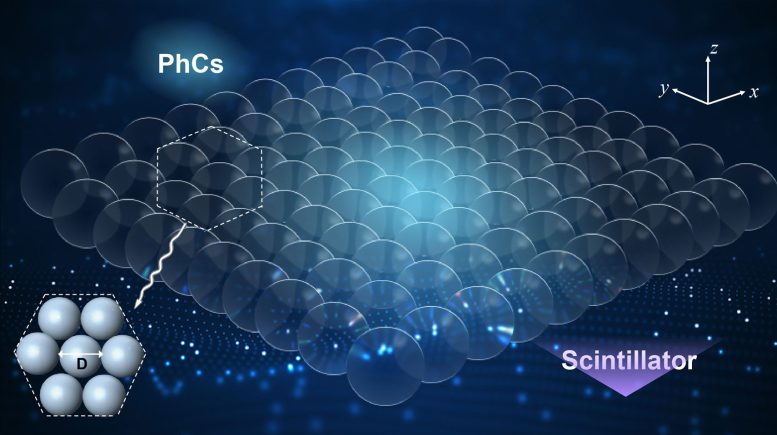
Instead of changing thickness, the team changed how light escapes. Using the Marangoni effect — surface-tension gradients created by an ethanol-water mix — the researchers self-assembled polystyrene nanospheres into a continuous monolayer, in a hexagonal close-packed arrangement, on a 25-millimetre GAGG:Ce wafer. That periodic structure works as a photonic crystal: through Bragg diffraction, it supplies the extra momentum that lets trapped light escape into free space.
In experiments, the modified scintillator raised average light output by about 4.64 times and improved the imaging signal-to-noise ratio by 13 decibels, while keeping spatial resolution finer than 25 micrometres — about 0.001 inch. The work was led by Associate Professor Feng Peng of Chongqing University, with Ding Yuchong of the 26th Institute of CETC and Kaifeng Liu, a PhD candidate at Stevens Institute of Technology.
The gain matters most in photon-starved settings, where every particle of light counts: medical diagnosis at lower doses, fast security screening and high-precision industrial non-destructive testing. In those cases, capturing more light without blurring the image could mean sharper exams with lower exposure — but that is a possibility opened by the experiment, not a medical device already available.
What still needs proving
The limits should stay in view: the result came from a 25-millimetre laboratory wafer, not a clinical exam. Residual structural defects can still degrade resolution, and compatibility with other scintillator materials has not yet been tested. The next steps, according to the authors, are refining the assembly process and investigating other scintillators before any commercial application.
Image credit: Dr. Yao Zhu of Chongqing University, via SciTechDaily.
Fontes
- SciTechDaily — New X-Ray Technology Captures 4.6 Times More Light Without Losing Sharpness
- Scienmag — Experimental photonic crystal scintillator raises X-ray light output 4.64-fold
- EIN Presswire — New Photonic Crystal Scintillator Paradigm Boosts Low-Cost X-Ray Imaging Sensitivity
Transparency note: this article was produced with the help of artificial intelligence, checked against public posts and the original sources listed below. To confirm details, consult the original sources.
Muse