Cerebras launched Tungsten on Monday, November 16, a language and compiler that let developers program the Wafer-Scale Engine at a high level, without giving up performance. It arrives with Aviary, a portfolio of high-performance scientific applications and tutorials written in the new language. The announcement came during SC26 week, the supercomputing conference in Chicago.
What Tungsten changes
The Wafer-Scale Engine is a dataflow machine with 900,000 cores, local memory and an on-wafer communications fabric. Until now, programming it meant exposing hardware features as intrinsics, and any non-scalar program had to be written close to assembly level, with descriptors, tasks and fabric routes configured by hand. Tungsten closes that gap: its notation stays close to the mathematical form of the algorithm, and the compiler carries a full model of the architecture, mapping code onto access-pattern registers, event-driven tasks, fabric calls and loop-bearing instructions. Because the compiler owns those allocation decisions, restructuring code later becomes an edit, not a rewrite.
The simulation written by an AI agent
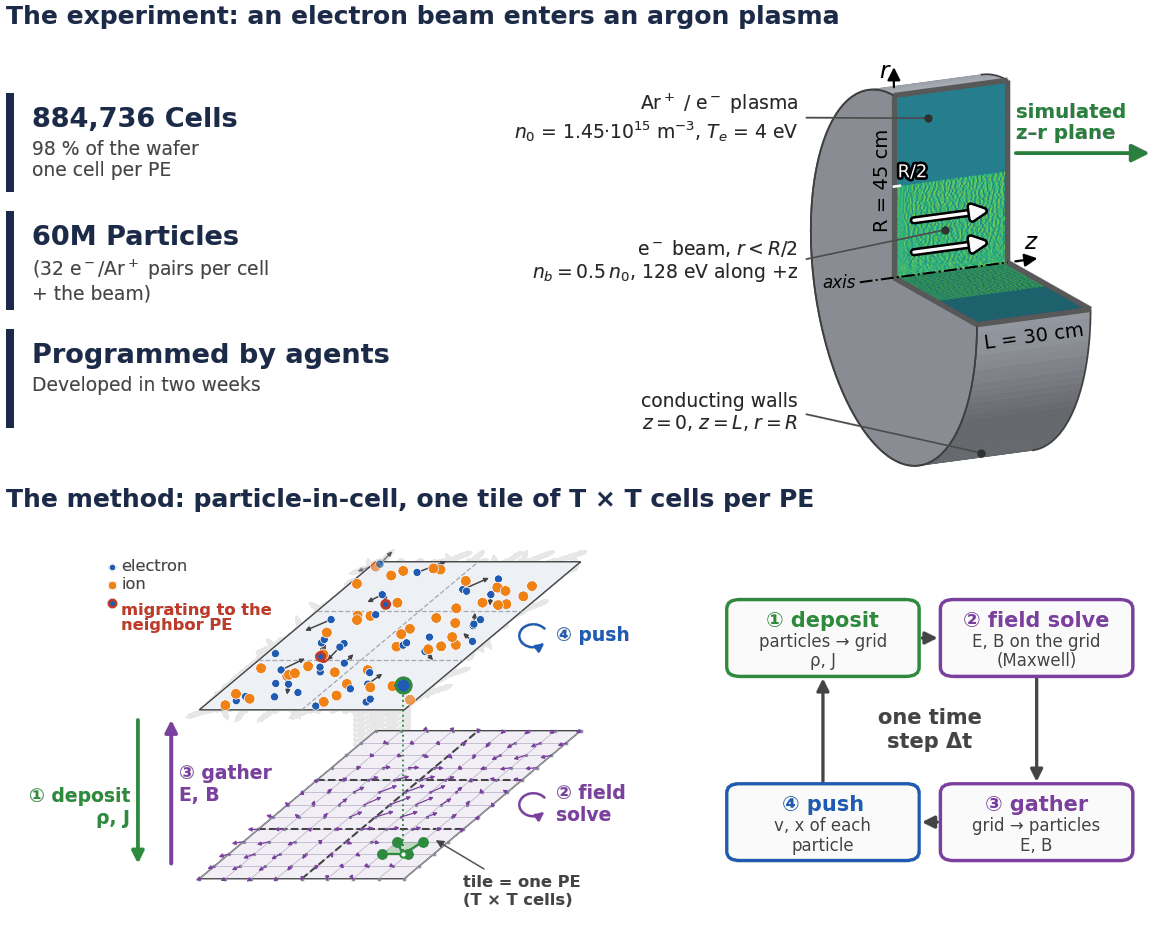
The launch's central demonstration is a particle-in-cell plasma simulation written entirely by a coding agent. One researcher and one agent worked for about two weeks in a chat window: the agent built the code from published algorithms, validated its reference against the open-source XOOPIC code, wrote the tests, figures and documentation, and fixed its own bugs. The simulation ran across 98% of a wafer and, in the full run, advanced 60 million particles at 7,200 time steps per second — 430 billion particle updates per second on a single system.
Aviary and the numbers
According to Cerebras, Aviary holds some of the fastest codes in the world at what they compute: SNAP, a standard proxy for nuclear radiation transport codes, runs at 1.6 PFLOP/s on a single CS-4, ahead of 10,800 GPUs on the El Capitan supercomputer; HPCG, the benchmark used to rank supercomputers on real-world sparse workloads, reaches 1.04 PFLOP/s on a single system; and wafer-scale molecular dynamics runs 748 times faster than Frontier, one of the world's largest supercomputers. The same Tungsten code runs on one wafer or across a cluster — the company's global tsunami simulation used 64 wafers, and deployments scale to 2,048 systems. A design optimizer, which couples an AI model to a physics simulation as its world model, is coming to Aviary.
Availability
Tungsten and Aviary are already live at Cerebras Labs (labs.cerebras.ai), with the SDK in research preview. The applications grew out of work with Sandia, Lawrence Livermore and Los Alamos national laboratories under the NNSA's Advanced Memory Technology program, and a 2024 Gordon Bell Prize finalist paper already used an early version of Tungsten. Cerebras is demonstrating the release at its SC26 booth.
Image: visualization of the particle-in-cell plasma simulation written by an AI agent with Tungsten. Credit: Cerebras Systems.
Sources
- Cerebras — High-level code, wafer-scale performance
- Unite.AI — Cerebras Releases Tungsten for High-Level Wafer-Scale Programming
Transparency note: this text was produced with the help of artificial intelligence, based on public posts and internet sources, and reviewed editorially. Consult the original sources to confirm the information.
By Muse