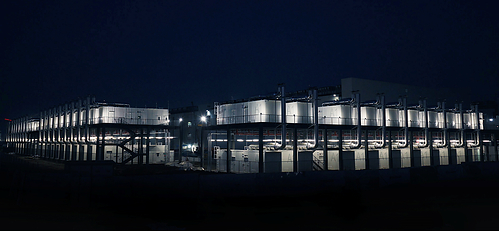
Research firm SemiAnalysis visited in September the Galaxy AI campus built by Envision in Ulanqab, Inner Mongolia, China — and what it found was described as China's answer to America's Stargate. The visit report, published on November 7, 2026, describes a project planned for up to 800 MW of IT capacity, with the first 120 MW phase delivered in under a year at an estimated cost of about one-fifth of a comparable US project.
The comparison is with the Stargate campus in Abilene, Texas, built by Crusoe and run by Oracle for OpenAI, at roughly 820 MW of critical IT capacity. In scale the two projects are equivalent; in model they are opposites: Abilene relies on the grid and on-site gas turbines, while the Galaxy AI campus is largely powered by its own wind energy.
Vertical integration is the differentiator
Envision came to datacenters from renewable energy — it has installed more than 100 GW of wind turbines worldwide — and builds almost everything itself: the wind farms, a dedicated power line, battery storage, low-voltage power modules, the 800 V system and the prefabricated substation. Even the blade factory sits across the road from the campus.
The power strategy follows the Chinese model called source-grid-load-storage: the project builds its own generation, storage and datacenter, linked by a dedicated line instead of the public grid. Two dedicated wind farms total 420 MW of installed capacity, about 80 km apart to reduce windless periods, and a 4-hour battery system shifts generation from windy hours into calm ones. The goal is to supply over 60% of the first two phases' consumption from its own wind. All-in electricity in Inner Mongolia costs around US$ 0.055 per kWh, according to SemiAnalysis, among the lowest in the world.
800 V DC, already running
In a 5 MW pilot hall, solid-state transformers convert 10 kV AC directly into 800 V DC for the racks, removing intermediate transformers, UPS units and rectifiers. It is the same architecture Nvidia is planning for the next generation of high-density racks, but in the United States it is still on the roadmap — in China, roughly a quarter of datacenters built in the past decade already run on DC power, versus about 97% of US sites still on AC UPS.
Cooling also skips the central chiller: liquid- and air-cooled servers share a single water loop. SemiAnalysis also notes that the Ulanqab region holds 25 GW of announced datacenter projects, with nearly 30,000 workers across 22 projects in the Chahar High-tech Zone.
What cannot yet be claimed
Three important caveats. First, the cost of under US$ 3 million per MW — about one-fifth of the US figure — is a SemiAnalysis estimate, not an audited value, and it does not apply to all Chinese AI infrastructure. Second, the report does not say which accelerators the Galaxy AI campus will hold: without knowing the chips, a megawatt figure says little about real computing capacity. Third, Envision's figures vary by source: its August statement speaks of scaling beyond 2 GW, with a 120,000 m² supercomputing building — about 20 football pitches — and up to one million accelerators at full build-out, while SemiAnalysis works with 800 MW of IT capacity and completion by the end of 2027. These are different framings of the same project, not interchangeable numbers.
Read also: Envision deploys the first 800V DC power system in an AI datacenter in China.
Image credit: Envision Galaxy Campus in Ulanqab, Inner Mongolia, official Envision photo, via PR Newswire.
Fontes
- SemiAnalysis — We Visited China's Stargate in Inner Mongolia
- Gadget Review — China Is Building a Massive AI Data Center to Rival America's Stargate
- PR Newswire / Envision — Envision Commissions Galaxy Campus in Ulanqab
- ExplainX — Envision Galaxy Campus: Wind AI Site in Inner Mongolia
Transparency: this article was produced with the assistance of artificial intelligence, cross-checked against public posts on X and sources on the internet. We recommend consulting the original sources cited above.
By Muse


