Threat intelligence firm GreyNoise disclosed on Monday (23/11) an intrusion campaign that compromised 24 Check Point management servers at 22 organizations across 17 countries. The actor, tracked as GreyNoise Threat 13 (GT13), has not been attributed to any known group — and the company believes the campaign is still active, because the intruder retains persistent access to the compromised devices.
Confirmed activity ran between October 17 and November 2, 2026. Victims sit in sectors such as financial services, energy, government, transportation, mining, engineering and manufacturing, in countries including the United Kingdom, Ireland, France, the Netherlands, Greece, Germany, Austria, Bulgaria, Poland, India, Thailand, Vietnam, South Korea, Hong Kong, China, Australia and the United States.
How the intrusion worked
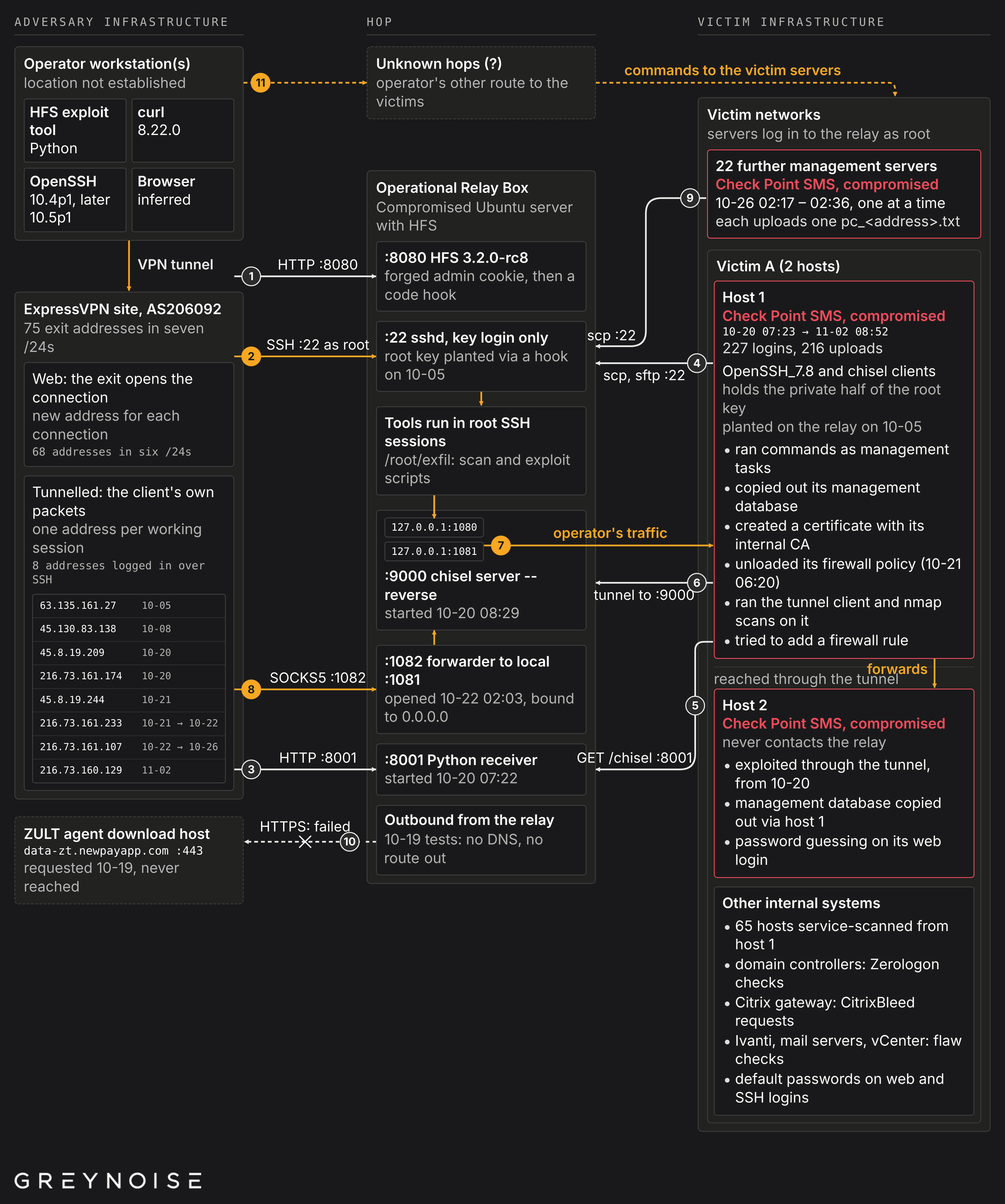
According to GreyNoise, GT13 used 99 IP addresses — ExpressVPN exits or already-compromised Check Point devices — across more than 1,400 network sessions, with over 800 command-line artifacts and more than 1,200 files downloaded, uploaded or created.
On October 2, the group compromised a Rejetto HFS file server by exploiting CVE-2026-61500 and turned it into a relay server for the following operations, including adding an SSH key to the server's root access. From that relay, the actor began operating the already-compromised Check Point servers. Because the intruder already had access to those servers before the HFS compromise, GreyNoise says it could not determine how the initial access happened.
In the next stage, the group exploited CVE-2026-16232, a Check Point SmartConsole authentication bypass, to run more than 100 management tasks on victims' servers: copying the firewall database and internal certificate authority files, minting a new certificate, unloading security policies — which effectively switches the firewall off — and attempting internal reconnaissance and lateral movement. The flaw was patched in July 2026 and is listed in CISA's Known Exploited Vulnerabilities (KEV) catalog.
On October 26, the actor issued a bulk certificate-management task to all 24 compromised servers. The task failed — and it was precisely the error messages returned that allowed GreyNoise to identify and notify many of the affected organizations, directly or through government partners.
The AI role: suspected, not confirmed
GreyNoise assesses that GT13 used large language models and agentic systems to scan for vulnerabilities, exploit flaws, develop tools and interact automatically with compromised assets — alongside hands-on-keyboard activity. The company describes the actor's offensive apparatus as “mature” and AI-enabled, but makes clear this is an assessment, not a confirmation: there is no attribution to a known group, nor any assessment of motive or national origin.
Check Point, in turn, told The Hacker News that the activity involves CVE-2026-16232, “a previously disclosed vulnerability with patches already available”, and that it is neither a new flaw nor a novel exploitation technique. The company says its priority is ensuring customers apply the available updates and follow its published hardening guidance.
What to do
For organizations using the affected products, the recommendation is to apply the CVE-2026-16232 fix, restrict access to management interfaces — which should not be exposed to the internet — and review logs for unauthorized management tasks, unexpected certificates and unloaded policies since mid-October.
Read also: CVE-2026-123039: Check Point flaw giving root on firewalls joins CISA's actively exploited list
Sources
- GreyNoise — “An Active Intrusion Campaign Against Check Point Security Management Servers”
- The Hacker News — “Hackers Compromise 24 Check Point Management Servers in Suspected AI-Driven Attack Campaign”
Transparency note: this article was produced with the assistance of artificial intelligence, cross-checked against public posts and internet sources, and editorially reviewed. Please consult the original sources listed to verify the information.
By Muse