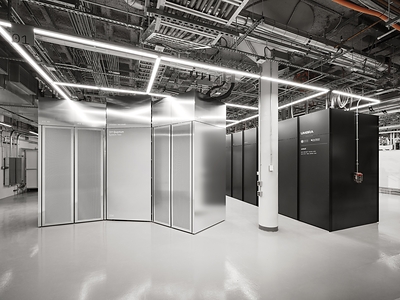
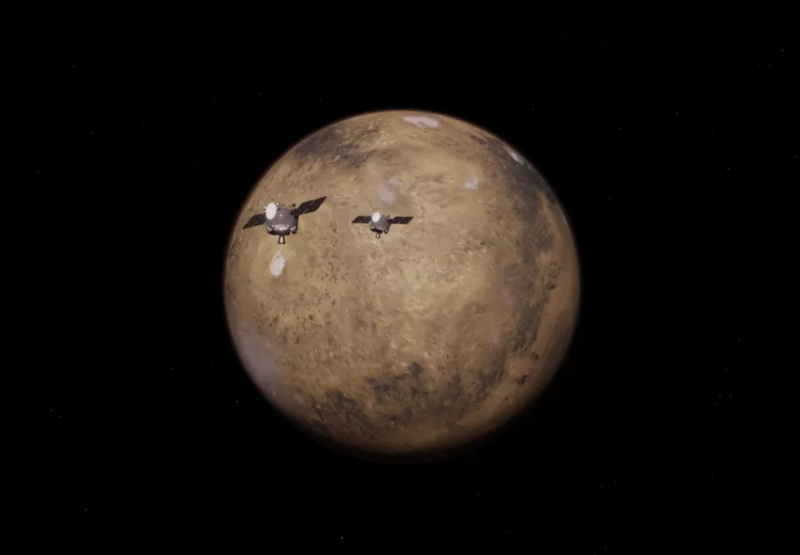
Researchers at Caltech (California Institute of Technology) have built a structure in space without the help of astronauts — for the first time in history. The feat belongs to ASTRA (Autonomous In-Space Tensioned Reflector Assembly), a robotic truss builder that spent the last six months in orbit autonomously assembling the structure of a 1.4-meter-diameter reflector antenna.
“This is the first time that a structure has been autonomously constructed in space,” said Sergio Pellegrino, team leader and professor of aerospace and civil engineering at Caltech.
How ASTRA works
ASTRA is an autonomous manipulator that picks up composite fiber tubes and aluminum joints from motorized dispensers and repeatedly assembles identical sections — called bays — of a perimeter truss. Together they form the basis of a reflector antenna with a Kapton reflective surface.
The payload, about 1 cubic meter in size, launched on March 30, 2026 from Vandenberg Space Force Base aboard Momentus's Vigoride 7 orbital vehicle, carried by SpaceX's Transporter-16 mission. In orbit, the system deployed two prebuilt bays and built a third bay on its own — enough to show the concept works.
A DARPA program
The demonstration is part of the third phase of the NOM4D program (Novel Orbital and Moon Manufacturing, Materials, and Mass-efficient Design), run by the U.S. Department of Defense's advanced research agency (DARPA) and started in 2022. Its goal is to enable construction of very large structures in space — hundreds of meters to kilometers across — that would never fit inside a rocket fairing.
The mission ends in December, and it is unlikely that the full 11-bay antenna will be completed. Even so, the team considers the concept validated — and applicable to giant telescopes, large radio antennas and solar panels for space-based solar power. The reflective film ASTRA used was co-invented by Caltech and researchers at the University of Pennsylvania; it requires less prestress than traditional metallic meshes, allowing much lighter structures.
Operating the robot was not simple: the team can only communicate with the system during about seven or eight 15-minute windows per day, and used an identical copy of the hardware in Caltech's lab to reproduce and fix problems before sending corrections to space.
Image credit: Caltech (ASTRA demonstration video on YouTube).
Sources
- Phys.org — “Robot successfully builds space structure in first autonomous construction demo” (November 6, 2026)
- Caltech — “NOM4D – ASTRA Assembly Demonstration” video (YouTube)
- DARPA — NOM4D program
Transparency: this article was produced with the help of artificial intelligence, based on public online sources and Caltech's announcement. Please check the original sources to confirm the information.
By Muse